/
CBSE 2027 date sheet out: boards start 16 February, Class 10 ends 9 March, Class 12 on 9 April. All key dates
CBSE has released the 2027 date sheet 101 days ahead. Exams start on 16 February at 10.30 am. Class 10 Maths is on 17 February and Social Science on 8 March; Class 12 Physics is on day one and Biology on 25 March. Over 46 lakh students have registered.
P
5 min
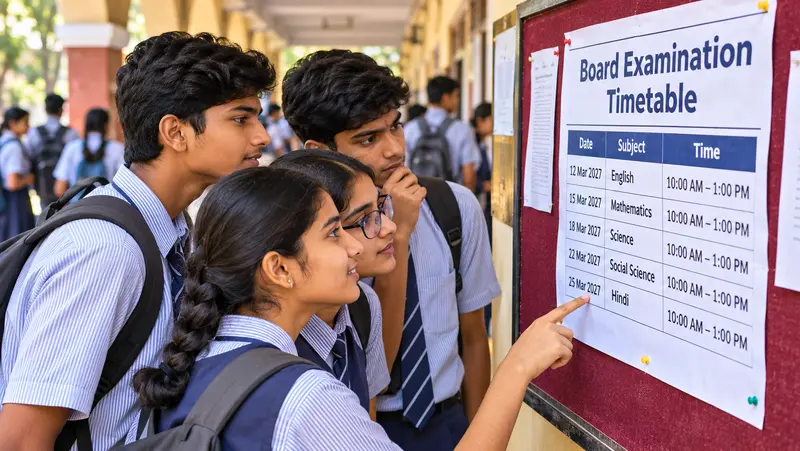
The Central Board of Secondary Education released the date sheet for its Class 10 and Class 12 board examinations on 6 November 2026, a full 101 days before the first paper. Exams for both classes begin on Tuesday 16 February 2027. Class 10 ends on 9 March and Class 12 on 9 April, and all papers start at 10.30 am. Over 26.5 lakh students have registered for Class 10 and over 19.8 lakh for Class 12, a total of more than 46 lakh.
Class 10 students will sit papers in 83 subjects and Class 12 students in 121. Below are the dates that most students need.
Class 10 dates
The first day is for Painting, so for most Class 10 students the examination really starts the next day with Mathematics.
| Date | Class 10 subject |
|---|---|
| Tuesday 16 February | Painting |
| Wednesday 17 February | Mathematics Standard and Basic |
| Friday 19 February | Home Science |
| Monday 22 February | Science |
| Wednesday 24 February | Computer Applications, Information Technology, Artificial Intelligence |
| Friday 26 February | English (Communicative; Language and Literature) |
| Saturday 27 February | Malayalam, Odia, Assamese, Kannada, Nepali, Sindhi, Kokborok |
| Monday 1 March | Sanskrit, Arabic and others |
| Wednesday 3 March | Hindi Course A and B |
| Thursday 4 March | Urdu A, Punjabi, Bengali, Tamil, Marathi, Gujarati, Manipuri, Telugu (Telangana) |
| Friday 5 March | Telugu, Russian, Persian, music subjects and others |
| Saturday 6 March | French |
| Monday 8 March | Social Science |
| Tuesday 9 March | German, Spanish, Japanese, other languages, NCC, Book Keeping and Accountancy |
Most main papers run from 10.30 am to 1.30 pm. Skill subjects usually run for two hours, ending at 12.30 pm.
The order deserves a note. Mathematics comes very early, one day after the start, and Science follows five days later. Social Science is last among the main papers, 14 days after Science. A student who leaves Maths revision until January will feel that.
Class 12 dates
Class 12 runs for almost eight weeks and spreads the main subjects widely.
| Date | Class 12 subject |
|---|---|
| Tuesday 16 February | Physics |
| Thursday 18 February | Physical Education |
| Tuesday 23 February | Accountancy |
| Thursday 25 February | Geography |
| Saturday 27 February | Chemistry |
| Tuesday 2 March | Psychology |
| Friday 5 March | English Core and Elective |
| Tuesday 9 March | Mathematics, Applied Mathematics |
| Saturday 13 March | Hindi Core and Elective |
| Tuesday 16 March | Economics |
| Friday 19 March | Political Science |
| Saturday 20 March | Artificial Intelligence |
| Thursday 25 March | Biology |
| Saturday 27 March | History |
| Tuesday 30 March | Sociology |
| Wednesday 31 March | Computer Science, Informatics Practices, Information Technology |
| Thursday 1 April | Business Studies, Business Administration |
| Tuesday 6 April | Sanskrit Core, Taxation |
| Friday 9 April | Retail, Web Application |
Regional and foreign languages fall on 3 March. Students should check the full official sheet for skill and vocational subjects, since the paper for a less common subject may fall on a date not listed here.
For a science student, the gaps are generous. Chemistry comes 11 days after Physics and Mathematics 10 days after Chemistry, with Biology 16 days after that. Physics is the first paper of all, however, so there is no gentle start. Commerce students begin with Accountancy on 23 February and do not finish until Business Studies on 1 April, which is more than five weeks. Humanities students face Geography early, then Political Science, History and Sociology in the second half of March.
Why it matters
The early release is the Board's main message. It says that the timely submission of List of Candidates data by schools made it possible, and that a date sheet this far ahead lets students plan, cuts anxiety and helps families arrange travel for the summer. CBSE lists the factors it considered: adequate gaps between subjects commonly taken together, the tentative schedules of major entrance examinations for Class 12, the number of candidates at each centre on any one day, and keeping teachers from being away from school for too long during evaluation.
The Board says that more than 40,000 subject combinations were examined to make sure no student has two papers on the same date.
There is a trade-off. Class 12 students aiming for engineering and medical entrance tests have to prepare for those alongside a long board calendar, and a final paper in April can run close to those dates. CBSE says every effort has been made to finish well before such tests begin. A stretch of nearly eight weeks gives more rest between papers, but critics of long schedules say that it also prolongs the stress for students and families. Whether that is a fair price for wider gaps depends largely on a student's subject mix.
Practical examinations and internal assessment for 2026-27 run from 1 January to 13 February 2027 for schools in India and abroad. Winter-bound schools will hold them from 9 November to 19 December 2026, so those students start this coming week.
The date sheet's notes are short: important instructions will be issued separately, the instructions on the admit card must be read, compliance with CBSE's instructions is mandatory and no communication devices are allowed inside the examination centre.
The sheet is labelled the main examination. CBSE's site also lists a second Class 10 board examination held in 2026, and students should watch for any separate notice on that for 2027. The official document is on cbse.gov.in, and every student should check their own subject codes against it and not rely on any summary, including this one.
Sources
About the Author
P
Prateek Rawat
Staff Writer
Prateek Rawat is a contributor to Wirony. All articles published under this byline undergo editorial review and approval before publication, with any necessary corrections handled…
P
5 min
What did you think?