/
India to join EU's 93.5-billion-euro Horizon Europe: direct grants for Indian labs as programme nears its end
India and the EU have concluded talks on India's association with Horizon Europe, the Ministry of Science and Technology said on 7 November. Indian researchers could get direct grants and lead projects under Pillar II from January 2027, once signed and ratified. India's payment is undisclosed.
P
5 min
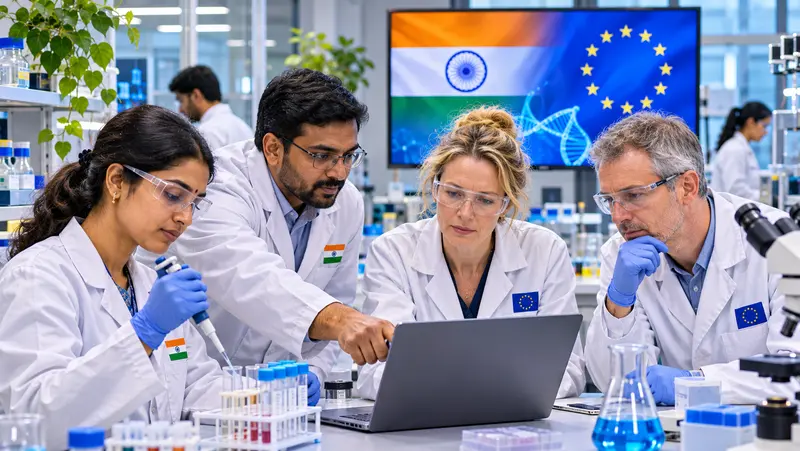
India and the European Union have completed negotiations for India's association with Horizon Europe, the bloc's flagship research and innovation programme, the Ministry of Science and Technology said on 7 November 2026. The programme is worth 93.5 billion euros. Once the agreement is signed and ratified by both sides, it is expected to take effect in January 2027, allowing Indian researchers, institutions and companies to apply for funding and to lead projects.
It would make India one of a small group of major economies with this status. The European Commission described it as a significant milestone for relations.
What association means
Indian scientists have long taken part in European projects, but usually as guests, often without direct access to EU funds. Association changes the terms.
According to the Commission's account, Indian institutions will be able to receive grants directly and Indian scientists to lead and coordinate major international projects, on terms similar to those available to organisations in EU member states. The Indian ministry says that the association will give researchers, institutions and industry access to calls for funding, European consortia and advanced research infrastructure, and that it will deepen talent mobility and lead to the joint development of critical technologies and standards.
The scope is specific. The deal covers Pillar II of Horizon Europe, which deals with global challenges and European industrial competitiveness.
| Pillar II cluster | Examples of relevance to India |
|---|---|
| Health | Disease research, medical technology |
| Digital, industry and space | Artificial intelligence, advanced manufacturing, satellites |
| Climate, energy and mobility | Clean energy, batteries, transport |
| Food, bioeconomy and environment | Agriculture, water, natural resources |
That is the part of the programme closest to applied research and industry, and the ministry says these themes align with India's priorities. Pillar II is not the whole of Horizon Europe, and the releases do not say how India will be treated under other parts of the programme.
The talks moved quickly. Exploratory discussions were announced in February 2026, after the India-EU summit of 27 January. Formal negotiations followed the Trade and Technology Council ministerial meeting in Brussels on 15 July, so the deal took less than four months to finish after that. The Commission's research chief, Ekaterina Zaharieva, had invited India to explore the idea in 2025.
India joins a group of 23 non-EU associated countries that includes the United Kingdom, Canada, Japan, South Korea and Switzerland.
Why it matters
For Indian research, the attraction is direct. Domestic research spending is modest for a country of India's size, and European consortia bring funds, equipment and networks. An Indian university or company that leads a project gets a say in its direction, along with the intellectual property and reputation that follow. For Indian start-ups in health, climate and deep technology, Horizon projects can also open a route to European partners and markets.
For Europe, India offers scale, talent and a large testing ground for technologies. The arrangement fits the broader partnership the two sides are building alongside their trade talks, and it comes at a time when both want to reduce dependence in critical technologies.
There are two important questions that the announcements do not answer.
The first is the cost. Association is not free. When the talks began, the Commission's own explanation said that India would make a financial contribution to the programme, similar to other associated countries. Neither the Indian ministry's release nor the summary of the Commission's statement gives the amount. For a country with a limited science budget, the size of that contribution, and how much Indian teams win back, will decide the value of the deal. Countries that join usually aim to win at least as much as they pay, and that depends on the quality and number of proposals.
The second is timing. Horizon Europe is a seven-year programme for 2021 to 2027. If the agreement takes effect in January 2027, Indian applicants will have access to the final stretch of the programme, with a smaller share of calls still to come. The real prize may be the position it gives India in whatever follows Horizon Europe after 2027, and the releases say nothing on that.
Sceptics will also point to a practical gap. European proposals are complex, competition is fierce and success rates are low. Many Indian institutions have little experience of EU rules on finance, reporting and data protection. However, the ministry's emphasis on institutional cooperation suggests that this is meant to be a long-term relationship and not a single funding round, and earlier India-EU projects offer a base on which to build.
What happens next
The next steps are formal. The agreement must be signed and ratified on both sides before it can come into force. Researchers should watch for the signing date, the published terms and the first Pillar II calls open to Indian applicants, and should begin talking to European partners now, because consortia form well before a call closes.
Universities and companies would be wise to set up support offices for EU proposals. The Indian government could do much to help by funding proposal preparation and by simplifying the rules on foreign grants.
Once the agreement is in force, the numbers to watch are straightforward: how many Indian-led projects win, how much money comes in compared with what India pays and whether smaller institutions, and not only the top few, are able to take part.
Sources
About the Author
P
Prateek Rawat
Staff Writer
Prateek Rawat is a contributor to Wirony. All articles published under this byline undergo editorial review and approval before publication, with any necessary corrections handled…
P
5 min
What did you think?