/
Orionid meteor shower peaks tonight: when and how to watch Halley's Comet debris from India
The Orionids peak overnight and are best seen in the pre-dawn hours of Thursday, 22 October, at up to about 20 meteors an hour under dark skies. A bright moon will wash out the fainter streaks, so the hours after it sets matter most.
R
4 min
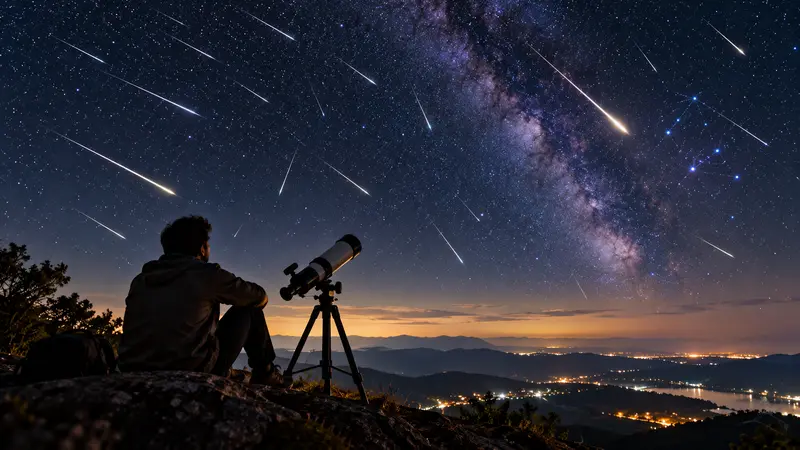
The Orionid meteor shower peaks overnight, and the best time to see it from India is the pre-dawn darkness of Thursday, 22 October. Under a dark, clear sky you can expect roughly 10 to 20 meteors an hour, with up to about 20 at the very best. This year the moon is a bright waxing gibbous, about 70 to 80 per cent lit, which will wash out the fainter streaks, so the hours after it sets matter more than usual.
When and where to look
Few meteors appear before about 11 pm, when the shower's radiant, the point the meteors seem to stream from, has climbed high enough. It sits in the upper part of Orion, near the red star Betelgeuse and close to the border with Gemini. To find it, locate the three stars of Orion's belt and move up to Betelgeuse at the hunter's shoulder. From Indian latitudes the radiant rises around 10 or 11 pm and passes almost overhead from Mumbai before dawn. The count rises through the night and is best after midnight.
The moon is the problem. It was new on 10 October and will be full on 26 October, so it is large and bright on the peak night. On the peak mornings it sets at roughly 2:30 to 4:00 am IST, depending on the city, and the exact time for your own place is worth checking. From Mumbai, the clearest window is estimated at about 3:30 am to 5:15 am, after moonset and before dawn brightens the sky. Until the moon sets, face east or north-east with it behind you, or put a building, hill or tree between it and your eyes. With the moon up and a typical rural sky, expect a handful of meteors an hour, with a few bright ones standing out.
The Orionids are dust shed by Halley's Comet, which passes the sun about every 76 years, last in 1986 and next in 2061. Earth crosses the comet's trail twice a year: in May, which gives the Eta Aquariids, and in October, which gives the Orionids. Each grain is tiny, but it meets the atmosphere at about 66 km a second, which is why it burns up in a streak. Many leave glowing trains that linger for a second or two, and some of the brighter meteors may become fireballs.
The peak is broad. One prediction puts the exact maximum at 06:54 UTC on 23 October, which is 12:24 pm in India, when the sun is up, so the pre-dawn hours of 21, 22 and 23 October can all be rewarding. The shower is active from early October to early November and stays so until 7 November, though counts away from the peak are low. If your peak night is cloudy, you can try again on a later clear night.

How to watch
You do not need to stare at Orion. Meteors appear anywhere in the sky, and looking a little away from the radiant makes their trails look longer. Lie back in a wide, dark, open place away from city lights, give your eyes 20 to 30 minutes to adjust, and keep phone screens off; a red-light torch helps. Telescopes and binoculars are no use here, because they show only a small patch of sky, and meteors can appear across a large area. Check cloud cover and moonset before deciding how far to travel, and pick a safe, accessible spot with a wide view, especially if you are taking children out late.
Pre-dawn October can be chilly, so carry warm layers, a blanket and a mat or reclining chair. For photographers, a tripod, a wide-angle lens, a high ISO and exposures of 15 to 25 seconds aimed at the sky around Orion are the usual starting point. Meteors are random, so keep shooting.
A night like this is easier with a plan. The best window opens after 3 am, so a few hours of sleep first is sensible, and a flask of something warm helps more than it sounds. If you are taking children, choose a safe spot that is easy to reach by road rather than the darkest hilltop on offer, let them settle on a mat or in a reclining chair, and tell someone where you are going if the site is remote. The show is slow, and the patient viewers see the most.
R
4 min
What did you think?