/
Tesla debuts next-gen Roadster with thruster-assisted ‘flight’ demo in Texas
Tesla revealed its next-generation Roadster in Texas, demonstrating thruster-assisted hovering, inversion and a controlled landing. The company also showed a recorded run claiming 60 mph in under one second, but gave no price or production timing.
R
4 min
Tesla used a short, tightly scripted event in Texas on Thursday night to do what its chief executive has teased for years: make a car leave the ground.
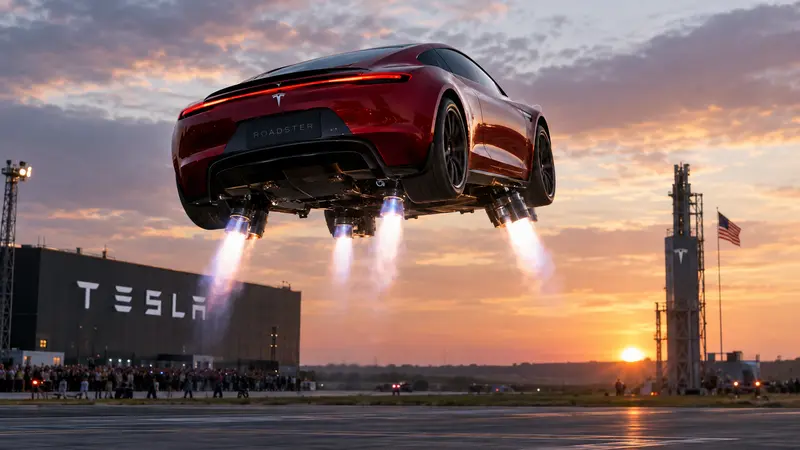
In a live demonstration at SpaceX’s McGregor facility near Waco, the long-delayed next-generation Roadster climbed a steep, curved ramp, went inverted, then appeared to hover and rotate in mid-air before landing on all four wheels. Elon Musk, who hosted the livestream, responded simply after the landing: “Well, it worked.”
Tesla and SpaceX engineers described the stunt as enabled by an “advanced ultra-high pressure air tank” feeding a set of thrusters. The company framed it as a production-intended approach to what it called short-burst flight, rather than a one-off trick.
The same presentation also included a separate, recorded run of the Roadster accelerating to 60 mph in under one second, a claim that, if replicated in customer cars, would put it in a category of its own. Another figure shown during the event was a 0–100 km/h time of 0.8 seconds.
Thrusters, air tanks and a halfpipe
Tesla has been talking about a second-generation Roadster since a concept first appeared in 2017. Thursday’s reveal was the first public demonstration of the headline feature Musk has repeatedly hinted at: a SpaceX-linked “package” that uses rocket-style hardware.
On stage, Musk said the car has “altitude control thrusters and main thrusters in the rear, so it can basically fly like a rocket, and it could do rolls.” Lars Moravy, Tesla’s vice-president of vehicle engineering, followed with a line aimed squarely at the hype cycle: “Flying cars are real.”
The demonstration was built around a large curved structure that functioned like a halfpipe. The Roadster drove up the ramp until it was upside down, then continued while inverted. At the edge, the vehicle left the surface and rotated before returning to the ground, with thrusters firing during the sequence.
Details offered during and around the event pointed to a compressed-air system rather than combustion. One report said the setup stores 260 kilograms of compressed air in an ultra-high-pressure tank that replaces the rear seats, feeding ten nozzles positioned around the body to provide lift, attitude control and assisted landings.
Tesla also leaned into the spectacle. Guests were warned about loud noise and were handed earplugs at check-in, according to accounts from the event.
A decade of waiting, few buying details
For all the engineering talk, the reveal left basic consumer questions hanging. Tesla did not announce a price, trim levels, or a production start date during the brief show. The presentation ran under half an hour and, in tone, resembled a performance as much as a conventional product briefing.
More from ScienceExplore Science
The company’s messaging suggested the thrusters are not just for theatrics. One description tied them to a “suction system” intended to increase traction, with Musk claiming it would “crush every track record that has ever existed.” The language echoed earlier hints that the Roadster could use SpaceX-derived cold-gas thrusters to enhance acceleration, braking and cornering, and now extends to controlled lift.
Design, too, was positioned as a break from the 2017-era concept. The new Roadster’s look was described as drawing cues from the Cybertruck, signalling Tesla’s current design direction even for a halo sports car.
The long gestation matters because the Roadster has been more than a model name for Tesla. It has served as a symbol of the company’s ambitions at moments when its line-up was otherwise defined by mass-market vehicles and incremental updates. Announcing a successor in 2017 helped keep attention on performance and technical daring; delivering a working demonstration in 2026 is Tesla’s bid to show it can still surprise.
What comes next
Tesla’s next task is to translate Thursday’s controlled demonstration into a product that can be built, sold and used outside a closed course. The company has yet to say whether the thruster system will be standard equipment or part of an optional package, and it has not outlined how much of the stunt is intended for routine driving versus tightly managed, short-duration use.
Even the terminology remains slippery. Some early online chatter described the Roadster as a “flying car” before the event, with at least one report noting that such claims were unverified ahead of the reveal and that brief lift would not amount to conventional flight. Tesla’s own framing now sits in the middle: the company is presenting the capability as short-burst flight and orientation control without wings or rotors.
Still, the demonstration achieved what Musk promised in the narrowest sense. The Roadster did leave the ground, rotate, and come back down under control, and Tesla paired that with an acceleration claim designed to dominate any conversation about specs.
For a car first teased nine years ago, it was a loud, literal attempt to reset expectations. The unanswered questions, from pricing to timelines, will decide whether Thursday night becomes a turning point or just the most expensive stunt show Tesla has ever staged.
R
4 min
What did you think?