/
Webb helps trace most distant fast radio burst to tiny young galaxy over 10 billion light-years away
Astronomers have traced FRB 20240304B, detected by MeerKAT in 2024, to a tiny young galaxy seen by the James Webb Space Telescope. The burst appears to have travelled for more than 10 billion years, setting a new distance record and offering fresh clues about FRB origins and intergalactic matter.
P
6 min
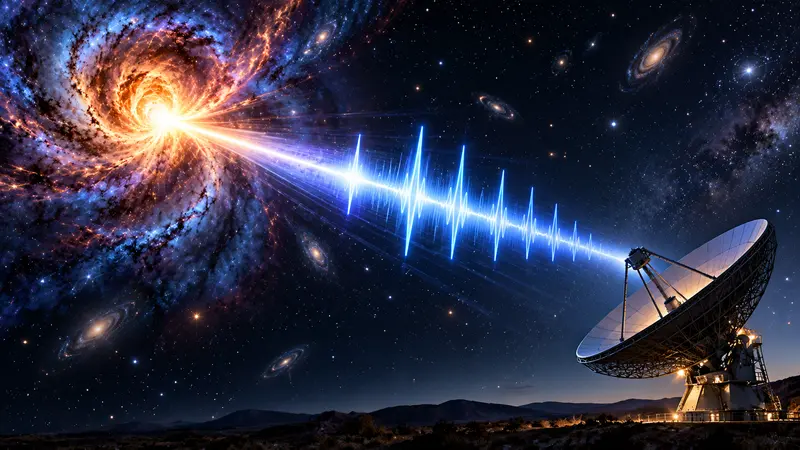
Astronomers have pinned down the most distant fast radio burst ever traced to a host galaxy, after a faint, millisecond flash detected in 2024 was matched to a tiny, young system seen by the James Webb Space Telescope. The burst, FRB 20240304B, appears to have left its galaxy more than 10 billion years ago, when the universe was about 3 billion years old, setting a new distance record for these brief radio pulses.
The signal was first captured on March 4, 2024 by the MeerKAT radio telescope in South Africa, using the MeerTRAP search system, and later followed up with Webb observations that finally revealed a host too dim for ground-based instruments to see. The work was led by Manisha Caleb and Themiya Nanayakkara of the University of Sydney’s Sydney Institute for Astronomy.
Fast radio bursts, or FRBs, are intense spikes of radio emission that typically last from a fraction of a millisecond to a few seconds. They are over almost as soon as they are found, which is why most of them remain unlinked to a specific galaxy. Yet the class has become one of astronomy’s busiest frontiers: researchers estimate an FRB goes off somewhere in the sky about once a second.
A flash from the early universe
FRB 20240304B stood out quickly because its radio signature suggested an extreme distance. The pulse arrived with a dispersion measure of about 2,458, meaning the signal was stretched and delayed by free electrons along its path through intergalactic space. It also showed a scattering time of 5.6 milliseconds at 1 gigahertz, another hint of a long journey through tenuous gas.
MeerKAT measured the burst’s peak at roughly half a jansky. That brightness, paired with the heavy “smearing” of the signal, put it in a small club of events likely to come from the distant universe rather than the nearby cosmic neighbourhood.
The problem was the usual one: knowing where to look is not the same as seeing what is there. Follow-up imaging from ground-based telescopes could not find a galaxy at the position in the sky, even after a one-hour exposure with the Keck Observatory in Hawaii. The non-detection implied the host was simply too faint for Earth-based sensors.
Webb changed that. Its near-infrared camera, NIRCam, detected a dim patch of light at the burst location, and its near-infrared spectrograph, NIRSpec, identified strong hydrogen and oxygen emission lines. Those lines yielded a redshift around 2.148, placing the galaxy deep in cosmic time. Reports describing the host say it is a small, youthful system, with one account characterising it as a dwarf galaxy roughly 1,000 times less massive than the typical hosts previously tied to FRBs.
The location on the sky is in the direction of the Virgo constellation. With the host finally in hand, the burst becomes more than a curiosity: it is a marker of conditions in the universe when galaxies were still assembling and heavy elements were building up.
Why one distant burst matters
FRBs are still a puzzle, but the evidence has been tilting toward magnetars, the highly magnetised remnants of massive stars. Magnetars are neutron stars with violent magnetic fields that can crack a crust, drive a flare, and send out a blast of energy across the spectrum. Studies of another burst, FRB 20221022A, concluded the emission came from within thousands of kilometres of a turbulent neutron star magnetosphere, supporting models that locate the radio flash very close to the compact object.
The new record-holder does not settle the debate on its own, because it is based on a single event, and the team has described the match to the host galaxy in probabilistic terms. Still, the youth of the host is being treated as a clue. A small galaxy that is actively forming stars is also a place where massive stars live fast and die young, producing the neutron stars and magnetars that could power at least some FRBs.
More from ScienceExplore Science

Other ideas remain in circulation, particularly for bursts that do not repeat. Some models invoke catastrophic collisions such as neutron star mergers or interactions involving black holes. Others focus on shocks in plasma. Astronomers now tend to think the label “FRB” may cover more than one physical mechanism, especially because some sources repeat while many others have only been seen once.
Beyond the origin story, the new distance record strengthens the case for using FRBs as measuring sticks for the universe between galaxies. As a burst crosses billions of light-years, its radio waves pass through thin gas, dust, and otherwise hard-to-detect matter. That material changes the signal in predictable ways, including the dispersion measured in the arrival time across frequencies. With enough bursts at known distances, researchers can map how ordinary matter is spread through intergalactic space and test how much of it might be “missing” from galaxy inventories.
A single faraway event cannot do that job alone. It can, however, extend the reach of the method to earlier epochs, when the cosmic web of gas was younger and the first generations of galaxies were still evolving.
The next targets for FRB hunters
The FRB field has been moving quickly, with surveys turning up both strange outliers and useful benchmarks. One recent landmark was the detection of FRB 20250316A in March 2025 by CHIME, described as the brightest FRB yet recorded and localised to a spiral arm of the galaxy NGC 4141. At the other extreme sits FRB 20240304B, which is not being billed as the brightest, but is now being treated as the most distant.
Together, those finds sketch the range of environments where FRBs can occur, from nearby spiral structure to tiny galaxies in the early universe. That variety is one reason astronomers are wary of single-cause explanations.
For now, the immediate next step is more of the same, but with higher stakes: catch more bursts at the far edge of the observable universe and pin them to hosts that are otherwise invisible. MeerKAT’s wide-field capabilities make it well suited to spotting rare events, while Webb’s sensitivity in the infrared can reveal faint galaxies that elude even the largest ground-based observatories.
Each new localisation also feeds a second goal: building a cleaner sample of FRBs with well-measured distances. If the sky really produces roughly one FRB per second, then the bottleneck is not the universe’s supply. It is the ability to detect, localise and follow up enough of them before the clues fade back into the cosmic noise.
In that sense, FRB 20240304B is both a record and a warning. The universe can deliver a message from 10 billion years ago in a few milliseconds, and it still takes years of patient work, and a space telescope, to read the return address.
P
6 min
What did you think?