/
World Mental Health Day 2026 puts lived experience at centre as Ghana reports rise in cases
World Mental Health Day 2026, observed on 10 October, focused on putting lived experience at the centre of mental health policy and care. Ghana reported 36,196 recorded cases across five conditions in Jan–Jun 2026, up from 29,782 a year earlier.
P
5 min
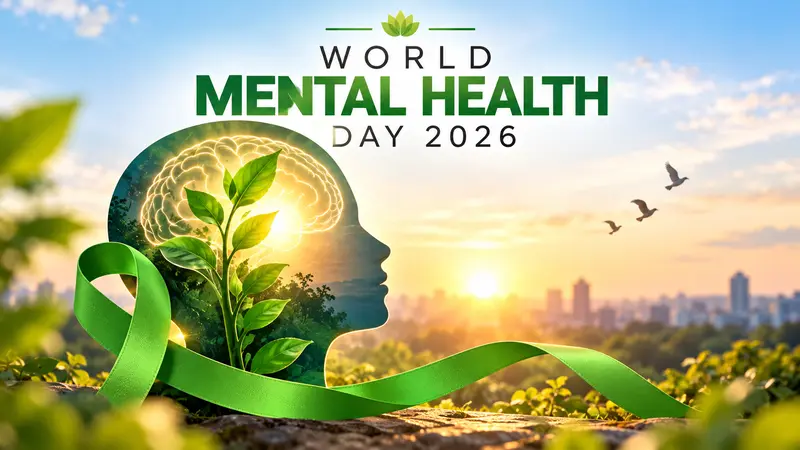
World Mental Health Day was marked on 10 October 2026 with a global push to put people who have lived through mental illness at the centre of how care is designed, delivered and judged.
The day’s theme, “Lived experiences heard: real voices, real change,” frames mental health not only as a clinical issue but as a public system problem: who gets listened to, whose needs are treated as urgent, and what kinds of support exist outside hospital walls. The message is simple. Services work better when the people who use them help shape them.
That call landed as fresh figures from Ghana pointed to rising demand for care, and as new conversations gained traction about the ways stress is hidden in plain sight, from the automatic “I’m fine” to the pressure to stay reachable for work long after office hours.
A theme built around real voices
This year’s advocacy focuses on integrating people with firsthand experience into planning and delivery of psychological care. The approach is being promoted by the World Health Organization and the World Federation for Mental Health, with an emphasis on building systems that respond to what patients and families say they actually need.
A central plank is a shift away from isolating institutional models and toward community-based support. The argument is that long stays in inpatient settings can leave people cut off from family, work and daily routines, while local services can help earlier and more continuously, especially when they are linked to primary care.
Another priority is inclusive decision-making. The day’s agenda presses governments and health systems to consult people with lived experience when drafting legislation, setting national mental health plans, and training frontline staff. It also challenges the habit of treating patient input as an afterthought, gathered only once a programme is already in motion.
The theme also speaks to a quieter barrier: silence. Campaigns tied to the day urged workplaces, schools and families to look beyond reflex answers and create room for honest conversations about stress, exhaustion and fear.
Ghana data points to rising caseloads
In Ghana, the Mental Health Authority reported 36,196 recorded cases involving five major mental health conditions between January and June 2026. That was an increase of 6,414 cases compared with the same period in 2025, when 29,782 cases were recorded.
The Authority’s breakdown showed schizophrenia, schizotypal and delusional disorders as the largest category, with 15,193 cases. Epilepsy followed with 9,072 cases, and depression with 5,939. Mental disorders associated with alcohol use accounted for 3,081 cases, while bipolar disorder made up 2,911.
The Authority cautioned that the figures cover only five of the 10 conditions included in its analysis. They also do not capture people who do not seek treatment.
The numbers, released ahead of World Mental Health Day, added weight to the year’s focus on lived experience. The Authority called for people who have navigated mental illness and care systems to help shape policies and services, aligning with the day’s wider push to bring service users into decision-making rather than leaving them on the receiving end.
The everyday language of distress
Alongside policy discussions, World Mental Health Day 2026 also drew attention to the way mental strain shows up in routine speech and online culture. Casual references to distress have become common: joking about anxiety, describing a rough day as a “breakdown,” or using diagnostic terms loosely. Specialists have warned that humour can be a release valve, but it can also become cover.
Mehezabin Dordi, a clinical psychologist at Sir H. N. Reliance Foundation Hospital, described humour as a coping tool that can help people handle difficult emotions. “Humour can sometimes be a helpful way to deal with difficult emotions. Making a joke about anxiety, burnout or a stressful situation can help us release tension, gain perspective and feel less alone,” she said.
The risk, clinicians say, is that jokes can become a default response that discourages deeper conversations, especially when someone’s distress is persistent or worsening. Context matters: who is making the joke, what sits underneath it, and whether there is space to speak plainly when the laughter stops.
A related concern is the social script of “I’m fine.” Psychology discussions around the day pointed to the ways that phrase can mask loneliness, emotional exhaustion, stress or fear. The point is not that the words are always a warning sign, but that they can be a convenient end to a conversation when a person does not feel safe, or does not want to be a burden.
Work culture has become part of that same story. With messaging apps and email always within reach, many employees remain tethered to work well past official hours. Dr Paramjeet Singh, consultant psychiatrist at PSRI Hospital in New Delhi, said the workday often does not end when people leave the office, with messages and “quick updates” pulling attention back to the job late into the evening.
For employers, the day’s theme translates into a practical question: whether staff have any real say in the conditions that shape their mental health. For employees, it raises another: how to set boundaries without risking penalties in workplaces that treat constant availability as commitment.
World Mental Health Day is observed annually on October 10. In 2026, its organising message is a demand for systems that listen, and for everyday conversations that do not stop at automatic reassurances. What comes next depends on whether institutions, including health services and workplaces, are willing to share power with the people most affected by their decisions.
P
5 min
What did you think?