/
India's new conservation rulebook counts sacred groves and village tanks towards the 30% target: how it works
Environment Minister Bhupender Yadav released India's I-OECM guidelines at CBD COP-17 in Yerevan on 3 November. They recognise areas outside protected zones, such as sacred groves and irrigation tanks. A $60.79 million project aims to add 3% of land and sea to the existing 27%, reaching 30x30.
P
5 min
India has published its first national rulebook for recognising conserved land and water outside formal protected areas. Union Environment Minister Bhupender Yadav released the Guidelines for the Designation of India's Other Effective Area-Based Conservation Measures, or I-OECMs, 2026, at a side event of the 17th Conference of the Parties to the Convention on Biological Diversity in Yerevan, Armenia, on 3 November 2026, according to the Environment Ministry.
The name is clumsy, but the idea matters. It decides how India will try to meet one of the most ambitious numbers in global conservation.
What an OECM is, and why India needs them
Under the Kunming-Montreal Global Biodiversity Framework, adopted in 2022, countries agreed under Target 3 to conserve 30% of land and sea by 2030, the goal known as 30x30. That total can include protected areas such as national parks. It can also include Other Effective Area-Based Conservation Measures: places that are not legally protected for nature, but in which biodiversity is in fact being conserved over the long term.
India's own arithmetic explains the interest. The ministry says that 27% of India's land and marine area is already under protection, and that its new project aims to add 3%. That is a large gain to find in a crowded country in which creating new national parks is slow and often disputed. Recognising what already works is the obvious alternative. As Mr Yadav put it, OECMs are a new approach in which conservation is achieved mainly through landscape management outside forests and protected areas.
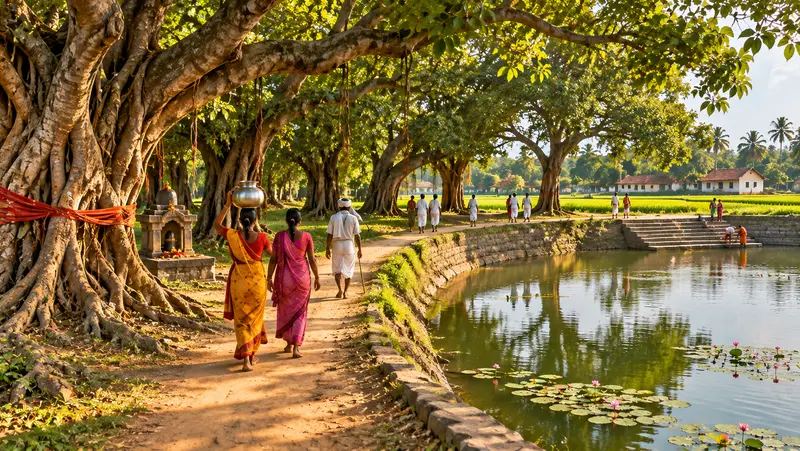
The guidelines cover land, inland water, and coastal and marine ecosystems. Illustrative sites include biodiversity parks, sacred groves, community-managed irrigation tanks, seagrass and seaweed beds, and areas closed during seasonal fishing bans.
The four tests and the approval process
Four criteria are mandatory.
| Test | What it requires |
|---|---|
| Status | Not a legally protected or conserved area |
| Governance | Managed under Central or State frameworks, or by recognised local bodies such as Panchayats and Biodiversity Management Committees |
| Boundaries | Defined limits, with no overlap with areas already reported to the World Database on Protected Areas |
| No change | Recognition must not alter existing activities, governance or regulatory regime |
Sites may also qualify on the strength of biodiversity significance, ecosystem services and cultural values.
Applications go to the National Biodiversity Authority from Central and State departments, local governments and Biodiversity Management Committees. The authority examines them and forwards each to the State Biodiversity Board or Union Territory Biodiversity Council within 30 days. That body validates the information and returns a recommendation within 30 days. The authority then decides with an inter-departmental committee, and the ministry authorises recognition. Each site needs a monitoring framework with measurable indicators, assessed at least once every five years. India will work with UNEP-WCMC to publish recognised sites internationally.
The ministry is explicit on one point: recognition does not make an area a protected area and does not change its ownership or legal status.
More from ScienceExplore Science
Why it matters
This is the part that local communities will care about most. A village that looks after a grove or a tank does not lose control of it. There are no new restrictions on paper, and the guidelines provide for non-monetary recognition of good practice.
India has also commissioned a project to test the approach. Under the Global Environment Facility, it runs for 72 months from 15 May 2026 to 15 May 2032, with total financing of $60.79 million, made up of a $6.65 million grant and $54.14 million in co-financing. It will work in six landscapes and seascapes, including the Gori Valley in Uttarakhand, Kumbhalgarh to Jaisalmer in Rajasthan, Satkosia to Kalahandi in Odisha, Srisailam to Cumbum in Andhra Pradesh and Telangana, and Sahyadri to Konkan in Maharashtra and Goa. The targets include 50,000 hectares of new terrestrial conservation areas, restoration of at least 5,000 hectares of degraded land and direct benefit for at least 50,000 people, half of them women.
The concerns are real, however. The first is arithmetic: critics of OECMs worldwide warn that they can become a way to reach a percentage by relabelling, with little change on the ground. The test that recognition must not alter existing activities cuts both ways. It protects communities, but it also means that a recognised site gets no new protection if a road or mine is proposed nearby.
The second is durability. A protected area has legal force. A sacred grove depends on custom and local institutions, which can weaken over time, and the guidelines offer no money to the keepers beyond recognition.
The third is the five-year review, which is a long gap in a fast-changing landscape. The strength of the monitoring framework will decide whether a site's status means anything.
The practical questions now are how many applications come in, which states move first and whether the National Biodiversity Authority can keep to its 30-day steps. The six demonstration landscapes will show the model working, or not, over the next few years.
India also has to show progress under its National Biodiversity Strategy and Action Plan for 2024–2030. With four years to go, the path to 30% looks plausible on paper. Whether the additional 3% represents real gains for nature, or merely better bookkeeping, will depend on the quality of the sites recognised and on what is done after the certificate is issued.
Sources
About the Author
P
Prateek Rawat
Staff Writer
Prateek Rawat is a contributor to Wirony. All articles published under this byline undergo editorial review and approval before publication, with any necessary corrections handled…
P
5 min
What did you think?