/
Bank of England raises Bank Rate to 4% in 8–1 vote as Middle East energy shock lifts inflation forecast to 5%
The Bank of England raised Bank Rate by 0.25 points to 4% on 5 November, by 8–1, with one member wanting 4.25%. Brent averaged $108 and UK gas prices were 81% above the July assumption. Staff see inflation near 5% by mid-2027. The next decision is on 17 December.
A
4 min
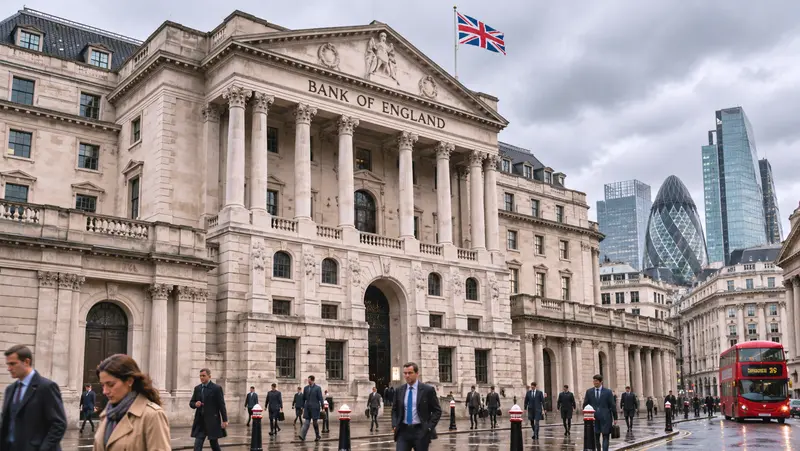
The Bank of England raised Bank Rate by 0.25 percentage points to 4% in a decision published on Thursday 5 November 2026. The Monetary Policy Committee voted 8–1. Andrew Bailey, Sarah Breeden, Swati Dhingra, Megan Greene, Clare Lombardelli, Huw Pill, Dave Ramsden and Alan Taylor voted for 4%, while Catherine Mann preferred a larger rise to 4.25%. In September the committee had held at 3.75% by 6–3, with three members already wanting 4%.
The reason is energy. The Bank says the conflict in the Middle East is in its ninth month, and that the pressure on prices in the pipeline is now sufficient to warrant an increase.
The numbers behind the decision
| Measure | Figure |
|---|---|
| Bank Rate | 4% (from 3.75%) |
| Vote | 8–1 |
| CPI inflation, September | 3.5% |
| Staff CPI projection, 2027 Q1 | about 4½% |
| Staff CPI projection, 2027 Q2 | about 5% |
| Brent crude, 15 working days to 27 October | $108 a barrel |
| UK gas, same period | 216p a therm |
| Gilts held by the Bank | £362 billion |
Brent was 38% above, and gas 81% above, the levels assumed in the July Monetary Policy Report. Staff projections for inflation in the second quarter of 2027 are about 1¼ percentage points higher than in July. Budget measures are expected to take about ¼ of a percentage point off inflation by then, so the rise would have been larger without them.
Inflation at about 5% is two and a half times the Bank's 2% target. That is why a committee that expects GDP growth to fall back still chose to raise rates.
Why raise rates into an energy shock
A central bank cannot produce more oil or gas. Higher rates do nothing about the first round of an energy shock, when petrol and heating bills rise. They are aimed at the second round, when companies raise prices and workers seek higher pay to make up for it, so that a one-off jump in prices becomes persistent inflation.
The minutes admit that second-round effects are not yet clear, but the risk has grown. Activity has also been stronger than expected, helped by exports and spending on artificial intelligence, although the Bank expects GDP growth to fall back. Greene cited wage growth of around 3.5%.
Mann's dissent shows the hawkish end of the debate. She expects inflation of 4.9% by mid-2027 and wanted to act more forcefully. No member voted to hold. In September, three wanted a rise. In November, all nine did, and the argument now is over how fast.
Why it matters for borrowers is straightforward. Two-year fixed mortgage rates have already risen by nearly 50 basis points since early September, because lenders price off market expectations and not the day's decision. Those coming off cheaper fixed deals will feel it most. Markets expect Bank Rate at about 4.25% by February, which means one further rise is largely priced in.
Savers will gain a little, and sterling tends to find support from higher rates, which softens the cost of imports priced in dollars. Companies face higher borrowing costs just as energy bills rise, and the Bank expects that squeeze to weigh on growth.

The committee stresses that policy is not on a preset path. Decisions will be made meeting by meeting, and they depend on how energy prices and second-round effects develop.
There is a serious counter-argument. If energy prices fall because of a settlement in the Middle East, the rise could look premature, and Britain would have tightened policy into a slowing economy. Oil has already eased in recent sessions on hopes of de-escalation. Monetary policy works with long lags, so a rate rise today will have most of its effect well after the projected peak in inflation.
Against that, the Bank is looking at inflation that has been above target for a long time, and it fears that expectations may rise if it stays still. The minutes say the degree of inflationary pressure in the pipeline warrants action now.
What to watch next
The next decision comes on 17 December 2026. Before then, four things will shape it.
First, energy prices. A sustained fall in Brent and gas from the October averages would reduce the case for another rise. Second, the October and November CPI figures. Third, pay data, since evidence of wages rising in response to energy prices would strengthen the hawks. Fourth, how quickly mortgage rates adjust, since that is the main channel through which policy reaches households.
There are wider lessons for other central banks. The energy shock is a global one, and the same trade-off between growth and prices faces policy makers elsewhere. For Indian readers, the link is through oil, sterling and global rates: Indian markets rallied on 5 November on positive global cues, with crude lower, but a major central bank raising rates because of energy shows that the shock has not gone away.
This article is for information and is not investment advice.
Sources
About the Author
A
Amita Sahani
Staff Writer
Amita Sahani writes for Wirony. Every story under this byline is reviewed and approved by an editor before it is published, and corrections are made openly.
A
4 min
What did you think?