/
Cancer drugs get cheaper from 9 November: 1,031 formulations cut, 600 brands by over half. What to check
NPPA's 30% trade margin cap on 137 cancer drugs takes effect on 9 November. Companies have reported lower MRPs for 1,031 formulations, with 600 brands down over 50%, and estimated savings of Rs 3,502 crore a year. Bevacizumab brands fall by up to 87%. How to check a price and complain.
A
5 min
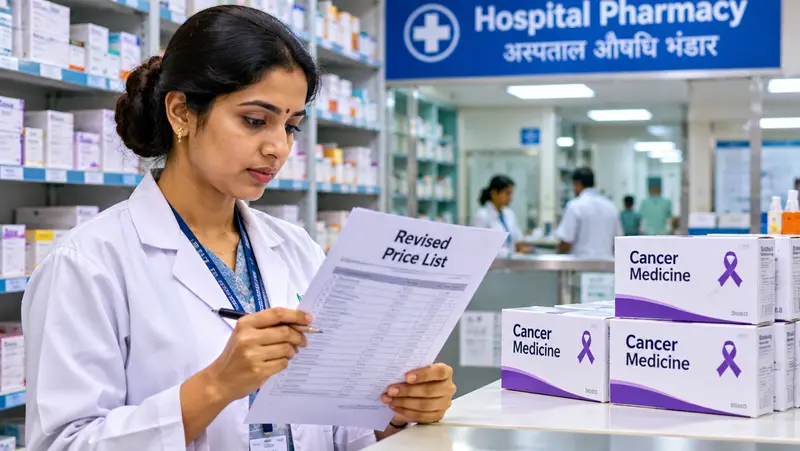
The prices of a large number of cancer medicines in India will fall from Monday 9 November 2026, when a cap on trade margins for 137 anti-cancer drugs takes effect. The National Pharmaceutical Pricing Authority said on 7 November that 76 companies have reported revised maximum retail prices for 1,225 formulations covering 121 drugs. Prices have been reduced on 1,031 formulations, with 600 brands down by more than 50% and the biggest cut at 96.45%. The estimated saving to consumers is Rs 3,502.31 crore a year.
For a family paying for months of treatment, these are not small numbers. Cancer care is one of the heaviest costs an Indian household can face.
What has changed, and how
The move is called Trade Margin Rationalisation. A trade margin is the gap between what a manufacturer receives and what the patient pays at the counter, covering stockists, distributors, retailers and hospitals. These 137 drugs are non-scheduled, which means they were outside direct price control, and companies could set high MRPs that left very large margins in the chain.
Under Paragraph 19 of the Drugs (Prices Control) Order, 2013, NPPA has capped the margin at 30% of MRP. The notification of 17 October followed the recommendations of an expert committee set up by the Directorate General of Health Services, made up of oncologists, specialists and officials. The list covers immunotherapy drugs used for more than 20 types of cancer, denosumab, pegfilgrastim and bevacizumab, and it names pembrolizumab, durvalumab and osimertinib among those expected to become more affordable.
The examples published by NPPA show how wide the old margins were.
| Medicine, strength and use | Brand | Old MRP (Rs) | New MRP (Rs) | Cut |
|---|---|---|---|---|
| Bevacizumab 100 mg, lung, colon, ovary, cervix | Bryxta | 25,995 | 3,318 | 87% |
| Denosumab 60 mg, breast and prostate | DenOsteoRel | 24,955 | 6,240 | 75% |
| Abiraterone 250 mg, prostate | ABIRONE | 41,250 | 3,218 | 92% |
| Pegfilgrastim 6 mg, prevents neutropenia | PEG FILTERO | 9,093 | 1,631 | 82% |
| Palbociclib 125 mg, breast | Palbopro | 40,421 | 2,720 | 93% |
| Pemetrexed 500 mg, lung | ReliTrexed | 9,977 | 1,113 | 89% |
| Fulvestrant 250 mg, breast | FASNORM | 30,422 | 3,672 | 88% |
| Pertuzumab 420 mg, breast | LUPIHER 2 | 83,520 | 37,358 | 55% |
The list also exposes something a patient rarely sees: how far brands of the same molecule differed. Before the change, the listed palbociclib 125 mg brands ran from Rs 2,246 to Rs 40,421. Bevacizumab 100 mg ranged from Rs 7,686 to Rs 25,995. Pack sizes may differ in some cases, so these are not exact comparisons, but the gap gives a sense of how much of the old price was margin. Not every brand falls so far. Dr Reddy's Womab, a pertuzumab brand, drops by about 28%.
The authority's earlier estimate was that MRPs could fall by up to 70%, depending on price structures. The reported cuts for many brands are larger. This builds on a 2019 pilot in which margins on 42 cancer drugs were capped at 30%, and the MRP of 526 brands fell by up to 90%.
Why it matters
Many families in India pay for cancer treatment out of pocket, and medicines can be a large part of the bill. A saving of Rs 3,502 crore a year is meaningful for patients and their families, and a cut of this scale can decide whether a patient completes a course of treatment.
Three cautions apply. First, 10 to 15 of the 137 drugs are not yet sold in India, and the cap will apply when they launch. Reports are in for 121 drugs, and 194 of the 1,225 reported formulations show no reduction, either because their margins were already within the limit or for other reasons. Second, a drug's price is only part of the cost of care. Scans, surgery, radiation, hospital stays and travel are not covered by this order. Third, the measure caps margins, not manufacturing prices, and companies can still take the annual increase allowed under Paragraph 20(1) of the price control order, subject to the 30% ceiling.
There is an industry argument as well. Critics of price controls warn that squeezing margins can reduce the incentive for distributors and hospitals to stock some medicines, particularly in smaller towns, and can discourage launches of newer drugs. However, the 2019 pilot did not stop the government from widening the approach, and the authority's list will be updated periodically. The real test will be whether stocks stay steady at the new prices.
Hospitals are the place to watch. Many patients buy from in-house pharmacies, where they have little choice of supplier. Every retailer, dealer, hospital and institution must now display the revised MRP list on its website and premises, and State Drug Controllers are responsible for monitoring compliance.
What patients and families should do
Check the price. Use the Pharma Sahi Daam mobile application or the NPPA website, nppa.gov.in. Look up the exact brand, strength and pack.
Look at the label and the bill. Stock already in the market may carry an old MRP. The rule is that the revised price applies from 9 November, so ask the pharmacist or hospital to bill at the new rate.
Ask about the brand. Prices still vary between brands of the same medicine. Ask the treating doctor whether a lower-priced equivalent is suitable. Do not change or stop a prescribed medicine without medical advice.
Complain if overcharged. Reports can go to monitoring-nppa@gov.in, the helpline 1800-11-1255, or by post to the Deputy Director, Monitoring, NPPA, YMCA Cultural Centre Building, 1 Jai Singh Marg, New Delhi. Keep the bill.
The notification, SO 5690(E), remains in force until further orders. The list of revised prices is being updated as companies submit figures, so a brand missing today may appear shortly.
This article is for information and is not medical advice.
Sources
About the Author
A
Amita Sahani
Staff Writer
Amita Sahani writes for Wirony. Every story under this byline is reviewed and approved by an editor before it is published, and corrections are made openly.
A
5 min
What did you think?