/
Bomb threats hit a dozen-plus European flights; planes diverted, checks in Warsaw and Brussels find nothing
Planes were diverted in France and Bulgaria and passengers evacuated in Romania after bomb threats hit more than a dozen flights across Europe on 5 November. Checks in Poland and Belgium found nothing. Czech police reported threats to four planes. EASA is monitoring. No group has been named.
P
4 min
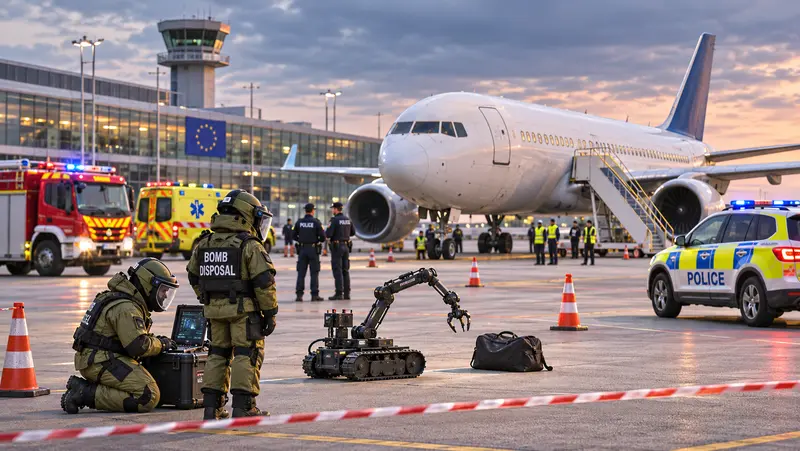
More than a dozen passenger flights across Europe received bomb threats on 5 November 2026, forcing several aircraft to divert and setting off security checks at airports in multiple countries. The European Union Aviation Safety Agency said it would continue to monitor developments and assess any aviation safety implications.
No injuries were reported in the accounts available, and in the cases where results of searches have been stated, nothing dangerous was found. The scale and timing, however, make this one of the more unusual days for European aviation in recent memory. Authorities have not named a source or a motive.
What happened, country by country
The incidents spread across at least six countries.
| Country | Flight | What happened |
|---|---|---|
| France | Aer Lingus A320, Dublin to Rome | Diverted to a military airbase at Evreux after a bomb alert; 151 passengers and six crew moved to safety |
| Bulgaria | Three Ryanair flights to Sofia | Flights from Copenhagen and Madrid landed safely in Sofia; a flight from London Stansted diverted to Plovdiv |
| Poland | LOT, Warsaw to Paris | Stopped while taxiing at Warsaw Chopin after a report of a dangerous object; nothing found |
| Belgium | LOT, Warsaw to Brussels | Landed at Brussels after a threat; inspection found nothing suspicious |
| Romania | Wizz Air, from Milan | Landed safely at Bucharest; 182 passengers and seven crew evacuated |
| Czech Republic | Four aircraft heading to Prague | Police reported threats |
The French case drew the strongest response. The office of Prime Minister Sebastien Lecornu said the aircraft landed safely and that military bomb disposal teams inspected the plane after everyone had left it. Using a military base for a civilian flight points to how seriously the alert was treated, because such a site can keep a suspect aircraft well away from a busy terminal.
How crews and airports respond
Passengers often wonder why a threat that may be a hoax causes so much disruption. The answer is that authorities cannot tell at first. EASA's standing guidance for air traffic services sets out a clear approach. Controllers handle the aircraft in the most expeditious way possible, in line with local instructions, while keeping it as safe as they can. Once on the ground, the aircraft is taken to an isolated parking position. If passengers and crew disembark, other aircraft and people are kept at a safe distance.
Aircraft design rules also plan for this. Large airliners are required to have a designated least-risk bomb location, a place on board where a suspected device could be put to limit the effect of an explosion. Crews and controllers are trained for bomb threats as part of normal preparation.
For those on board, this means a sudden change of course, an evacuation and a long wait on a remote part of the airfield. Most threats turn out to be false. Treating any one as false before a search, however, is not an option.
Why it matters
A single hoax is a nuisance. A wave of them across several countries on the same day, involving different airlines, is something else. It suggests either a co-ordinated effort or copycat activity, though officials have not said which. The record so far is silent on how the threats were delivered, whether by phone, email or online post, and on whether they share a source.
The cost is real even when nothing is found. Diversions disrupt schedules, crews run out of permitted duty time, passengers miss connections and security staff are pulled from other work. Repeated false alarms can also wear down the system by forcing authorities to spend attention on hoaxes, which is often the point. Sending false threats against aircraft is a serious offence across Europe, and those responsible can face prison.
Europe's security services have been on alert for hybrid activity in recent years, including drone incursions at airports and sabotage of infrastructure. Some commentators will link these threats to that pattern. However, no European authority has publicly made such a link in this case, and it would be premature to assume one. Threat waves by individuals and online groups have happened before, in India among other places.
For passengers, the practical advice is simple. Follow crew instructions, leave bags behind if told to evacuate and check the airline's app for rebooking. Passengers on cancelled or heavily delayed flights in the EU may have rights to care and rebooking, and those rights depend on the circumstances. Security incidents are usually treated as outside an airline's control, which can affect compensation, but airlines still have a duty of care during disruption.
The key questions now are for investigators. How were the threats sent? Do they come from one source? Are more expected? EASA has said it will assess the safety implications, and national police forces will be leading the work. Readers should treat any early claim of responsibility with caution until an official body confirms it.
Sources
About the Author
P
Prateek Rawat
Staff Writer
Prateek Rawat is a contributor to Wirony. All articles published under this byline undergo editorial review and approval before publication, with any necessary corrections handled…
P
4 min
What did you think?