/
UNEP: developing countries need $305 billion a year to adapt, and tripling aid would cover at most 29%
UNEP's Adaptation Gap Report 2026, released on 4 November, puts developing countries' needs at about $305 billion a year by 2035 against $28.2–31.7 billion of international public finance in 2024. Even tripling flows would meet only 20–29%. COP31 opens next week in Antalya.
P
5 min
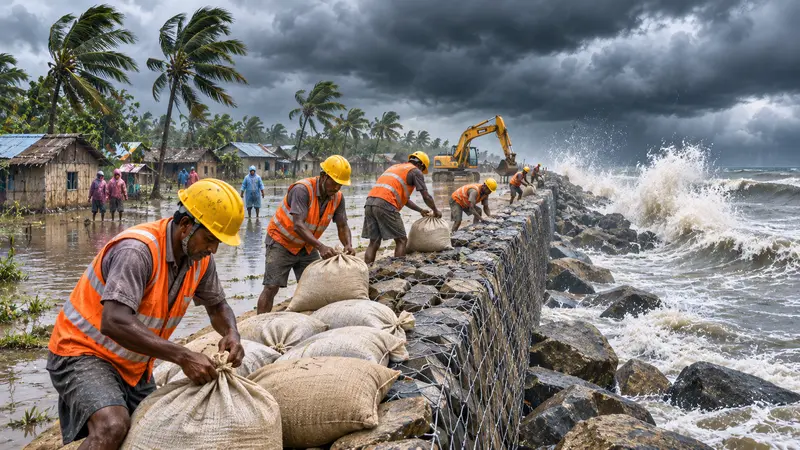
The United Nations Environment Programme said on 4 November 2026 that the world is not ready for the climate it already has, let alone what comes after global warming passes 1.5°C. Its 2026 Adaptation Gap Report, subtitled "Ready? Not", estimates that developing countries will need about $305 billion a year by 2035 to adapt. International public finance for adaptation reached between $28.2 billion and $31.7 billion in 2024, an increase of only about $1 billion on the year before.
The report arrives a week before COP31 opens in Antalya, Türkiye. "The world is not ready to adapt to current climactic conditions, never mind what overshoot of 1.5°C will bring," said UNEP's Executive Director, Inger Andersen.
What the numbers say
Adaptation means measures that reduce harm from climate change that can no longer be avoided: sea walls, heat action plans, drought-resistant crops, flood warnings, stronger drains. It is a different problem from cutting emissions, and it is the part of climate policy that poorer countries say they cannot pay for alone.
| Measure | Figure |
|---|---|
| Annual need by 2035, developing countries | about $305 billion |
| International public flows, 2024 | $28.2–31.7 billion |
| Rise from 2023 | about $1 billion |
| Flows if tripled by 2035 | $85–120 billion |
| Share of needs that would cover | 20–29% |
| Flows between developing countries, 2019 to 2024 | $3.8 billion to $9.6 billion |
The needs figure is a central estimate based on countries' climate plans, national adaptation plans and models. It largely excludes the private sector's own needs, which UNEP says could almost double it. Current flows are therefore around a tenth of what is needed.
The key finding concerns the promise made at COP30 in Brazil. The Global Mutirão decision called for efforts to at least triple adaptation finance by 2035. Depending on whether the tripling starts from current flows or from the Glasgow Climate Pact baseline, it would take finance to $85–120 billion a year. After inflation, that would meet just 20–29% of needs. So the headline target at the centre of this year's negotiations would, even if fully met, leave more than 70% of the gap open.
Why it matters
The trend matters as much as the level. Growth in flows is flattening at the moment when climate impacts are intensifying. Flows to the least developed countries and small island states have risen in real terms since 2019 but have declined from their 2022 peak, when they should be rising. For those countries, tripling could actually meet 49–83% of needs, which shows how much difference targeted finance can make to the most exposed.
Private money is not a substitute. UNEP says private flows are growing, but they mainly address the private sector's own adaptation needs or are likely to be paid for by developing countries themselves, and they may close only 15–20% of the gap for public-oriented actions such as coastal defences or health systems, which do not earn returns for investors.
Then there is the bill for damage that adaptation cannot prevent. The first round of the Fund for responding to Loss and Damage drew requests worth $2.8 billion against an initial envelope of $342 million, about eight times the money available. UNEP says this shows large unmet demand, although the global loss and damage finance gap is not yet known. It also finds that complex procedures and limited capacity make support hard to reach.
For a country like India, with a long coast, a heat-exposed workforce and a monsoon-dependent farm economy, adaptation is an everyday budget matter, not a distant negotiation. WHO added a related estimate on the same day: scaling up measures such as heat-health warning systems, clean water and sanitation, and cleaner household energy could prevent 1.6 million deaths a year, with economic and fiscal benefits of about $9.3 trillion.
What is going right
The report is not all gloom. The Glasgow goal of doubling finance from 2019 levels to $40 billion by 2025 could still be met, because multilateral development banks are likely to have raised their financing significantly in 2025. That depends, UNEP warns, on whether bilateral flows are hit by falling official development assistance. Money moving between developing countries has more than doubled since 2019.
Finance is also not the only obstacle. Governments are adopting climate framework laws, building platforms for policy learning, improving coordination across levels of government and setting up mechanisms to manage climate money. UNEP treats these institutional steps as a condition for converting plans into action.
Three questions will test the Antalya talks. The first is whether countries set out how tripling will happen, by when and from which baseline, since the baseline alone changes the result by tens of billions of dollars a year. The second is whether developed countries protect adaptation budgets as aid budgets shrink. The third is whether the Loss and Damage fund gets enough money, and simpler access, to meet demand that already runs at eight times its first envelope.
Andersen's own conclusion is that tripling is a floor, not a goal: nations "will need to go even higher to save lives, avoid losses and damages and protect economies." The report's numbers suggest that if the negotiators reach only the existing aspiration, the adaptation gap in 2035 will still be measured in hundreds of billions of dollars a year.
Sources
About the Author
P
Prateek Rawat
Staff Writer
Prateek Rawat is a contributor to Wirony. All articles published under this byline undergo editorial review and approval before publication, with any necessary corrections handled…
P
5 min
What did you think?