/
Ebola passes 10,500 cases as WHO adds two targeted vaccines to its trial, one from Oxford and Serum Institute
The Bundibugyo Ebola outbreak in the DRC reached 10,563 confirmed cases and 5,130 deaths by 1 November, says US CDC, the second-largest on record. WHO said on 4 November two vaccines built for this virus, one by Oxford and Serum Institute of India, will join its trial. India has reported no case.
A
5 min
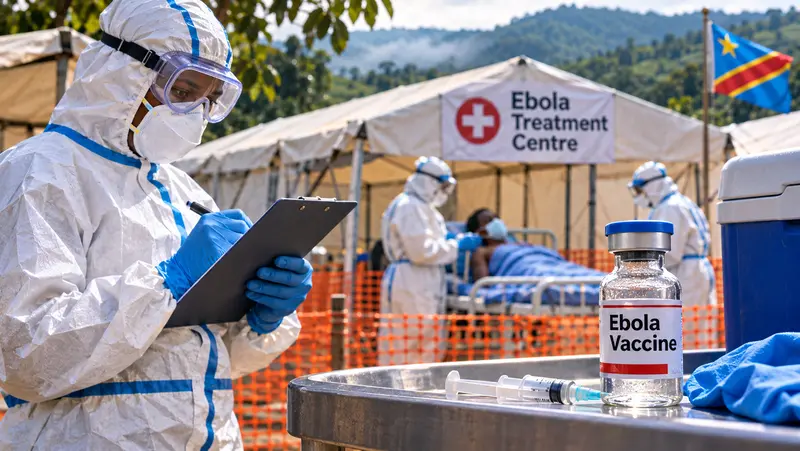
The Ebola outbreak in the Democratic Republic of the Congo has passed 10,500 confirmed cases. The US Centers for Disease Control and Prevention reported 10,563 confirmed cases and 5,130 confirmed deaths across all affected countries as of 1 November 2026, nearly all of them in the DRC. The agency calls it the second-largest Ebola outbreak on record and says it is spreading substantially faster than earlier ones. On 4 November, the World Health Organization said two vaccines designed specifically for the virus behind this outbreak will be added to a trial under way in the country.
The outbreak is caused by Bundibugyo virus, one of the Ebola family of viruses, for which there is no approved vaccine or specific therapy. It was declared on 15 May, and WHO determined it a public health emergency of international concern on 17 May.
Where the outbreak stands
The figures come from several official counts, each with its own date.
| Country | Confirmed cases | Deaths | Status |
|---|---|---|---|
| DR Congo | 10,532 | 5,126 | Active; eight provinces |
| Uganda | 20 | 2 | No active cases; last patient released 16 July |
| Kenya | 9 | 2 | All in Nairobi; no community spread reported |
| Nigeria | 1 | 0 | Imported case reported 20 October |
| France | 1 | 0 | No active cases |
These are CDC figures as of 1 November. WHO's last Disease Outbreak News, with data to 20 October, recorded 9,704 cases and 4,687 deaths in the DRC, a case fatality ratio of 48.3%, with Ituri province as the epicentre on 7,040 cases and North Kivu next on 2,146. Kenya's count differs slightly between agencies. WHO's Director-General said on 4 November that transmission is slowing in some areas but new hotspots are emerging.
The most troubling numbers are about detection. WHO reported that of 482 deaths added in the two weeks to 20 October, 307 happened in communities and not in treatment centres. Contact follow-up stood at 79.7% against a required 95%. CDC's assessment cites an Africa CDC estimate that only 30 to 40% of cases are being detected, and notes that just 15 to 20% of cases came from known contacts as of July, far below the 90% target. Those figures mean the outbreak is larger and less visible than the count suggests.
The new vaccines
WHO's expert groups recommended adding two candidates to the Tumaini trial: ChAdOx1, from the University of Oxford with the Serum Institute of India, and Moderna's mRNA-1469. WHO says this is the first time vaccines made specifically for Bundibugyo virus will be tested during an outbreak. They will enter the trial after national approvals. The trial, led by the DRC's Institut National de Recherche Biomédicale, uses ring vaccination, in which the contacts of confirmed patients are enrolled, the method that proved Ervebo in Guinea. Four rings are in place. Ervebo, which targets a different Ebola species, is also being tested for protection against this virus; the DRC has received 70,000 doses, and CDC says its efficacy here is unclear.
Treatment research is moving too. The PARTNERS trial, launched in July, is testing whether the monoclonal antibody MBP134, the antiviral remdesivir or both improve survival, and maftivimab will soon be added. Early treatment findings are expected in the coming months and vaccine results in early 2027. "Vaccines alone will not end this outbreak," Dr Tedros Adhanom Ghebreyesus said, "but they could become a powerful new tool for bringing it under control."
What officials expect, and why it matters
CDC's scenario assessment of 2 November is sobering. Of three scenarios through January 2027, it considers the most likely to be a very large, sustained outbreak with high-intensity transmission in several areas. No indicator, it says, suggests the outbreak will be brought under control in that window. Reported cases may have stabilised in recent weeks, but the agency warns that this could reflect reporting lags or under-detection. Its confidence is moderate because of data gaps. For scale, the 2014-2016 West Africa epidemic reached 28,610 cases and 11,308 deaths, and the 2018-2020 DRC outbreak 3,470 cases and 2,287 deaths.

The response is complicated by insecurity, displacement and heavy movement of people and trade in the region, WHO says, and the same country is facing its worst cholera outbreak in decades, with more than 60,000 cases this year.
Travel policy is now an open disagreement. WHO advises against any restriction of travel or trade with affected countries and on 4 November urged countries to lift such measures. The United States has gone the other way: travellers who were in the DRC within 21 days cannot board commercial flights to the country, including its own citizens, and from 3 November all passengers on international flights to the US must sign an attestation that they have not been in the DRC in the prior 21 days. CDC rates the risk to the American public as low, and no US case has been reported.
India's Health Ministry said in May that the country had reported no case of this disease, and India does not appear in CDC's list of affected countries as of 1 November. It told citizens on 24 May to avoid non-essential travel to the DRC, Uganda and South Sudan, issued protocols for international passengers and hospital isolation, and began enhanced screening at airports and other points of entry. In June the Civil Aviation Ministry launched the Air Suvidha 2.0 portal for health self-declaration by arriving passengers.
Travellers who have been in an affected area and develop fever or unexplained bleeding should seek medical care at once and tell the doctor about their travel. The disease spreads through direct contact with the blood or body fluids of infected people, and symptoms usually appear 8 to 10 days after exposure, within a range of 2 to 21 days.
The Serum Institute's role gives India a direct stake in the vaccine effort. What to watch next is WHO's revised risk assessment, which is in progress, the first rings using the new vaccines, and the treatment results due in the coming months. This article is for information and is not medical advice.
Sources
About the Author
A
Amita Sahani
Staff Writer
Amita Sahani writes for Wirony. Every story under this byline is reviewed and approved by an editor before it is published, and corrections are made openly.
A
5 min
What did you think?