/
More than half of Afghan primary-age children are out of formal school, UNESCO and UNICEF warn
The Afghanistan Education Situation Report 2026 from UNESCO and UNICEF says 53% of primary school-age children are outside formal education, and over 2.6 million girls have been denied secondary school since 2021. Fewer than half of Grade 4 pupils reach minimum language levels.
P
4 min
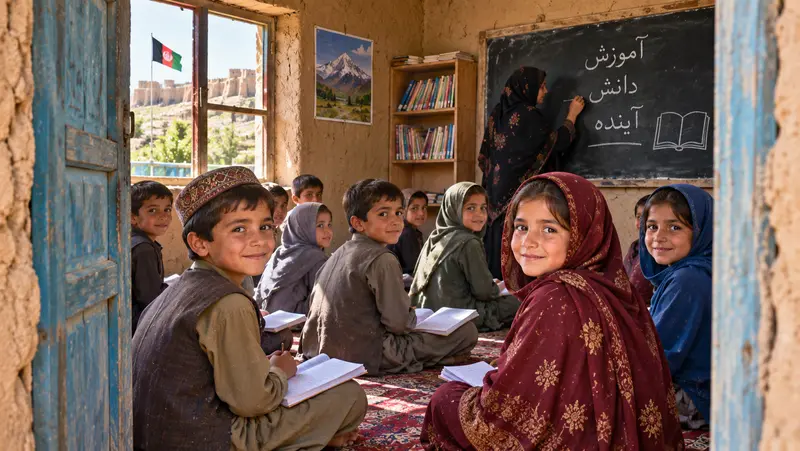
More than half of Afghanistan's primary school-age children remain outside formal general education, UNESCO and UNICEF said on 4 November 2026 in the Afghanistan Education Situation Report 2026. The two UN agencies put the figure at 53%. They also say that more than 2.6 million girls have been denied secondary education since the Taliban returned to power in August 2021, and describe Afghanistan as the only country in the world that formally prohibits girls and women from education beyond the primary level.
"Afghanistan's education situation in 2026 is defined by a widening mismatch between strong demand for learning and the capacity of the education system to meet it," the agencies said.
The report's most striking theme is that this is no longer only a story about girls, though that remains the central injustice. The whole system is falling behind.
The numbers
| Afghanistan Education Situation Report 2026 | Figure |
|---|---|
| Primary-age children outside formal education | 53% |
| Girls denied secondary education since 2021 | Over 2.6 million |
| School-age population, 2019 | About 10.4 million |
| School-age population, 2024 | About 11.5 million |
| Public primary enrolment, 2025 | About 6.6 million |
| Children aged 3–4 in early learning | Fewer than 1 in 100 |
| University enrolment, 2026 | About 208,000 |
| University enrolment, 2020 | About 430,000 |
Public primary enrolment has grown, by around 560,000 since 2022, and that shows real demand. It is not, however, keeping pace with population growth. A country with more children each year and a limited number of schools ends up with a larger share out of class, even as the absolute count of pupils rises.
Quality is a further concern. A national assessment of more than 55,000 pupils across all 34 provinces found that fewer than half of Grade 4 students reached minimum proficiency in language for Grade 3, and only one in four reached the same level in mathematics. So many of those who attend are not learning enough.
Universities tell the same story. Enrolment has edged up from 189,000 in 2024 to about 208,000, but it remains less than half of the 2020 figure, because women are barred.
Why it matters
The ban on girls beyond the sixth grade is the core issue. The agencies say that the remaining options for teenage girls, such as community-based classes, literacy and skills programmes, distance learning and private tutoring, are far from sufficient. About 5,300 community-driven classes were operating by October, serving around 162,000 learners, 64% of them girls. That is a lifeline for those few. It is also a tiny fraction of the 2.6 million affected. "Nothing can replace in-person schooling," the report says.
The effect will reach well beyond any classroom. If girls cannot finish school and women cannot study at university, the country will have too few female teachers, nurses and doctors, and in a society where women are often treated by women, that has direct consequences for health and for the next generation's schooling. A UNICEF analysis in April warned of the loss of thousands of women teachers and health workers by 2030.
Boys are affected as well. Enrolment among boys has weakened too, the UN agencies say, and the decline carries through to the lower and upper-secondary levels. The report warns of an increasingly narrow pathway from primary school into secondary education, university, skills training and work. It also cautions that information on private, Islamic and alternative education is incomplete, so the true picture may differ in places.
Forced returns have added pressure. By September 2026, about 1.23 million Afghans had returned during the year, mainly from Pakistan and Iran, including more than 245,000 children who need education support. Many are arriving in areas with few schools, and some have grown up in another country's system.
The Taliban authorities have said in the past that education policy must comply with their reading of Islamic law and Afghan culture. However, that position is rejected by the UN agencies, which describe education as a fundamental human right and call for it to be restored in full. Other Muslim-majority countries educate girls at all levels, as UN officials have often pointed out.
The report also points to insufficient funding and recurrent emergencies, on top of the ban itself.
What happens next
UNESCO and UNICEF are calling for the full restoration of the right to education for Afghan girls and women, and for barriers that undermine quality to be lifted. They also urge sustained support for teachers, classroom instruction and materials.
Without urgent action, they warn, Afghanistan will leave a whole generation behind and undermine its future recovery. A girl who was 12 when the ban began in 2021 is now 17. For her, the window for secondary school has already closed. Every year that passes adds another group to that number, and the question for donors and neighbouring governments is what can still be offered to them while the ban stands.
Sources
About the Author
P
Prateek Rawat
Staff Writer
Prateek Rawat is a contributor to Wirony. All articles published under this byline undergo editorial review and approval before publication, with any necessary corrections handled…
P
4 min
What did you think?