/
Delhi notifies 2026 slum policy: 1-BHK flats within 3 km for up to 5 lakh families. What to know and check
The Delhi Government on 5 November notified its 2026 slum and jhuggi relocation policy, covering about 4–5 lakh families. It prioritises rehabilitation on site or within 3 km, with 1-BHK flats allotted by computerised draw. A January 2025 cut-off was directed in June; check the notified terms.
R
4 min
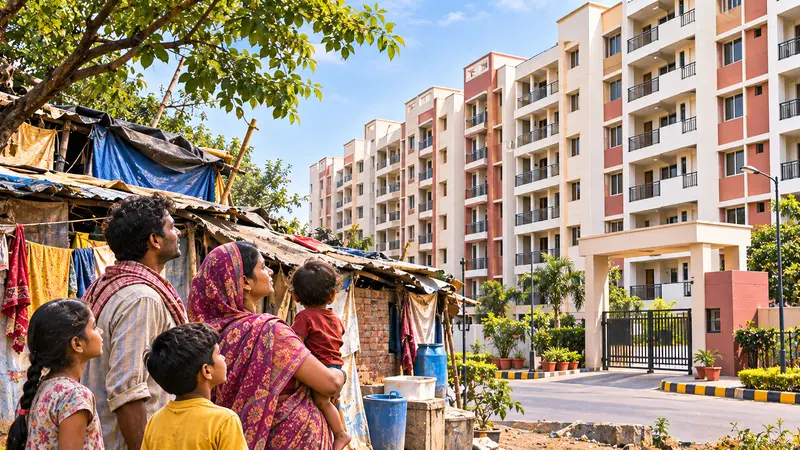
The Delhi Government on 5 November 2026 notified the Delhi Slum and Jhuggi Jhopri Relocation and Rehabilitation Policy, 2026, which it says will give permanent homes to eligible families in slum settlements across the capital. The initiative is expected to benefit around 4 to 5 lakh families, or about 20 lakh people. Chief Minister Rekha Gupta said the aim is to give families not only housing but also dignity, security and a better quality of life.
The headline promise is location. Eligible families are to be rehoused, with in-situ rehabilitation given priority, at the existing settlement or within a radius of three kilometres. For people who work as domestic helpers, drivers and vendors nearby, that matters as much as the flat itself, because resettlement far from work has been the main complaint about past relocation.
What the policy offers
According to the government's account of the notified policy:
- eligible families get 1-BHK housing units;
- colonies are to have schools, anganwadi centres, healthcare services and playgrounds;
- persons with disabilities get special consideration;
- maintenance and security are provided for five years;
- allotment is through a transparent computerised draw;
- a grievance redressal mechanism will be set up.
The policy is also said to give a chance to many families left out of earlier schemes. That is probably its most consequential feature, and it turns on one detail: the cut-off date.
At a review meeting on 16 June 2026, Union Home Minister Amit Shah said the policy had been finalised and that the Delhi government should notify it at the earliest. He said the eligibility cut-off date for JJ clusters should be fixed as 1 January 2025, and that the decisions would benefit 4 lakh families. The previous policy, approved by the Delhi Cabinet in 2016, moved the cut-off from 4 June 2009 to 1 January 2015. A shift to 2025 would bring in a decade of later arrivals.
The full notified text was not available on an official website at the time of writing, so readers should confirm the final cut-off, the documents needed to prove residence and any payment required from families. Earlier schemes required a beneficiary contribution, and the government's summary of the new policy does not say what families must pay.
Why this has been so hard
Delhi has tried this before. A government statement in 2022 recorded 675 listed and 82 unlisted JJ bastis on the land of various agencies, and said the 2015 policy, later renamed the Mukhya Mantri Awas Yojana, was then in force. The Delhi Development Authority runs a separate in-situ programme, and its Kalkaji project delivered 3,024 flats in November 2022. Set against 4 to 5 lakh families, that gives a sense of the scale: even a large project of that kind would need to be repeated more than a hundred times.

Land ownership is another obstacle. Clusters sit on land held by the Railways, the DDA, the Delhi government and others, and any on-site rebuilding needs that agency's cooperation. The Home Minister's June instructions suggest how the government wants to move faster. He directed the DDA and the Delhi Urban Shelter Improvement Board to issue tenders for five clusters within 45 days, to prepare documents for another 50 clusters, and said Delhi should issue tenders for at least five public-private partnership projects a month.
That reliance on private developers is where critics will press. In a partnership model, a builder is generally paid through the right to use part of the land commercially, so the plan depends on land values and developer interest. Housing advocates have long warned that families can be moved into transit camps for years while a project stalls, and that many residents fail eligibility tests because they cannot produce old documents. Supporters reply that no public budget could build on this scale alone.
What residents should do
Families who may be covered can take a few practical steps now. Keep every proof of residence, such as ration cards, electoral rolls, electricity bills and any earlier survey slip, and keep copies. Watch for survey notices from the Delhi Urban Shelter Improvement Board or the agency that owns the land. Do not pay anyone who offers to secure a place in the list, since allotment is meant to run through a computerised draw. Use the grievance mechanism in writing if a name is left out.
Three things will show whether this differs from earlier promises. The first is the published text, especially the cut-off and the family contribution. The second is the first tenders, since the Home Minister's timetable of five clusters in 45 days was set in June and progress can be checked. The third is what happens to residents during construction, including where they live and for how long.
For the capital, the stakes are high. About 20 lakh people is a large part of the city's workforce. A policy that keeps them near their work could change daily life for a generation, but only if the flats get built.
Sources
- Delhi notifies slum rehabilitation policy to provide permanent homes (All India Radio)2026-11-05
- Union Home Minister chairs a review meeting on the rehabilitation of slums in New Delhi (PIB)2026-06-16
- As per DDA's Rehabilitation Policy, viable JJ clusters are taken up for in-situ slum rehabilitation (PIB)2022-02-10
About the Author
R
Reyaansh Agarawal
Staff Writer
Reyaansh Agarawal contributes to Wirony, covering stories that are carefully reviewed and approved by the editorial team before publication. Wirony is committed to maintaining tran…
R
4 min
What did you think?