/
US Supreme Court to decide whether Trump can suspend asylum claims at the southern border
The US Supreme Court agreed on 13 November to hear the administration's appeal over Trump's proclamation declaring an invasion at the southern border and suspending asylum claims. The D.C. Circuit held he cannot deny asylum categorically. Argument is expected in spring, with a decision by June 2027.
A
4 min
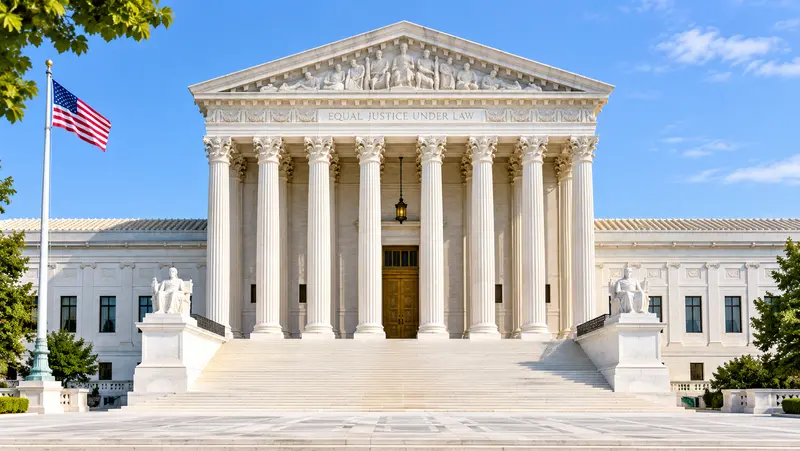
The United States Supreme Court agreed on Friday, 13 November 2026, to decide whether President Donald Trump can suspend asylum claims at the southern border, taking up a central part of his immigration crackdown. The justices will hear the case, Mullin v. Refugee and Immigrant Center for Education and Legal Services, in the spring, and a decision is expected before the end of the term in June 2027. The administration is asking the court to overturn lower-court rulings that found its order illegal. The order stays in effect while the case goes on. This explainer sets out the process and the arguments and is for information only.
What the order does
Trump issued the proclamation on his first day in office in 2025. It declares that the situation at the southern border is an invasion and uses that declaration to deny asylum claims from people who present themselves at the border. The administration argues that the president has wide authority over asylum, including the power to suspend the system altogether, and that asylum is a purely discretionary benefit. Its petition says the proclamation lawfully suspends access to it.
Federal law lets people seek asylum if they fear persecution in their home countries, whatever way they arrived in the United States, and the executive branch decides whether to grant it. Opponents say those decisions must be made case by case and that the law does not allow the president to stop people from applying at all.
A federal judge in Washington ruled for immigrant rights groups that had challenged the order. The administration appealed to the D.C. Circuit, where a three-judge panel ruled against it. The appeals court held that federal law gives the president discretion over asylum decisions, but that he cannot deny them categorically. The Supreme Court did not give a reason for taking the case, as is its practice when it grants review.
| Stage | Result |
|---|---|
| Proclamation | Issued on the first day of Trump's second term in 2025; declares an invasion and bars asylum claims at the border |
| Federal district court in Washington | Rules for the immigrant rights groups |
| D.C. Circuit | Rules against the administration: discretion, but no categorical denial |
| Supreme Court | Grants review on 13 November 2026 |
| Argument and decision | Spring 2027; decision expected by the end of June |
The two sides and the questions
The justices will consider whether the order is lawful and whether a judge can grant relief to all asylum seekers and not only the plaintiffs, a question about the reach of court orders. Solicitor General D. John Sauer wrote that border encounters have fallen 93% since the proclamation took effect, to their lowest level since the 1960s, and called the restrictions critical to that. Federal lawyers say years-long processing times had contributed to a major influx, because many migrants were released into the country while awaiting decisions.

The American Civil Liberties Union and several immigrant rights groups say border crossings were already falling before Trump took office. They call the order an unlawful attempt to unilaterally remove legal protections for people fleeing danger. Keren Zwick, the executive director of the National Immigrant Justice Center, said the plaintiffs fled persecution and torture, including political imprisonment and threats from the Taliban, and that the administration refused to consider them for asylum.
Why it matters
This is the third major immigration case the court will hear this term. The others concern whether people can be quickly deported to countries other than their own, and whether immigrants can be held indefinitely during deportation proceedings. Earlier, the court ruled for the administration in another asylum case, which could allow it to revive a policy of metering, in which officials turn migrants back at the border. A ruling for the refugees in this case could limit that approach, and a ruling for the administration could give a president wide powers to close the asylum system.
For people at the border, nothing changes until the court decides, and the proclamation continues to apply. The case will be argued on the court's calendar in the spring, and the court's website posts the briefs and the argument schedule. Legal analysts will watch two things: how the justices treat the word invasion, which the administration says is a decision for the president, and whether they limit the way lower courts grant relief to people who are not parties to a case.
The case is named Mullin v. RAICES because it is brought against the officials who run the policy, and Markwayne Mullin is the Secretary of Homeland Security. The groups challenging the order are the Refugee and Immigrant Center for Education and Legal Services and other organisations, who sued on behalf of people seeking asylum. The Supreme Court's term runs from the first Monday in October to the end of June or early July, and cases it agrees to hear in November are typically argued in the early months of the next year, which is consistent with the spring argument described in the reports.
Sources
About the Author
A
Amita Sahani
Staff Writer
Amita Sahani writes for Wirony. Every story under this byline is reviewed and approved by an editor before it is published, and corrections are made openly.
A
4 min
What did you think?