/
US skips its UN human rights review again; Council moves the session to January 2027
Washington skipped its Universal Periodic Review at the UN Human Rights Council in Geneva on 10 November, for the second year running. The Council president noted its absence and the review was moved to January 2027. The State Department called the Council irredeemable.
S
4 min
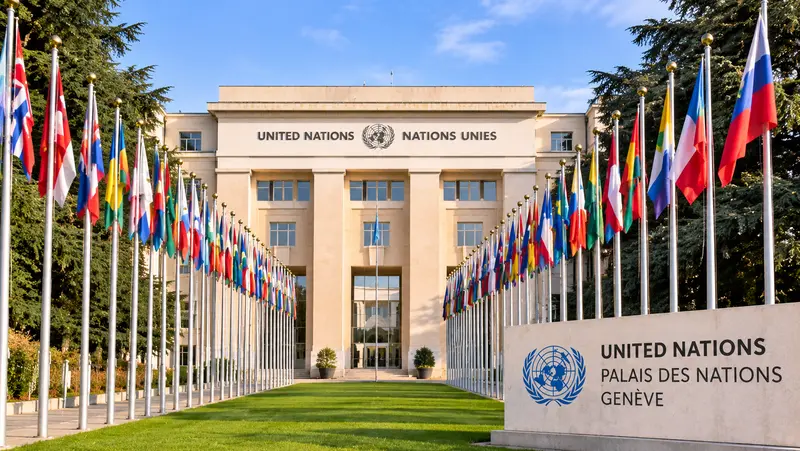
The United States did not attend its Universal Periodic Review at the United Nations Human Rights Council in Geneva on Tuesday, 10 November 2026. At the start of the session the Council's president, Sidharto Reza Suryodipuro of Indonesia, announced that the delegation of the United States was not present in the room. After the American refusal to take part, the Council moved its examination of the United States to January 2027. It is the second year in a row that Washington has skipped its turn. A State Department spokesperson said that taking part would imply endorsement of the Council's work, which the department gives no credibility. This report is for information only.
What the review is
The Universal Periodic Review is a UN process in which every one of the 193 member states has its human rights record examined by the Human Rights Council, which has 47 member states. Each country is reviewed every four to five years. It presents a national report, other states put questions and make recommendations, and the country replies. Fourteen countries were due to take part in the session this month.
For the United States, nearly 200 documents were submitted by American and international rights groups on topics including migration and racial discrimination. Countries had planned to raise issues such as access to abortion and the death penalty. During President Donald Trump's first term, the United States submitted its report and took part.
What Washington said and who objected
The State Department spokesperson said the United States had already withdrawn from the Council and called it an irredeemable body that makes a mockery of human rights. The statement did not address the allegations about the American record. Washington withdrew from the Council in February 2025, soon after Trump began his second term, saying the body was biased against Israel. The administration has since also withdrawn from other UN agencies and cut its UN funding.
| Year | What happened |
|---|---|
| February 2025 | United States withdraws from the Human Rights Council |
| 2025 | United States skips its scheduled review |
| 10 November 2026 | Delegation absent again; review moved to January 2027 |
Jamil Dakwar of the American Civil Liberties Union said that enough was enough and argued that attacks on fundamental rights and civil liberties were unprecedented in generations. Eric Tistounet, the Council's first secretary, warned that a walkout could damage the credibility of the review system.

Is it a first, and what happens next
Descriptions of the event differ. Some news reports said the United States was set to become the first country to fully shun a regular review since the process began two decades ago. Others noted that the United States also missed its turn last year, and that Israel skipped its own review in 2025, so whether it is a first depends on how a refusal is defined. The Council has again decided to give the United States another chance to take part, in January 2027.
Because the process rests on cooperation, the Council has no power to compel a state to appear. Its tools are to reschedule, to record the absence and to continue with the cycle for other states. The review of the United States may be held with or without its delegation, and its outcome would carry the same standing as other reviews, which are recommendations and not binding orders. The Council has not directly criticised Washington's record, and experts have raised concerns about issues such as migrant deportations, which the United States says follow its immigration law.
In a normal review, the state under examination presents its report to a working group, and other states ask questions and make recommendations in a session of about three and a half hours. A group of three states, called the troika, helps manage the process. A report of the outcome is then drawn up and adopted at a later plenary, where the country says which recommendations it accepts and which it only notes. The recommendations are not legally binding, and the system works through public attention and peer pressure. The cycle began in 2008, and the United States has taken part in earlier rounds in 2010, 2015 and 2020, each time submitting a national report and sending a delegation.
That history is why the absence matters to the Council. If a state of the size and influence of the United States declines to take part, other states may be less willing to submit to scrutiny, and the Council has to decide how to handle a refusal. Rescheduling for January keeps the door open without penalising the absence. The Council has no enforcement powers, and what it can do is keep recording the review as pending.
What to watch next is whether the United States takes part when the review is rescheduled for January 2027, and how many other states take the floor if it does. The Council's president and its secretariat have signalled that they would like Washington to return to the process, and the response of Washington's allies will show how far the refusal is seen as a problem for the system as a whole.
Sources
About the Author
S
Subhash Gupta
Desk Editor
Subhash Gupta is a writer at Wirony, contributing articles that are reviewed and verified by the editorial team before publication. The publication prioritises accuracy, editorial…
S
4 min
What did you think?