/
Iran says three oil tankers hit mines in Strait of Hormuz, all caught fire
Iran's navy and the IRGC said on 14 November that three oil tankers caught fire after hitting mines in the Strait of Hormuz, saying the ships crossed without authorization. Names, flags and damage were not given.
P
3 min
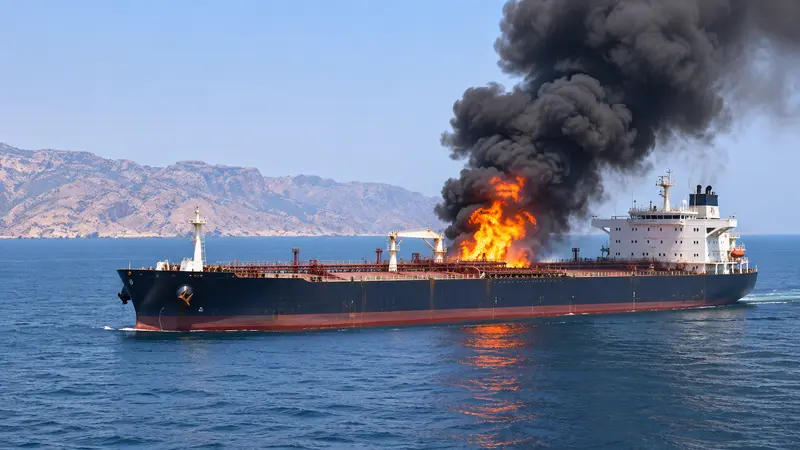
Iran's navy and the Islamic Revolutionary Guard Corps (IRGC) said on Saturday 14 November that three oil tankers caught fire after striking naval mines in the Strait of Hormuz. The first military statements did not give the names or flags of the ships.
The IRGC described three separate incidents, with fires reported aboard each vessel. At least one of the ships was a supertanker, according to reports of the statements. Iran's navy has not set out how badly the vessels were damaged.
Another naval statement, covering two tankers, placed them in the eastern part of the strait. It said both caught fire after striking a mine, and it too left out the identities of the ships and the extent of the damage.
Five vessels in 24 hours, IRGC says
The tally changes depending on the statement. A separate IRGC Navy claim for 14 November said two tankers exploded after hitting mines, bringing the total over 24 hours to five vessels. Other statements spoke of three tankers. The material available does not explain how the two sets of figures fit together.
The IRGC's explanation for the incidents centres on how the ships were travelling. It said the vessels had switched off their radar and positioning systems and were trying to cross the strait by an unauthorized route, without the permission Tehran requires. One account of the statements said this applied to two of the tankers.
That permission requirement is recent. Iran has demanded authorization for every vessel passing through the strait since its conflict with the United States began in February. Ships that transit without it, on the IRGC's account, are doing so outside the route and rules Iran has set.
The strait is the narrow passage through which oil from the Gulf reaches the open sea, which is why a mine strike on a laden tanker carries consequences beyond the ship itself. Crew safety, insurance and routing decisions all depend on whether a passage is judged safe.
The United Nations says 25 seafarers have been killed around the Strait of Hormuz since the war began in February. It also says traffic through the strait is about 65 percent below pre-war levels. Those figures describe the whole period of the conflict and are not a count of casualties from Saturday's incidents.
No casualty figure for the three tankers has been given in the statements. Nor has any owner, operator or flag state confirmed the Iranian account of what happened to the ships.

The Iranian claims also arrive alongside other movements in the region's oil trade. Iraq has resumed crude exports through Syria, a route that does not depend on the strait. The development was reported in the same coverage as the tanker incidents, and the material does not say whether the two are linked.
What the authorities have said
The cause, as officially stated so far, is the one the IRGC and Iran's navy have given: mines struck by ships that were off the authorized route with their tracking equipment switched off. The statements do not say who laid the mines, when they were laid or where they were placed. They do not say whether the Iranian military has cleared any of them.
There is also no word yet on any rescue or salvage operation, on whether fires have been put out, or on any inquiry into the incidents. No compensation or new safety measures for shipping have been announced in the material.
Iran has not said when it will release the names and flags of the tankers. Those details would let owners, insurers and the ships' flag states respond to the claims directly.
For now the picture rests on Iranian military statements issued on 14 November, which describe fires on at least three tankers, differ on the overall count, and say the ships were crossing without Tehran's authorization in a strait where shipping is already well below its pre-war volume.
About the Author
P
Prateek Rawat
Staff Writer
Prateek Rawat is a contributor to Wirony. All articles published under this byline undergo editorial review and approval before publication, with any necessary corrections handled…
P
3 min
What did you think?