/
US midterms on 3 November: Democrats favoured to win the House, Senate a closer call; Trump approval at 37.3%
With US midterms on 3 November, forecasters give Democrats about an 82 to 91 per cent chance of winning the House and 62 to 75 per cent for the Senate. Democrats lead the generic ballot by nearly nine points, and Donald Trump's approval averages 37.3%.
R
3 min
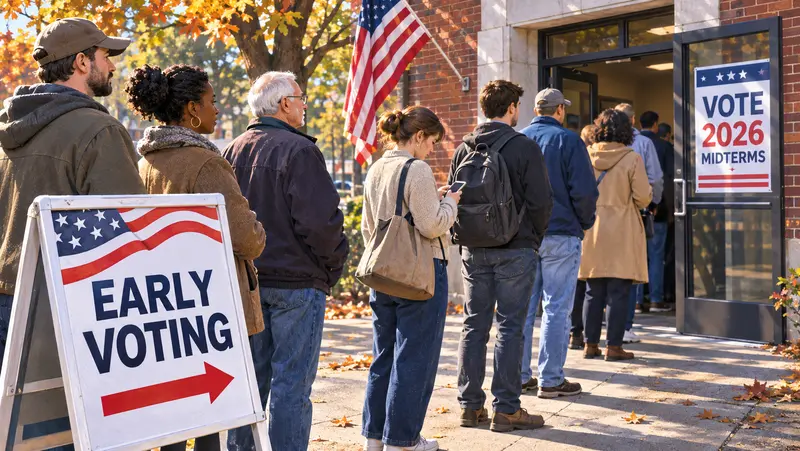
The United States votes in midterm elections on Tuesday, 3 November, and forecasters put the Democrats well ahead for control of the House of Representatives, with the Senate a closer call. Decision Desk HQ's forecast, as of 30 October, gives the Democrats an 82% chance of winning the House, with a projected 239 seats, and a 62% chance of winning the Senate, with a projected 52 seats. Other models and betting markets are more bullish on the House, and the Senate figures range from about 57% to 75%.
The forecasts
| Source | House | Senate |
|---|---|---|
| Decision Desk HQ | 82% | 62% |
| Silver Bulletin | 88% | 75% |
| Midterm Forecast | 91% | 70% |
| Prediction markets (Polymarket and Kalshi) | 92.1% | 68.5% |
The figures are the Democrats' chance of controlling each chamber. An earlier Decision Desk figure put the Senate at 57%, which may be out of date. The Hill notes that leads in most states are narrow and within the margin of error.
The generic ballot
Democrats lead the generic ballot by nearly nine points on average, a margin that has held over the last month, according to the Nate Silver average. At the same point in 2018, Democrats led by 7.5 points and went on to gain 41 House seats. In 2022 Republicans led by 2.9 points and gained nine seats. Democrats need a net gain of only three seats to win the House. Republican mid-decade redistricting in states across the South could limit Democratic gains.
The Senate
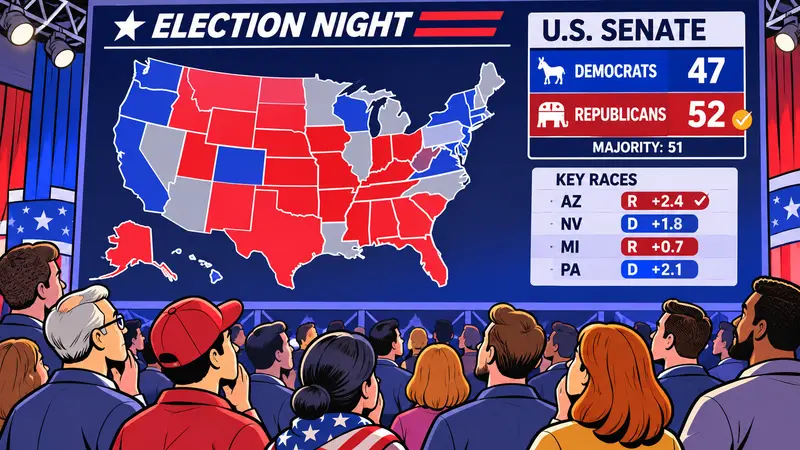
Democrats hold 47 seats and need 51 for control, because a 50-50 split would give Vice President JD Vance the tiebreaking vote. One analysis says flipping four Republican seats is very possible. Latest polling cited for the competitive races:
| State | Candidates | Polling |
|---|---|---|
| Maine (R) | Collins vs Jackson (D) | Jackson ahead by 2 to 7 |
| Michigan (D) | Rogers (R) vs El-Sayed (D) | El-Sayed led 11 of 12 October polls |
| Ohio (R) | Husted vs Brown (D) | Brown ahead by 2 to 6 in most polls |
| Georgia (D) | Ossoff vs Collins (R) | Ossoff ahead by 9 on average |
| North Carolina (R) | Whatley vs Cooper (D) | Cooper ahead by 11 on average |
| New Hampshire (D) | Sununu (R) vs Pappas (D) | Pappas ahead by 7 on average |
| Alaska (R) | Sullivan vs Peltola (D) | Peltola ahead by 2 to 7 |
| Iowa (R) | Hinson vs Turek (D) | Small leads trading |
| Texas (R) | Paxton vs Talarico (D) | Talarico ahead by 2 to 6 in most polls, one poll has Paxton +1 |
| Nebraska (R) | Ricketts vs Osborn (I) | Few polls; Ricketts +1 in one |
| Kansas (R) | Marshall vs Hamilton (D) | Hamilton ahead by 1 to 5 in most polls |
| South Carolina (R) | Graham vs Andrews (D) | Graham ahead by 1 to 3 in most polls |
One analysis describes the Democrats as favoured to flip the Senate, adding that this holds unless the polls are wrong.
President Donald Trump's approval averages 37.3%, with 59.9% disapproving, a net of minus 22.6, according to the Silver Bulletin average. Recent polls show net ratings between minus 26 and minus 38. One analysis says his approval is the second lowest heading into midterms since 1946, behind only Harry Truman, and it calls the Democrats the advantage on the generic ballot, the Senate and the president's approval. On inflation and the cost of living, 25% approve and 70% disapprove.
Forecasts are probabilities, not results, and the polls in this cycle could be off in either direction. For comparison, at this point in 2018 the Democrats led the generic ballot by 7.5 points and gained 41 House seats, while in 2022 the Republicans led by 2.9 points and gained nine. The Senate map includes seats in Texas, Ohio and Alaska that Republicans normally hold, and polls in several states are within the margin of error. Redistricting in the South could blunt Democratic gains in the House.
The reports found do not give poll-closing times by state or the time that results are expected, and they do not say which races will be called first. The close Senate contests in Maine, North Carolina, Georgia, Michigan and Texas are likely to decide control of the chamber.
R
3 min
What did you think?