/
Carney: Canada aims to be EU's first 'associate member' by June 2027; Germany balks, Trump calls it laughable
Mark Carney said after a Montréal summit on 30 October that Canada and the EU aim to conclude talks on Canada's 'associate membership' by June 2027. It has no basis in the EU treaties, Germany objected to the term, and the joint statement says 'ever closer association'.
P
3 min
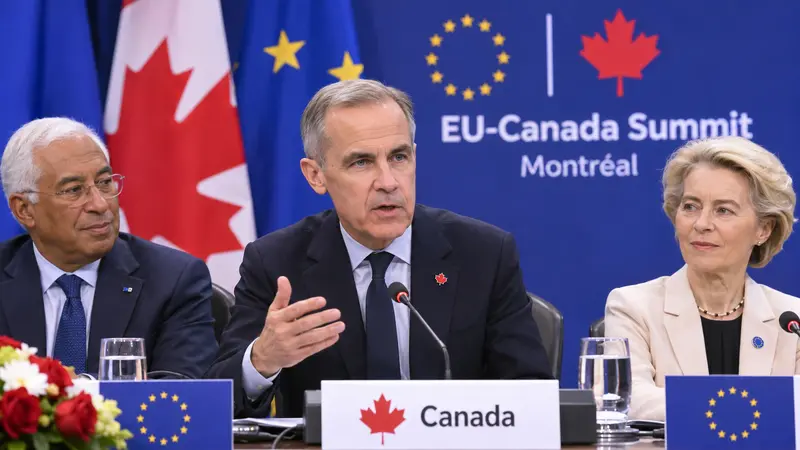
Canadian Prime Minister Mark Carney said on 30 October, at the close of a two-day European Union–Canada summit in Montréal, that Canada and the European Union aim to conclude negotiations on Canada's proposed associate membership of the bloc by June 2027. He called it the deepest possible partnership short of accession. The status has no basis in the EU treaties, Germany objected to the term, and the joint statement avoids it in favour of an ever closer association.
What Carney said
Carney said the full scope of the new form of membership would be determined in the coming months. He plans to attend a June meeting of European leaders to conclude the negotiations, and the Commission and the Canadian government will hold a spring meeting to develop the proposal. He said the partnership could give young Canadians opportunities to live, travel and study in Europe. He initially seemed reluctant, over concerns about Canadian sovereignty, but later defended the term, according to one report. He has pledged a vote in the Canadian Parliament.
The joint statement
The word associate does not appear in the final joint statement. It pledges instead to define, by the 2027 summit, an ever closer association of Canada with the EU, short of full membership. European Council President António Costa avoided the term and used the declaration's wording. The two sides also launched an Alliance for the Future focused on sovereignty and resilience in artificial intelligence, energy, critical minerals and quantum technology, and expanded cooperation on digital trade, energy, critical raw materials, supercomputing and satellite technology.
European Commission President Ursula von der Leyen proposed the idea in September, calling it an urgent reimagining of partnerships, without broad prior discussion with member states. She pointed to benefits such as Canada's full integration into the Horizon and Erasmus programmes and its participation in the €90 billion support loan for Ukraine. She acknowledged that the EU treaties reserve membership for European states.
Germany objected to the term associate member in the joint declaration. German ambassador Matthias Luttenberg said that some worry about the label and that the 27 member states need time to reflect. Commission spokesperson Paula Pinho said the EU regrets that it does not yet have full unity on the initial wording, but that it has a strong basis and is working out details. German Chancellor Friedrich Merz had first floated an associate member status for Ukraine, which Kyiv rejected. How the arrangement would be ratified in Europe is unclear.
The idea comes against a trade standoff with Washington. Talks between the United States and Canada collapsed in August, and Canada's retaliatory tariffs took effect last month. The White House has since lifted tariffs on some Canadian goods. President Donald Trump has repeated threats to make Canada the 51st state, and he called the associate-membership proposal laughable and threatened tariffs or a halt to trade with Europe. He has threatened to raise tariffs on Canadian cars, trucks and auto parts to 50% from 1 January 2027, and a Honda executive warned that this would be catastrophic for the industry.
Carney said that a deal with Washington would come when it suits Canadians and is not imminent, and he downplayed a deal before the US midterm elections on 3 November. Trump said that Canada is learning its lesson and that the dispute would be settled pretty soon, without details. A White House official said that Commerce Secretary Howard Lutnick and Trade Representative Jamieson Greer have held discussions with their Canadian counterparts. The United States accounted for 72.5% of Canadian merchandise exports in 2025.
The reports found do not say what rights or obligations an associate member would have, or how it would be financed. They also do not say which member states support the idea besides those that have voiced reservations. The first test is the spring meeting between the Commission and the Canadian government, and the second is the June leaders' meeting that Carney hopes to attend.
P
3 min
What did you think?