/
UN says drone strikes are crippling Sudan's power, fuel and hospitals; at least 306 killed in three weeks
The UN's top official in Sudan said on 3 November that drones appear to be targeting energy and fuel sites, cutting dialysis at a hospital near Khartoum and stranding aid trucks. The UN Human Rights Office documented at least 306 deaths in October's first three weeks from strikes by both sides.
S
4 min
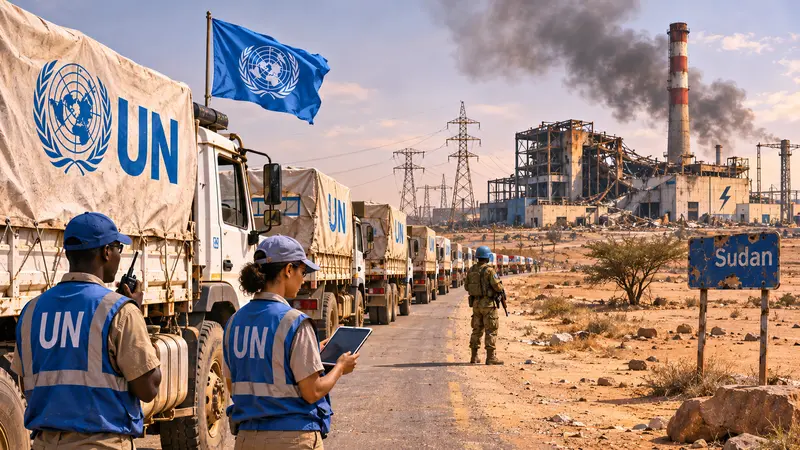
The United Nations has warned that a surge of drone strikes in Sudan is destroying the systems that keep people alive. Denise Brown, the UN Resident and Humanitarian Coordinator in Sudan, said on 3 November 2026 that there had been an intense pattern of strikes over the previous couple of weeks, and that they appear to be aimed at civilian infrastructure, which is protected under international humanitarian law. Energy and fuel sources appear to be systematically targeted, she said, with power stations and fuel stations hit repeatedly, along with markets and displacement sites.
Her warning followed a statement from the UN High Commissioner for Human Rights, Volker Türk, on 23 October. His office documented at least 306 deaths and hundreds of injuries from drone strikes in the first three weeks of October, attributed to both the Sudanese Armed Forces and the Rapid Support Forces.
What the UN has documented
The UN Human Rights Office listed strikes on homes, markets, hospitals, displacement sites, power stations and water sources in Kordofan, Darfur, Blue Nile, Khartoum and other states. Mr Türk said drones already account for most conflict-related civilian deaths in Sudan this year, and called the trend "deeply disturbing".
| Date (October) | Place | What the UN reported |
|---|---|---|
| 6–10 | Ghubeish and El Nuhud, West Kordofan | Alleged strikes on displaced people's shelters, attributed to government forces; at least 25 civilians killed |
| 9 | Abu Shendi, Blue Nile | Alleged RSF strike near a displacement site; at least 31 killed |
| 11 | Um Darfa hospital, Blue Nile | RSF-attributed strike; two health workers seriously injured, hospital out of service |
| 18 | Dibab, West Kordofan | Repeat strike on a transport truck; at least 139 killed |
| 19 | Amiet Market and Todach, Abyei | More than 80 killed; UN peacekeepers took 27 injured to their hospital |
The UN Security Council condemned the Abyei attack, said attacks on civilians could amount to war crimes and called for a prompt, transparent investigation. The accounts available do not name a perpetrator for the Dibab and Abyei strikes. Ms Brown said she does not know where the drones are being launched from.
How the strikes reach people who are not hit
The most important part of Ms Brown's account is what follows the strike itself. Attacks on power and fuel spread through everything that depends on them. Electricity went out at a hospital just outside Khartoum, which has no generator or solar panels, and 25 people who needed dialysis had their care stopped. Women are giving birth in hospitals without lights. Water supplies are disrupted because pumps need power.
Fuel shortages have produced queues kilometres long in Khartoum, where tuk-tuk drivers who earn by the day lose income while they wait. For the UN, the shortage directly limits relief. Hundreds of aid trucks are stranded. "If we don't have fuel, we can't move," Ms Brown said. World Food Programme convoys have been hit seven times this year and 20 times over two years.
Health care is under direct attack as well. WHO's Director-General said on 4 November that the agency has verified more than 230 attacks on health care since the war began, causing more than 2,000 deaths, and that drone attacks on power stations and fuel depots are worsening shortages.
Why it matters
The war, now in its fourth year, has already displaced millions. Severe acute malnutrition exceeds the emergency threshold in many areas, according to UNICEF studies cited by Ms Brown. Rainfall deficits have pushed people in parts of Darfur and Kordofan to move in search of food, and WFP is cutting rations and the number of people it serves because of funding shortfalls. Drones add a new layer: they can strike far from the front, at low cost, repeatedly, and without a visible attacker.
The legal position is clear even where the facts of a given strike are not. International humanitarian law protects civilians and objects essential to their survival. A power station serving a hospital, or a water source, cannot simply be treated as a fair target. Mr Türk renewed his call on both parties to respect those obligations, and said that peace efforts must also address "the continued influx of arms that is fuelling the conflict". Neither UN statement names the suppliers.
Ms Brown placed responsibility first on those sending the strikes and then on UN member states to act. She called for an end to the fighting and for urgent funding. "This is not about politics," she said. "This is about people."
Three signs will show whether the warnings have any effect. The first is whether the UN's monthly count of civilian deaths from drones falls or rises in November. The second is the investigation the Security Council has called for into the Abyei attack, which will test whether any strike leads to accountability. The third is fuel: whether aid convoys can move again, and whether hospitals around Khartoum get generators or solar power so that a single strike no longer ends treatment for dialysis patients.
Mr Türk has asked both parties and their affiliates to commit to a ceasefire. Neither has done so. Until that changes, the UN's message is that the number to follow is not only the dead from each strike but the larger number of people who lose power, water and care after it.
Sources
About the Author
S
Subhash Gupta
Desk Editor
Subhash Gupta is a writer at Wirony, contributing articles that are reviewed and verified by the editorial team before publication. The publication prioritises accuracy, editorial…
S
4 min
What did you think?