/
Spain's transport minister resigns after the Urda rail crash that killed 69; a restart order is probed
Spain's transport minister, Óscar Puente, resigned on 3 November, six days after a Renfe train hit an Iryo train near Urda, killing 69. The government says a protection-system failure halted trains and a control centre then let them restart; judges and the rail investigators are examining the order.
A
5 min
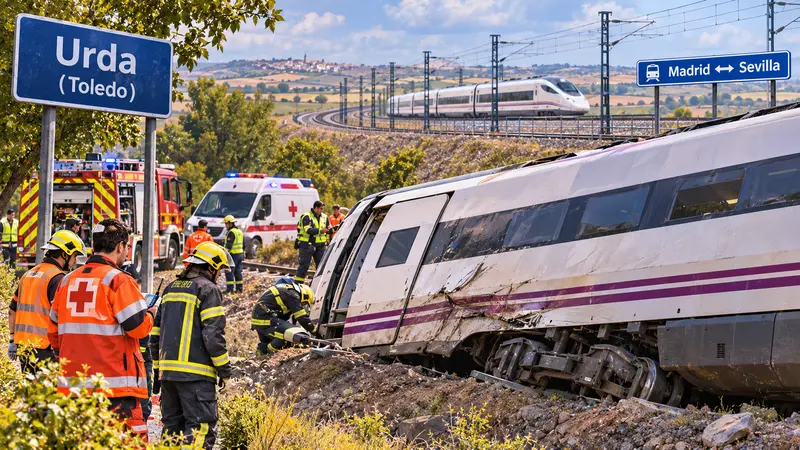
Spain's Transport Minister Óscar Puente resigned on Tuesday 3 November, six days after two high-speed trains collided near the village of Urda in Toledo province, killing 69 people. Prime Minister Pedro Sánchez said on 4 November that Carlos Cuerpo will take over the Transport Ministry on a temporary basis until the general election on 29 November. Mr Puente said that "a Minister of Transport in a country like Spain cannot continue in his post after two accidents in less than a year", and he withdrew from the Socialist Party's list for the election, where he had been expected to lead the party's slate in Valladolid.
The crash on 28 October is the second deadly collision on the Madrid–Seville high-speed line this year. In January, trains run by the same two operators, Renfe and Iryo, collided near Adamuz in Córdoba province, killing 46 people. Together the two accidents have killed 115 people in less than a year, and the Urda crash is Spain's deadliest high-speed rail accident since the Galicia derailment of 2013, in which 80 people died.
What happened on 28 October
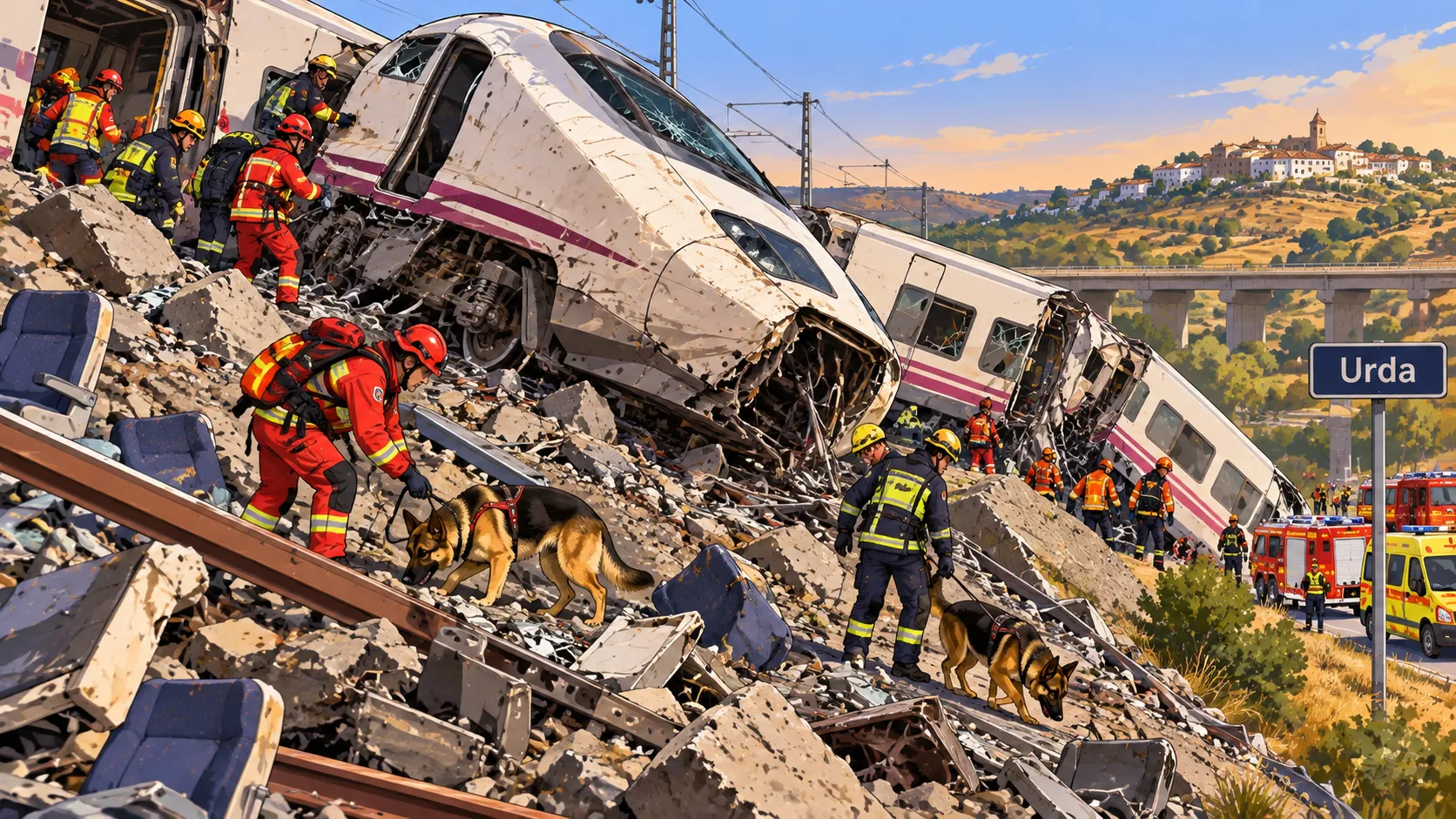
The collision happened at about 8:30 am local time near kilometre 118 of the line, between the towns of Mora and Orgaz, around 130 to 150 km south of Madrid. A Renfe train travelling from Madrid to Seville ran into the back of an Iryo train on the same route. Two coaches derailed and fell down an embankment. The Iryo train carried 146 passengers and the Renfe train 397, and 24 of the dead were found on the Renfe train.
The death toll was first given as 74 by the Interior Ministry. The presidency and the Transport Ministry later revised it to 69, which is the figure the government now uses, although some accounts continue to quote a higher number. The number of injured differs between accounts: at least 15 were seriously hurt and more than 50 were taken to hospital, and some totals run to about 200. The government declared three days of official mourning, until the end of Saturday 31 October, by a royal decree dated 28 October.
What investigators are examining
The government's account, given by Mr Puente in the first days, is that a failure in the automatic train protection system, which he described as a computer failure, halted six moving trains over a 63-kilometre section of the line, including the two that later collided. Mr Puente said that the infrastructure manager's control centre then authorised trains to resume running without speed restrictions, and he called the order to let one train proceed "inexplicable". The Civil Guard has questioned the operator of the Adif control centre at Atocha who was handling the traffic.
There are two investigations. A technical one, by Spain's rail accident investigation commission, will establish the causes. A judicial one is led by a judge at the court in Orgaz, and the Ministry of Justice has sent four more judges to help. Officials say the causes of the Urda collision and the Adamuz collision appear unrelated. In April the Civil Guard said that a rail on the Adamuz stretch had broken the day before the January crash.
A protection system exists to stop trains when something is wrong, and when it fails the line normally moves to a fallback in which people, not the system, guarantee that trains are kept apart. That is why the decision to let trains move again matters so much, and why the government's first new rule is a mandatory second sign-off in such moments.
The explanation that a single controller made a single decision has drawn criticism. The opposition and the train drivers' unions say it places the blame on one person, when a safety system failed and procedures did not stop a restart. No findings on responsibility have been published, and the investigators have not said that any one person was at fault.
The resignation and the response
Mr Puente's resignation followed hours of appearances before parliament. Several parliamentary groups, among them Sumar, Podemos, Compromís, BNG, PNV and Junts, had demanded that he step aside. Ester Muñoz of the opposition Popular Party said his departure "arrives 116 deaths late". He defended his record, rejected claims that the Madrid–Seville corridor had been neglected and pointed to a modernisation programme worth 780 million euros.
The government has announced several measures. A decree of aid for the victims' families was set for approval by the Council of Ministers on 3 November, and a relief package of 30 million euros was announced. On safety, it plans software to alert controllers to anomalies, a mandatory sign-off by two operators when a safety system fails, and a faster rollout of the European Rail Traffic Management System, ERTMS, the common signalling standard that replaces national systems. Mr Sánchez said after visiting the site that confidence in high-speed rail had been shaken and that the government's task was not only to find the causes but to offer solutions.
The train drivers' union, Semaf, has called strikes for 10 and 12 November. It says that working conditions and maintenance have worsened since the rail market was opened to competition in 2021.
The political calendar adds pressure. Spain votes on 29 November, and the minister who ran the system has gone before the election. What to watch is the technical commission's first findings on the protection system and the restart order, whether the two-operator rule is made binding quickly, and whether the strikes go ahead. For the 69 families and the survivors, the answers will matter less as politics than as proof that the same failure cannot happen a third time.
Sources
- La Moncloa: the Prime Minister announces three days of official mourning for the Urda accident2026-10-28
- La Moncloa: Pedro Sánchez on the Urda accident and confidence in high-speed rail2026-10-30
- La Moncloa: Carlos Cuerpo to take over the Transport Ministry temporarily after Óscar Puente's resignation2026-11-04
About the Author
A
Amita Sahani
Staff Writer
Amita Sahani writes for Wirony. Every story under this byline is reviewed and approved by an editor before it is published, and corrections are made openly.
A
5 min
What did you think?