/
Cabinet gives Agniveers a two-year second tour and a path to regular service: what changes and what is open
The Union Cabinet on 4 November approved a two-year second tour for the 75% of Agniveers not retained after four years, with regular enrolment for those willing and selected. The first batch of over 18,300 was due out by 31 December. Pay and selection rules are still to come.
P
5 min
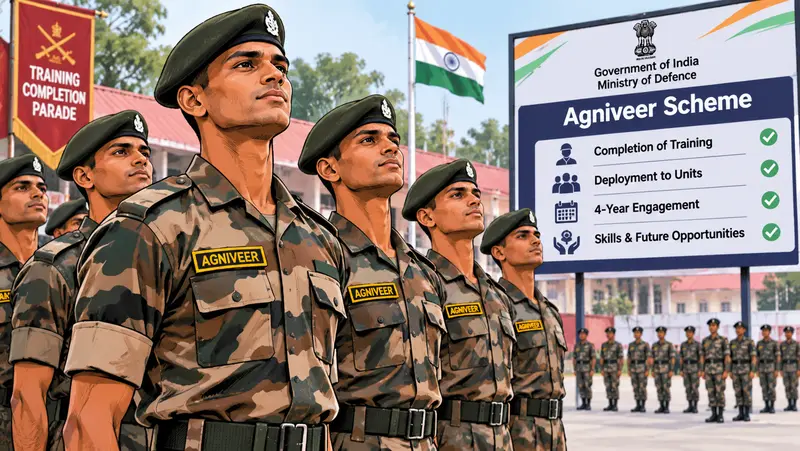
The Union Cabinet on Wednesday 4 November approved a change to the Agnipath recruitment scheme: Agniveers who are not selected for the regular cadre after their four-year engagement will be offered a further two years of service, a "second tour of duty". Chief of Defence Staff General N.S. Raja Subramani announced the decision, and Defence Minister Rajnath Singh welcomed it in a social media post, saying willing Agniveers could now be enrolled as regular soldiers after their four-year or six-year tenure if they meet the selection criteria.
The timing matters. The first batch of Agniveers, more than 18,300 young men and women, was due to be discharged by 31 December after completing four years. The Cabinet's decision turns that exit into a choice, and it is the first significant revision of the scheme since it was approved on 14 June 2022.
What was decided
The scheme as designed in 2022 gave recruits a four-year engagement, including about six months of training and three and a half years of deployment. On completion, up to 25% of each batch could be selected on merit for enrolment in the regular cadre. The remaining 75% were to leave with a one-time Seva Nidhi package, built from 30% of the monthly salary deposited in a corpus fund with an equal contribution from the government, which the 2022 announcement put at about Rs 11.71 lakh including interest, and which is tax-free. Agniveers also carry a non-contributory life insurance cover of Rs 48 lakh during service. Those who left at four years received no pension or gratuity.
The revision changes the position of the 75%. They can now opt for two more years, for up to six years in all. At the end of that second engagement, every Agniveer who is willing and meets the selection criteria is to be offered enrolment as a regular soldier. General Subramani said the decision created a pathway for Agniveers to be absorbed permanently in the armed forces, and cited the performance evaluations of the past four years, which he said had been very positive. The announcement also refers to higher remuneration, an enhanced Seva Nidhi and seniority benefits during the second tour. The amounts have not been given. The 25% merit-based selection after four years continues as before.
Why it matters
The first question for the families concerned is what the decision means for the young people finishing in December. The answer is that nobody has to leave at four years against their wish. A second tour gives them two more years of pay, a longer service record and a second chance at regular enrolment, and delays the search for a civilian job at a time when youth unemployment is already a concern.
For the forces, the change reduces the loss of trained people. Four years of training and deployment is a significant investment, and the original design discarded three out of four of those soldiers just as they became experienced. A six-year engagement also keeps more experienced hands in the field.
For the scheme itself, it is a quiet change of direction. The four-year, 25% model was criticised from its start in 2022 on the grounds that it left most recruits without a career at its end. The Cabinet has not scrapped the model, but the phrase "all willing Agniveers" in the new arrangement moves the system away from a fixed 25% cap. The government's earlier steps had been about life after service. Under the Sashastra Seema Bal recruitment rules notified by the Home Ministry in July 2026, 50% of Constable (General Duty) vacancies are reserved for ex-Agniveers every year, they are exempt from the written examination and the physical tests, and the upper age limit is relaxed by up to five years for the first batch and three years for later ones. Delhi has set a 20% quota in its fire and prison services, and Agniveers receive certified skills and the option of finishing school and degree courses. Those measures help the people who leave. The second tour tries to keep more of them in uniform.
What is still open
The Cabinet's decision sets the principle, and the briefing left the detailed provisions to follow. Several questions do not yet have answers.

The selection criteria for regular enrolment after the second tour have not been published, and neither has the number of vacancies. If every willing Agniveer is to be considered, the criteria will decide in practice how many are absorbed. The pay for the second tour, the Seva Nidhi arithmetic, and whether the corpus continues on the same 30% and matching basis are all awaiting notification. Accounts differ on whether the second tour applies only to the 75% not retained or to all Agniveers, and on whether it is voluntary. The accounts available describe it as an offer to the 75% and as a matter of individual willingness, which is how this article treats it, but the official notification will settle the point. Pension is also unsettled: regular pension and gratuity rules apply only to those who enter the regular cadre, so a six-year Agniveer who does not get enrolled will still leave without a pension.
Other questions are about scale. Batches after the first have been larger, so the effect on the forces' strength, the pyramid of ranks and the training load will grow in 2027 and 2028. A second tour also postpones, and does not remove, the question of what happens to those who are not enrolled at six years.
For serving Agniveers, the practical step is to wait for the formal notification from their service headquarters before deciding, since the terms of the second engagement, including whether the choice can be reversed, will be written there. Families should note that the decision is a policy announcement until the order is issued.
Sources
- Cabinet clears Agnipath scheme for recruitment of youth in the Armed Forces (Press Information Bureau, 2022)2022-06-14
- Defence Minister Rajnath Singh says Indian Army committed to welfare of Agniveers2024-07-04
- 50% of SSB Constable (General Duty) vacancies to be reserved for ex-Agniveers: MHA2026-07-29
About the Author
P
Prateek Rawat
Staff Writer
Prateek Rawat is a contributor to Wirony. All articles published under this byline undergo editorial review and approval before publication, with any necessary corrections handled…
P
5 min
What did you think?