/
UN's Western Sahara peacekeeping mission ends after 35 years as Russia and US veto each other's drafts
The UN peacekeeping mission in Western Sahara, MINURSO, ended after 35 years when its mandate expired on 31 October, after Russia vetoed a US draft and the US vetoed a Russian one. Guterres says it is in liquidation and warned of renewed hostilities. Morocco welcomed it; Polisario voiced concern.
A
5 min
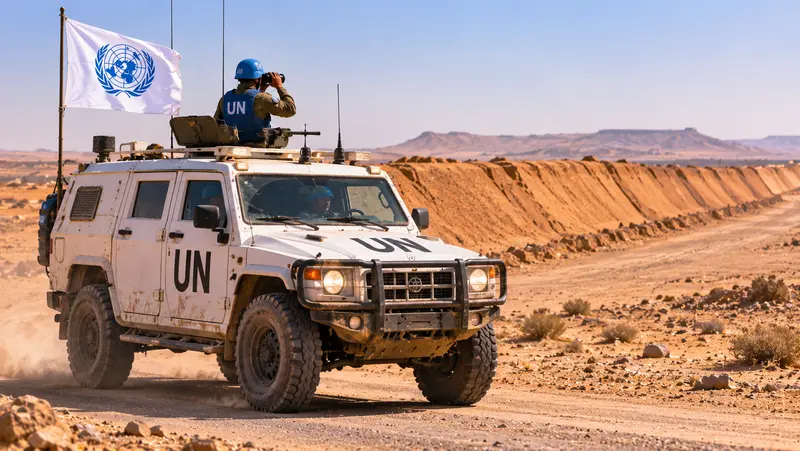
The United Nations peacekeeping mission in Western Sahara has ended after 35 years because the Security Council failed to renew its mandate, which expired at midnight on 31 October. Secretary-General António Guterres announced that the mission, known as MINURSO, entered a winding-down phase on 1 November, and equipment will be returned to the countries that contributed it. The mission was created to hold a referendum on the territory's future, and the referendum was never held.
The two vetoes
The United States had drafted a resolution that was backed by 11 of the Council's 15 members. It would have extended the mission for a year, dropped the word 'referendum' from the mission's name, moved it towards a political role and made Morocco's autonomy plan under Moroccan sovereignty the sole basis for further talks. Russia vetoed it on 30 October. Moscow then proposed renewing the mission on its existing terms, and the United States vetoed that text, with the countries that had backed the American draft abstaining.
Russia's ambassador, Vassily Nebenzia, called the American veto 'the political murder of the mission', and US Ambassador Michael Waltz said a referendum was never held because of disputes over voter eligibility. In October last year the Council had adopted a US-drafted resolution calling Morocco's autonomy proposal the 'most achievable' solution, with Russia abstaining.
Reactions
Morocco, which claims sovereignty over Western Sahara, welcomed the closure, and its Royal Cabinet called the non-renewal a significant development and said UN personnel and equipment should leave soon. The Polisario Front, which Algeria backs and which has sought independence since Spain withdrew in 1976, expressed concern, and its UN representative thanked Russia for the veto. The UN said the mission's departure does not abrogate the Sahrawi people's inalienable right to self-determination.
The conflict behind the mission
The dispute dates from 1975, when Spain was preparing to leave and King Hassan II of Morocco organised the Green March, in which around 350,000 unarmed Moroccan civilians crossed into the territory. Spain withdrew under the Madrid Accords, and Morocco and Mauritania took control. The Polisario Front fought a guerrilla war for independence until a UN-brokered ceasefire took effect in September 1991, when the Council created the mission to monitor the truce and organise a vote. The vote never took place because the parties could not agree on who was eligible to take part.
Morocco put forward its autonomy proposal in 2007, under which a Sahara Autonomous Region would exist under Moroccan sovereignty. In November 2020 Morocco moved into a section of the UN buffer zone to clear a Polisario blockade of a key route, and the Front resumed attacks, ending the ceasefire in practice. Hostilities have remained fairly limited, mainly because of the military imbalance in Rabat's favour. On 10 December 2020 President Donald Trump proclaimed US recognition of Moroccan sovereignty, and Algeria broke off diplomatic relations with Morocco in August 2021, partly over Morocco's moves in the territory. Diplomatic momentum has since shifted towards Morocco, and in October 2025 the Council backed the autonomy plan in Resolution 2797.
The Russian draft got three votes in favour, short of the nine needed, with 11 abstentions. Because the mission ended through deadlock and not through a vote to close it, the authority for a wind-down is uncertain, according to a Security Council monitor, and Morocco's palace has said UN personnel and equipment should leave in the coming days, though no official timetable has been confirmed. Before the mandate lapsed, the mission had closed three observation posts in September 2025, two of them east of the berm, and had given up its monitoring helicopter. Security Council reports record a rocket attack near Smara on 5 May and a drone strike on 7 June this year.
The Polisario's UN representative reportedly warned before the vote that it would leave the peace process if the US draft passed without substantial changes. France called the abrupt closure exceedingly alarming and Britain expressed immense disappointment, and Algeria's delegate thanked Russia and denounced the Council's failure. Colombia recognised Moroccan sovereignty in August and froze relations with the Sahrawi republic, and Honduras and Bolivia suspended their recognition of it earlier this year. US-sponsored talks involving Algeria, Mauritania, Morocco and the Polisario were held in Madrid and Washington in February without narrowing positions, and Guterres, whose term ends on 31 December, has said the end of the mission does not abrogate the right to self-determination.

About 200 civilian staff, military observers and staff officers from more than 35 countries served in the mission, with 41 countries contributing military or police personnel as of June, Egypt, Ghana and Pakistan being the largest contributors. Twenty died in its service. Observers patrolled a sand berm of about 2,700 km and were the only ground channel between the two sides, so ceasefire violations can no longer be independently verified.
Guterres warned of a risk of renewed hostilities between Morocco and the Polisario Front, and said the UN remains ready to support dialogue through his personal envoy, Staffan de Mistura. He said that a small team will remain to dispose of the assets, including mine-clearance capability.
The closure leaves the question of Western Sahara without a UN presence for the first time since 1991, and without the referendum that was the mission's purpose. With the United States and Russia backing opposite sides of the vote, it is also a sign of how the Council's divisions are reaching a conflict that had been among its most stable.
A
5 min
What did you think?