/
Trump says Russia-Ukraine deal could come soon and involve 'whole of Europe'; what the Oleshky truce shows
President Trump said on 5 November a Russia-Ukraine peace deal could come soon and might involve all of Europe, and confirmed meeting Putin's envoy Kirill Dmitriev. The remarks came as the First Lady hosted both sides over a local ceasefire at Oleshky. No terms, date or summit have been announced.
R
4 min
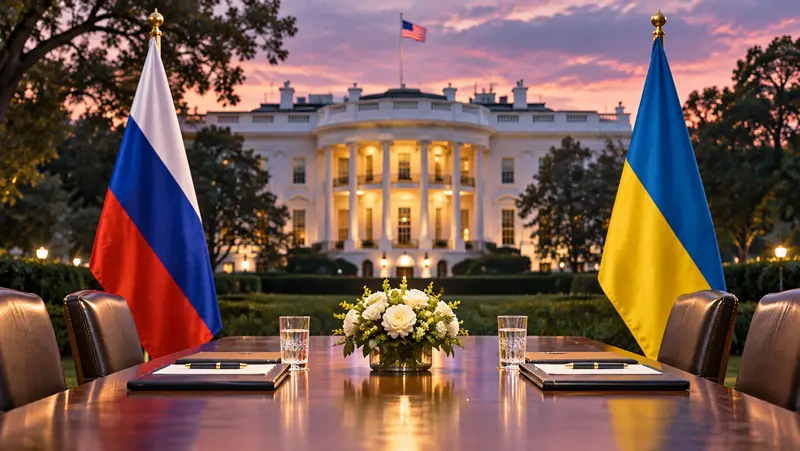
US President Donald Trump has expressed confidence that a peace agreement between Russia and Ukraine could be reached soon, describing it as a big agreement that could extend beyond the two countries and involve the whole of Europe. Speaking to reporters at the White House on 5 November 2026, he praised First Lady Melania Trump's humanitarian work and confirmed that he had met Kirill Dmitriev, envoy of Russian President Vladimir Putin, while declining to disclose what they discussed.
Mr Trump also said Russia and Ukraine were losing a combined 25,000 people every month, and that the war must end. That figure is his own, and it has not been independently verified.
The remarks were optimistic. The official record so far is thinner, and the difference is worth setting out.
What the White House has confirmed
The most concrete development is not a peace deal. It is a local arrangement. According to the Office of the First Lady, Mrs Trump gathered Russian and Ukrainian officials at the White House on 5 November. The event marked a ceasefire in Oleshky, a town on the Dnipro river in the Russian-held part of Ukraine's Kherson region.
The White House account makes these points:
- Russia and Ukraine signed the agreements, in both languages, on 23 October 2026.
- The ceasefire enabled humanitarian aid to reach the area and the evacuation of nearly 800 people.
- Mrs Trump says she served as "Exclusive Intermediary", and that her representative, Marc Beckman, engaged both sides after she learned of the crisis in September.
- Mr Dmitriev was invited to speak, and Russian human rights commissioner Yana Lantratova was among those Mrs Trump thanked.
- Ukrainian representatives gave Mrs Trump the Order of Princess Olga, First Class, on behalf of President Volodymyr Zelenskyy.
- She handed over letters addressed to President Putin and President Zelenskyy.
The White House says this is believed to be the first time a First Lady has personally brought representatives of two nations actively at war to the White House for diplomacy. In her remarks she called Oleshky "a spark" and said it should lead to something more enduring than a temporary ceasefire.
What a local truce can and cannot do
A humanitarian arrangement for one town is valuable, particularly for the 800 people who got out. It also has a diplomatic use. It shows that the two sides can sign a text, implement it and keep to its terms, at least in one place. Mrs Trump argued that it sets a meaningful precedent.
The limits are equally clear. Local truces have been agreed in many wars without leading to peace. The hard issues in this one are of a different order: control of occupied land, security guarantees for Ukraine, sanctions, the future of NATO's role and accountability for the war. Nothing in the White House statement or in the President's remarks speaks to any of these.
That is why the phrase "whole of Europe" is the most interesting part of what Mr Trump said, and the least explained. It could mean European security guarantees, a role for European troops, or a wider settlement of relations between Russia and the continent. He did not elaborate, and no European government has been quoted confirming such a plan in the material available.
The last detailed public framework was a year ago. After talks in Geneva on 23 November 2025, the United States and Ukraine issued a joint statement on a refined peace framework, saying final decisions would be made by the two presidents. There has been no announcement of a comparable document this time.
Why it matters
For Ukraine, any talk of a deal involves a difficult balance. It needs American support and wants the war to end, but it fears a settlement that rewards the invasion. The award to the First Lady suggests that Kyiv wants to stay close to this channel. For Russia, Mr Dmitriev's visible place at the White House is a political gain in itself, given its isolation from Western capitals since 2022.
There is reason for caution. Mr Trump has predicted early breakthroughs in this war several times, and those moments passed without a settlement. Critics will say that a ceremony around one town risks giving the impression of progress while fighting goes on elsewhere. However, supporters of the channel argue that humanitarian steps can build the trust that formal talks lack, and that 800 people evacuated are a fact and not a promise.
For India, a settlement would matter through energy prices, trade and food markets, and through the pressure over Russian oil purchases that has hung over relations with Washington.
Four signals would show that this is more than rhetoric. The first is a public statement from Kyiv or Moscow confirming that terms are under discussion. The second is a date or venue for talks at a senior level. The third is a European statement on what "the whole of Europe" means. The fourth, and the simplest, is whether the fighting slows anywhere beyond Oleshky.
Until then, what is on record is one signed local ceasefire, one confirmed meeting with no disclosed content, and a president's expectation that something larger is near.
Sources
- President Trump says peace agreement between Russia and Ukraine may involve whole of Europe (All India Radio)2026-11-06
- First Lady Melania Trump Unites Russia and Ukraine at The White House Following Historic Ceasefire (The White House)2026-11-05
- Joint Statement on United States-Ukraine Meeting (The White House)2025-11-23
About the Author
R
Reyaansh Agarawal
Staff Writer
Reyaansh Agarawal contributes to Wirony, covering stories that are carefully reviewed and approved by the editorial team before publication. Wirony is committed to maintaining tran…
R
4 min
What did you think?