/
Paraguay's Senate removes President Santiago Peña over Ueno Bank crisis; Vice-President Pedro Alliana sworn in
Paraguay's Senate found President Santiago Peña guilty of poor performance of duties on 6 November and removed him after a two-day impeachment over the Ueno Bank crisis. Deputies had backed the charges with 78 votes. Pedro Alliana was sworn in. Peña's lawyers say his resignation ended the case.
A
5 min
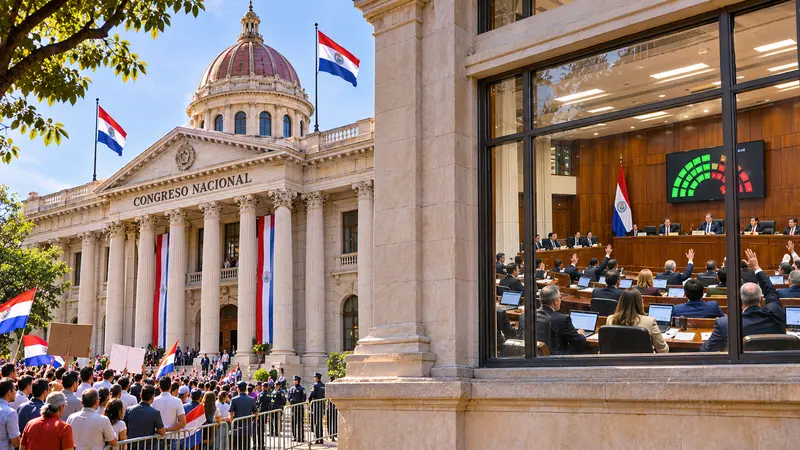
Paraguay's Senate on 6 November 2026 found President Santiago Peña guilty of poor performance of his duties and removed him from office, ending a two-day impeachment that grew out of the collapse of Ueno Bank. The Senate's own account says the vote, taken by roll call, was unanimous among the senators present. Vice-President Pedro Alliana was sworn in as the new President before Congress the same day.
Mr Peña, who took office in August 2023 for a five-year term, was among the youngest presidents in the country's history. His fall took a matter of days.
How it happened
The crisis began with Ueno Bank. In the first days of November, the leadership of Congress spoke of protecting savers and the financial system, after the bank was placed under intervention. Chamber of Deputies President Raúl Latorre set out three priorities: safeguarding Paraguayans' savings, protecting the financial system and holding any lawbreakers to account. On 4 November the Senate unanimously approved a law to return money to Ueno Bank's depositors.
The same day, 35 deputies filed formal charges against both Mr Peña and Vice-President Alliana. On Thursday 5 November the Chamber of Deputies approved the accusation against the President with 78 votes in favour, well above the two-thirds required by Article 225 of the Constitution. While the session was under way, the Chamber reports, Mr Peña presented his resignation. The ruling Colorado Party backed the case against Mr Peña, but not the one against Mr Alliana.
| Date | Event |
|---|---|
| 3 November | Congress leaders respond to the Ueno Bank crisis |
| 4 November | 35 deputies file charges; Senate passes depositors' law |
| 5 November | Deputies approve accusation, 78 in favour; Peña offers resignation; Senate takes up case |
| 6 November | Senate rejects 72-hour delay, convicts and removes Peña; Alliana sworn in |
The charges and the defence
The accusation, as published by the Chamber, made four main claims. It alleged a conflict of interest from Mr Peña's stake in Ueno Holding. It objected to his appointment of Carlos Carvallo, a former president of Financiera Ueno, to head the Central Bank of Paraguay. It accused him of pushing changes to the law on conflicts of interest. And it said he allowed hundreds of billions of guaraníes from the Institute of Social Security, the state pension and health body, to be concentrated in Ueno Bank, above the legal limits.
Mr Peña did not appear before the Senate. He asked for a further 72 hours to prepare his defence, and the chamber refused. His lawyers reserved all legal remedies, up to the Supreme Court of Justice and international human rights tribunals. Lawyer Adolfo Ferreiro argued that impeachment exists to protect officials from harassment and that the process was void. Ricardo Preda said that the accusation identified no specific rule that the President had broken, and that it blamed him for acts of the Central Bank and the Social Security Institute, over which he had no direct power. He also argued that once Mr Peña resigned, Congress lost the power to try him.
The accusers disagreed. Deputy Rocío Vallejo said it had been shown that the President ran the state in a way that endangered public assets and, in some cases, for his own benefit. Senators replied that the defence was arguing as if this were an ordinary criminal trial, when impeachment is a separate procedure about performance in office and loss of legitimacy. The Senate then declared him guilty.
Official figures on the vote differ in how they are expressed. The Senate says it was unanimous among those present, and India's state broadcaster reported a count of 44 to one. The Senate's own record is used here. That report also said that Mr Peña was placed under house arrest after the vote and that the Attorney General had opened three criminal cases. Those points were not in the Senate or Chamber statements consulted.
Why it matters
The speed is striking. In about 72 hours, a president with a governing party majority went from office to removal, with his own party voting against him. Supporters of the process say it shows that institutions can act when public money is at stake. Critics, including Mr Peña's lawyers, say it was a rush to judgment in which the accused was given very little time to respond. Paraguay has been here before: in 2012, President Fernando Lugo was removed in a similar express procedure, and neighbouring governments criticised it at the time.
There is a deeper concern for ordinary people. According to the state broadcaster's report, millions of depositors were left unable to reach their savings. Mr Latorre described the credibility of the financial system as one of the foundations of more than 20 years of macroeconomic stability. A banking failure tied to the top of the state is a heavy blow to that reputation. Whether depositors recover their money quickly matters more to them than who sits in the presidential palace.
The new President inherits a problem of his own. The charges filed on 4 November named Mr Alliana too, accusing him of working to shield the bank's crisis through legislation and of backing the placement of pension funds there, and of silence over warnings about lending limits. The Colorado Party did not back that case, and it did not go forward in the sessions reported. He has pledged to guarantee democratic stability and a process of transparency and pacification.
Three questions now loom. The first is the courts: whether Mr Peña's challenge on the validity of the trial reaches the Supreme Court or international bodies, and what happens with any criminal cases. The second is the bank: whether the new law gets depositors' money back quickly. The third is politics. Mr Alliana will govern with a party that has just removed its own leader. Paraguay's neighbours and its partners in Mercosur will be watching for any sign of instability, and the Central Bank's leadership is likely to come under scrutiny.
Sources
- Senado destituye a Santiago Peña tras declararlo culpable en juicio político (Senate of Paraguay)2026-11-06
- Diputados aprueba juicio político al presidente de la República, Santiago Peña (Chamber of Deputies of Paraguay)2026-11-05
- Pedro Alliana asumió como nuevo presidente de la República del Paraguay (Chamber of Deputies of Paraguay)2026-11-06
About the Author
A
Amita Sahani
Staff Writer
Amita Sahani writes for Wirony. Every story under this byline is reviewed and approved by an editor before it is published, and corrections are made openly.
A
5 min
What did you think?