/
Jason Turkish drawn into Michigan Senate feud after Stevens backs Mike Rogers
Jason Turkish, fiancé of Rep. Haley Stevens, is at the centre of a Michigan Democratic backlash after Stevens endorsed Republican Mike Rogers days before the Senate vote. Rogers accused Democrats of smearing Stevens and suggesting Turkish had unhealthy influence as Turkish publicly opposed Democr...
R
5 min
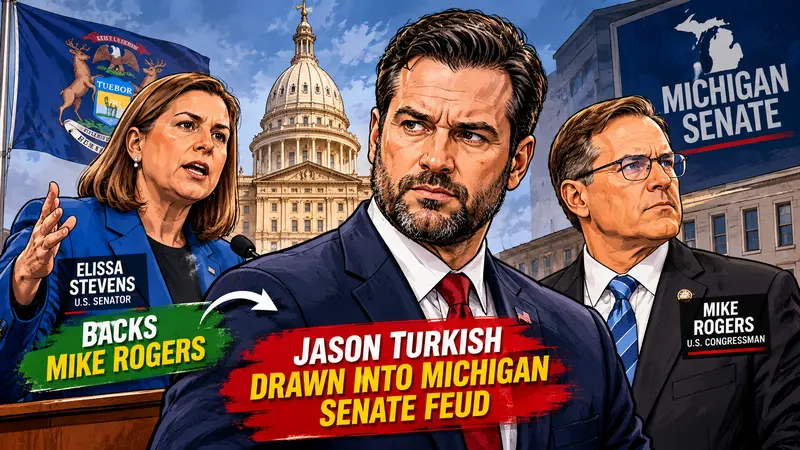
Jason Turkish, a Michigan attorney and disability rights advocate engaged to U.S. Representative Haley Stevens, was pulled deeper into the state’s bitter U.S. Senate campaign on 2 November 2026 as Democrats argued over whether he is shaping Stevens’ sudden break with the party.
The dispute followed Stevens’ endorsement of Republican candidate Mike Rogers on 1 November, a move that landed in the final days before Michigan’s 3 November election and detonated a long-simmering fight inside the party over its nominee, Abdul El-Sayed, and the war in Gaza.
Rogers on 2 November accused Democrats of attacking Stevens personally after her endorsement. He said two prominent Michigan Democrats, Debbie Dingell and Mallory McMorrow, had suggested Stevens was “mentally ill” for backing him. He also said McMorrow implied that Stevens’ fiancé, Turkish, was exerting unhealthy influence over her political decisions. The comments were Rogers’ characterisation of their remarks, rather than language independently confirmed to have been used.
As the argument spread, Turkish’s own political stance became part of the story. In the final stretch of the race, he has publicly criticised El-Sayed, saying the Democrat’s rhetoric regarding Israel had escalated in a way that made Jewish communities feel unsafe. Turkish also said he planned to cross party lines and vote for Rogers.
A private figure becomes a campaign issue
Turkish is best known in legal circles as the president and managing partner of Nyman Turkish PC, a national litigation firm with a heavy focus on disability rights. Legally blind since birth, he has built a public profile around access and equal treatment in education and civic life.
His education and legal credentials have been part of that narrative: he earned an undergraduate degree at the University of Michigan and graduated cum laude from Northwestern University Pritzker School of Law.
Some of his best-known work has targeted barriers faced by blind and disabled people. Turkish was involved in litigation that led to the removal of LSAT logic games for blind test-takers, and he has also been associated with efforts to expand absentee voting access in Michigan.
That record, however, is not what put him on the front pages this week. The attention has come from his proximity to Stevens, and from his willingness to speak publicly against the Democratic nominee in a race where party unity is usually treated as a necessity.
Reports on 2 November described prominent Democrats expressing concern about Turkish’s behaviour amid the endorsement controversy, including an account that a friend of Stevens claimed Turkish took her phone away after she shared a post endorsing Rogers. The claim has circulated as part of the broader argument about whether Stevens acted independently, but the material available publicly does not establish the full context for the allegation.
A former Michigan governor, Jim Blanchard, was also described as saying Stevens’ fiancé influenced her against El-Sayed and calling it “terrible political judgment.”
The fight over El-Sayed and Israel
The rupture did not begin with Stevens’ endorsement of a Republican. It was set up by months of tension among Michigan Democrats over Israel, antisemitism, and how candidates talk about the conflict.
Stevens had spent years cultivating relationships with Jewish leaders in Michigan and, during the Democratic primary for Senate earlier this year, became a preferred choice for many Jewish voters. After she lost the primary in August to El-Sayed, she had endorsed him, only to reverse course in the closing days of the general election.
That shift has produced anger and anxiety among Jewish Democrats as well as other party activists. Some worry the Jewish community is being positioned as a scapegoat if El-Sayed loses, after the endorsement fight turned into a public test of loyalty and identity politics.
Turkish, for his part, has been explicit about why he broke with the nominee. He has accused El-Sayed of escalating rhetoric about Israel in a way that made Jewish communities feel unsafe. His decision to campaign against the Democrat and to vote for Rogers has made him a central character in a drama that mixes personal relationships, party strategy and foreign policy.
Rogers’ intervention on 2 November added another layer, as he framed Democrats’ internal criticism as an attack on Stevens’ mental fitness and as a smear of Turkish’s influence. The accusation immediately broadened the argument beyond ideology and electoral tactics, into questions of personal autonomy and private conduct.
What comes next
With the Michigan Senate election scheduled for 3 November, the clash is unfolding with little time for repair. Stevens’ endorsement of Rogers came two days before voters go to the polls, and Turkish’s public opposition to El-Sayed has sharpened the sense of a party at war with itself.
For Democrats, the immediate question is whether the late-breaking feud changes turnout or persuades swing voters in a closely watched contest. For Stevens, the blowback risks complicating her standing inside her own party even as she remains a sitting member of Congress.
For Turkish, the episode marks an abrupt shift from being a high-profile advocate on disability rights to being discussed as a political actor and a personal influence on an elected official. In the span of a weekend, his name has become shorthand in Michigan politics for a larger argument: who speaks for the party, who gets blamed when it loses, and how quickly private relationships can become campaign ammunition.
R
5 min
What did you think?