/
Nintendo’s Ocarina of Time Switch 2 remake drops warp points to protect ‘important’ moments
Nintendo has revealed new details about the Switch 2 remake of The Legend of Zelda: Ocarina of Time, due on November 5. Producer Eiji Aonuma said the project was also meant to teach younger developers, and confirmed warp points were cut for hurting key moments.
R
4 min
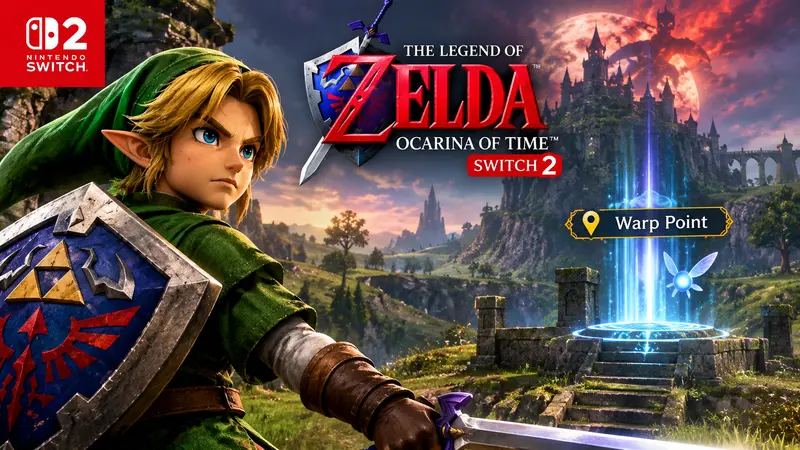
Nintendo has disclosed fresh details about its upcoming remake of The Legend of Zelda: Ocarina of Time (Nintendo Switch 2 Edition), framing the project as both a modern rebuild of a 1998 landmark and a training ground for the next generation of Zelda creators.
The new information surfaced in an “Ask the Developer” instalment released today, 2 November 2026, days ahead of the remake’s scheduled launch. Series producer Eiji Aonuma said one reason for revisiting Ocarina of Time was to give younger staff historical context for designing future Zelda games. Many developers on the team, he noted, did not work on the original and were children when it released.
Aonuma described taking a deliberate approach to decision-making on what should change. Rather than dictating every update himself, he said he chose to let younger developers decide what needed altering as they re-examined the game’s structure and pacing with modern expectations in mind.
A modern idea that didn’t fit
One proposed change did not survive. Aonuma said the team experimented with adding warp points similar to those found in The Legend of Zelda: Breath of the Wild, where fast-travel markers help players move around a large map.
He explained the initial motivation in practical terms. “In The Legend of Zelda: Breath of the Wild, there are many warp points that enable players to move quickly around the game’s vast world,” he said. By contrast, he joked that in the original Ocarina of Time, players often hurried across Hyrule Field by repeatedly rolling forward.
That, Aonuma said, felt like a problem worth fixing in a remake. “So I asked the team to add warp points that didn’t exist in the original game, giving players access to shortcuts,” he said.
But after implementation, the remake’s flow changed in ways the team did not like. Aonuma said the feature was removed because it disrupted “important” moments, suggesting that the original game’s travel time and geography were tied to its sense of progression and atmosphere.
The decision is a reminder of how remakes can become a series of trade-offs. Quality-of-life upgrades that feel standard in contemporary open-world design can also alter the rhythm of older games built around slower movement, deliberate routes, and specific story beats that land between destinations.
Launch week and anniversary push
The remake is positioned as a major release tied to the franchise’s anniversary marketing. Ocarina of Time is set to launch on November 5, with some retailers planning midnight events in select locations. One promotion mentioned for a London midnight launch at the Nintendo store at Argos Tottenham Court Road includes a free Nintendo 64 box replica for buyers, and there are also scheduled launch events in Toronto across certain flagship stores.
The remake itself is described as rebuilt “from the ground up” for Nintendo Switch 2, with improved performance and support for “ZELDA NOTES.” The Switch 2 edition arrives in a period when Nintendo is also selling anniversary-themed hardware.
A limited Zelda 40th anniversary Switch 2 Pro Controller was released on October 29 at $99.99, priced in line with other limited editions and $10 above the standard version. Demand has been high enough that restocks are already being anticipated this week, with reports pointing to possible replenishments as soon as November 6 at major retailers, while other stores are holding midnight launches on November 5.
The hardware rush and the remake’s marketing cadence underline how Nintendo is treating this release less like a simple reissue and more like a tentpole moment for the brand: a marquee classic, rebuilt to sit beside the series’ more recent “open-air” blockbusters.
That contrast is now central to Zelda’s identity. Breath of the Wild pushed the series into a broad sandbox built around survival systems, physics-driven problem solving, and wide latitude in how objectives are tackled. Tears of the Kingdom extended that approach with sky islands, underground areas, and object-building mechanics through Ultrahand.
At the same time, Nintendo has kept room for other styles. Echoes of Wisdom, a top-down adventure, puts Princess Zelda in the starring role and revolves around creating “echoes” to duplicate objects and solve environmental puzzles. The Switch 2 remake of Ocarina of Time now sits between those poles, aiming to preserve the original’s structure while deciding, feature by feature, where modern expectations should bend and where they should not.
What happens next is clear. The remake is due on November 5, with launch events and hardware restocks expected around the same window. For players, the immediate question is how the final balance feels in hand: a 1998 journey rebuilt for 2026, with at least one very 2017 convenience deliberately left behind.
R
4 min
What did you think?