/
19 Indian seafarers stranded in Yemen for two weeks evacuated, embassy says
The Embassy of India in Yemen said on 8 November that 19 Indian seafarers stranded about two weeks in Hodeidah and Sana'a have been evacuated and are heading home. It named no vessel, route or arrival date. The ministry counts 23 Indian deaths in the West Asia conflict, 15 of them seafarers.
A
5 min
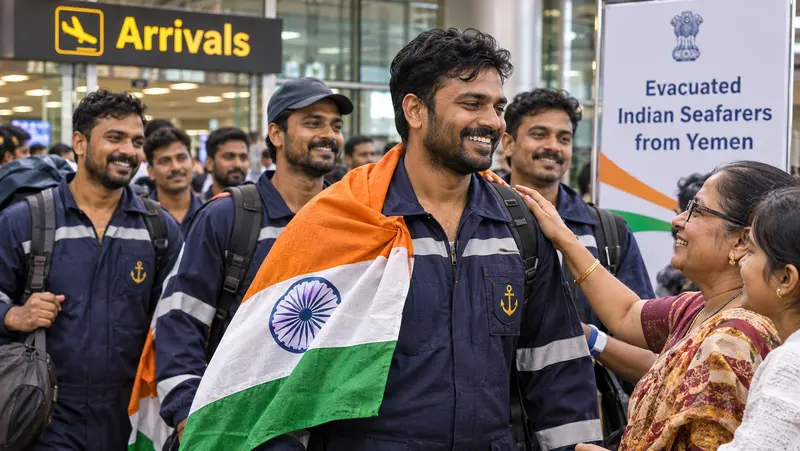
The Embassy of India in Yemen said on Sunday, 8 November 2026, that 19 Indian seafarers who had been stranded in Hodeidah and Sana'a for about two weeks have been evacuated and are on their way back to India. In a post on social media the embassy said all of them are safe and in good health, and it thanked all concerned for their cooperation and continued support. The post is the only official word so far. It does not name the vessel or vessels the men served on, say how they left Yemen, or give a date for their arrival.
The Ministry of External Affairs had not issued a separate statement when this report was written. The embassy's announcement follows a run of incidents involving Indian crews around Yemen and the Strait of Hormuz since the West Asia conflict began in February.
What the embassy has confirmed and what it has not
The embassy has confirmed five things: the number of men (19), the two places (Hodeidah, the Red Sea port, and the capital Sana'a), the length of the stranding (about two weeks), their condition (safe, in good health) and their direction of travel (home). It has left several questions open.
| Question | Status |
|---|---|
| Which vessel or vessels the men worked on | Not stated |
| How they came to be stranded | Not stated |
| Route and means of travel out of Yemen | Not stated |
| Which authorities helped | The embassy thanked "all concerned" and named none |
| Date of arrival in India | Not stated |
| Whether they include the 14 Indians from last month's yacht incident | Not stated |
That last point needs care. On 23 October the same embassy said 14 Indian nationals aboard a yacht off the Yemeni coast were safe and located around Hodeidah. The External Affairs Ministry's spokesperson, Randhir Jaiswal, said the ministry had been in touch with the parties there and that all of them were safe. The two groups may overlap, since both were in Hodeidah, but nothing official links them, and treating them as one group would be a guess.
Eight months of attacks: what the ministries have counted
The evacuation sits against a long official record. The ministry's spokesperson told briefings on 28 October and on 3 November that the number of Indians killed in the West Asia conflict had risen from 22 to 23, with seafarers accounting for 14 of the first figure and 15 of the second. He said five more Indians had been killed in attacks on commercial shipping in the Black Sea region and two were missing.
The statements of the shipping and foreign ministries mark the steps along the way.
| Date | What the government said or confirmed |
|---|---|
| 12 June | The government was on "highest alert" for seafarers, the Directorate General of Shipping advised maximum caution, and Rs 10 lakh ex gratia was ordered for the family of each seafarer who died |
| 15 July | After attacks on two merchant vessels in the Strait of Hormuz, the shipping minister launched the "Seafarer-First" initiative |
| 5 August | The Indian-flagged vessel MSV Faize Noore Oliya sank after an attack off Yemen; 14 people aboard, 13 of them Indian, were rescued |
| 23 October | The embassy said 14 Indians aboard a yacht off Yemen were safe around Hodeidah |
| 8 November | The embassy said 19 stranded seafarers had been evacuated |
The July attacks hit MT Al Bahiyah and MT Mombasa, which carried 30 Indian seafarers among 46 crew. One Indian seafarer was killed and another injured on MT Al Bahiyah, and nine Indians were injured on MT Mombasa, two of them critically. After the August sinking the shipping minister, Sarbananda Sonowal, said India "strongly condemns this unprovoked attack on the defenceless mechanised sailing vessel". The External Affairs Ministry called the continuing attacks on commercial shipping in the region deeply worrisome and asked for free and unimpeded navigation to be restored. In that case the Indian Embassy in Riyadh monitored the situation and worked with Yemeni authorities to look after the crew.
What the government says it does for crews
The Seafarer-First initiative, announced on 15 July, set out the standing arrangements. They include real-time, vessel-by-vessel monitoring, a dedicated liaison officer for each affected Indian seafarer, and round-the-clock coordination among the Navy, the Directorate General of Shipping and Indian missions abroad. The directorate was told to build a real-time dashboard tracking every Indian seafarer on vessels in the Persian Gulf, the Strait of Hormuz and the Gulf of Oman, whatever the vessel's flag. Shipowners, vessel managers and recruitment agencies were told to make sure that no Indian seafarer is compelled to sail without adequate information, protection and support.
The June announcement added two duties. Everyone involved must report promptly to the Directorate General of Shipping any incident that affects Indian seafarers, and the Seafarers Welfare Fund Society stands ready to give eligible seafarers and their families the benefits and financial help they are entitled to. The shipping ministry said at that time that dedicated communication channels and emergency response arrangements work around the clock, though it did not publish contact numbers in the statement.
The embassy's post does not say whether the 19 men were tracked under those arrangements, or whether the liaison-officer system was used for them. Those are questions the ministry can answer when it next briefs.
The next confirmations to watch are the men's arrival in India, which the embassy has not dated, and any ministry briefing that names the vessel and the route. Until then, the firm facts are that 19 Indian seafarers are reported safe and on their way home, and that the details of how they got out have not been published.
Sources
- All 14 Indians aboard yacht off Yemen coast safe: Indian Embassy (All India Radio)2026-10-23
- Union Minister Sarbananda Sonowal launches Seafarer-First initiative to safeguard Indian seafarers (All India Radio)2026-07-15
- Government on highest alert to safeguard Indian seafarers in Gulf region (All India Radio)2026-06-12
- India-flagged ship sinks after attack in Red Sea (All India Radio)2026-08-05
About the Author
A
Amita Sahani
Staff Writer
Amita Sahani writes for Wirony. Every story under this byline is reviewed and approved by an editor before it is published, and corrections are made openly.
A
5 min
What did you think?