/
New Zealand count: Labour tops the vote, National leads on seats
The Electoral Commission's preliminary count for the 7 November election has Labour on 29.36 per cent of the party vote and National on 29.21, but National on 42 projected seats to Labour's 36. National, ACT and NZ First reach 67 of 131; official results are due on 27 November.
A
4 min
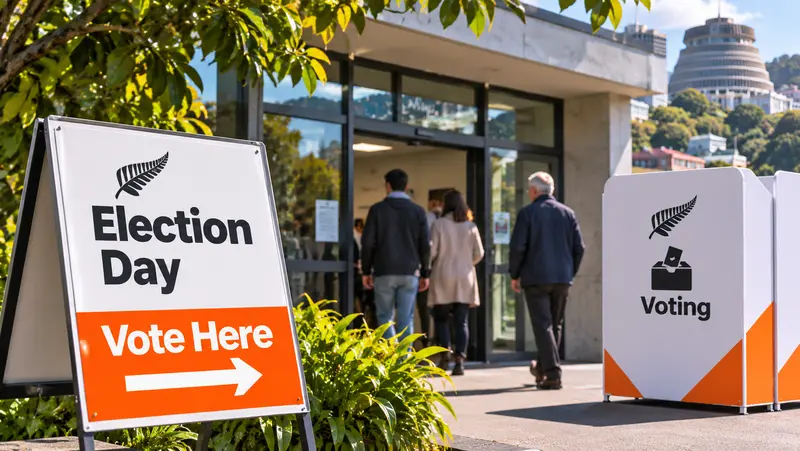
New Zealand's Electoral Commission has finished the preliminary count of the 7 November 2026 general election, and the result is close in the way that matters. Labour has the most party votes, 710,330 or 29.36 per cent, ahead of National's 706,680 or 29.21 per cent. National, though, holds the most projected seats, 42 to Labour's 36, because it won all 42 of its seats in electorates. The Commission reports 100 per cent of results counted at all 9,389 voting places, but stresses that this is not the formal declaration of results.
Labour leads the party vote by 3,650
The gap between the two largest parties is 3,650 votes out of 2,418,565 counted, or 0.15 of a percentage point. The Commission's table shows how those votes turn into the projected seats, with 71 won in electorates and 60 allocated from party lists.
| Party | Party votes | Share | Electorate seats | List seats | Projected seats |
|---|---|---|---|---|---|
| National | 706,680 | 29.21% | 42 | 0 | 42 |
| Labour | 710,330 | 29.36% | 21 | 15 | 36 |
| Green | 321,902 | 13.30% | 2 | 14 | 16 |
| ACT | 264,121 | 10.92% | 1 | 12 | 13 |
| NZ First | 236,630 | 9.78% | 0 | 12 | 12 |
| Opportunity | 144,298 | 5.96% | 0 | 7 | 7 |
| Te Pāti Māori | 13,845 | 0.57% | 5 | 0 | 5 |
| Total | 2,418,565 | – | 71 | 60 | 131 |
By route, the 71 electorate seats go to National (42), Labour (21), Te Pāti Māori (5), the Greens (2) and ACT (1). The 60 list seats go to Labour (15), the Greens (14), ACT (12), NZ First (12) and Opportunity (7), so Labour is the only large party with a sizeable share of both kinds. Two things in the table stand out. The Opportunity Party, with 5.96 per cent, takes seven list seats, which suggests it cleared the threshold for list seats, while Te Pāti Māori takes five seats on just 0.57 per cent because it won five electorates. The projection totals 131 seats. New Zealand's Parliament normally has 120, and it grows when parties win more electorate seats than their share of the party vote would give them. The Commission's page does not use the word for this, but the arithmetic implies 11 seats above the usual number.
The Commission also publishes the advance vote separately, and the comparison is revealing. Advance ordinary votes, 1,627,337 party votes or about two-thirds of the total, split differently from the rest. By subtraction from the Commission's two tables, the remaining 791,228 votes look like this:
| Party | Advance share | Share of all other votes (calculated) |
|---|---|---|
| National | 29.17% | about 29.3% |
| Labour | 30.17% | about 27.7% |
| Green | 14.29% | about 11.3% |
| ACT | 10.33% | about 12.1% |
| NZ First | 9.17% | about 11.0% |
| Opportunity | 5.48% | about 7.0% |
Labour and the Greens did better with advance voters, while ACT, NZ First and Opportunity did better with everyone else. National's share barely moved between the two groups. The figures in the second column are this article's own calculation from the published totals, not a number the Commission reports.

The arithmetic of 67 seats
With 131 projected seats, a majority needs 66. On the Commission's projection, National, ACT and NZ First together reach 67: 42, 13 and 12. Labour, the Greens and Te Pāti Māori reach 57 between them, and 64 if the Opportunity Party's seven are added. These sums are simple addition of the projected seats, not a forecast of who will govern, and the Commission's pages do not say which parties will form a government. The margin on the first sum is a single seat.
The smaller parties carry the sums. ACT's 13 seats come from 264,121 votes and NZ First's 12 from 236,630, while Te Pāti Māori's five come from 13,845 votes spread over its electorates.
What can still change on 27 November
The preliminary count is exactly that. The Electoral Commission says it will publish the official results on Friday 27 November, and that the detailed information to be presented to the House of Representatives, including the allocation of list seats, voting-place information and special vote statistics, is expected by Monday 14 December. The Commission declares the results of the official count by publishing a notice in the New Zealand Gazette.
Until then, every seat figure here is projected. The list seats in particular depend on the final party-vote totals, and a swing of a few thousand votes between parties could move one of them. The Commission's own pages are the place to follow it, including the result for each of the 71 electorates, seven of them Māori electorates, and the successful candidates page.
Sources
About the Author
A
Amita Sahani
Staff Writer
Amita Sahani writes for Wirony. Every story under this byline is reviewed and approved by an editor before it is published, and corrections are made openly.
A
4 min
What did you think?