/
China extends its US mineral export ban pause by two months, to 27 January 2027
China's commerce ministry extended on 23 November the suspension of its ban on exports of gallium, germanium, antimony and superhard materials to the US, which would have ended on 27 November. The new window runs to 27 January 2027. The move keeps the trade truce going after the Trump-Xi talks.
R
4 min
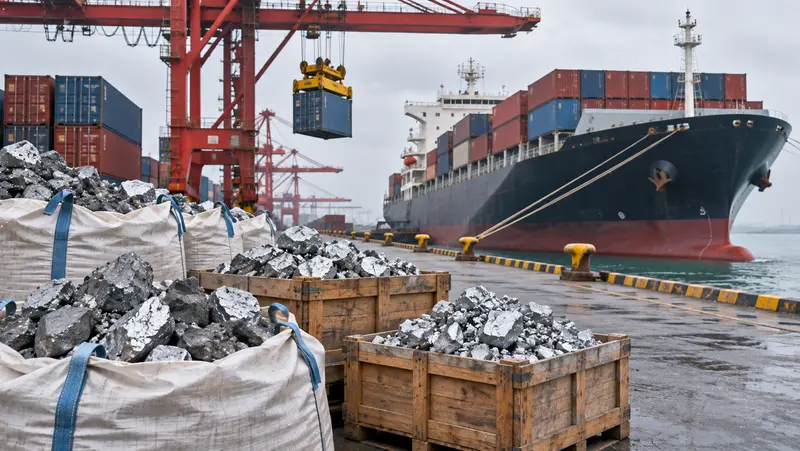
China's commerce ministry has extended by two months the suspension of its ban on exports of certain critical minerals to the United States, a move that keeps the trade truce between Washington and Beijing on track. The notice, dated Monday, 23 November 2026, and reported on 24 November, suspends the measure from 28 November 2026 to 27 January 2027. The earlier suspension was due to expire on 27 November.
The measure is the second paragraph of Announcement No. 46 of 2024, issued by the Ministry of Commerce. The 2024 rules banned exports to the United States of dual-use items related to gallium, germanium, antimony and superhard materials, and said licences would generally not be granted. Gallium and germanium are used in semiconductors, solar cells and radar and communications equipment, and antimony in batteries and flame retardants. Superhard materials, such as synthetic diamond, are used in cutting tools and electronics. One report lists only gallium, germanium and antimony, and others include superhard materials.
China first imposed the ban in December 2024, and suspended it in November 2025 after the truce reached in October 2025 at a meeting of Presidents Donald Trump and Xi Jinping in South Korea. The suspension has been renewed until now to 27 November 2026, so the new notice adds roughly two months.
| Item | Detail |
|---|---|
| Notice | Ministry of Commerce, dated 23 November 2026 |
| Measure | Second paragraph of Announcement No. 46 of 2024 |
| Items | Gallium, germanium, antimony and superhard materials |
| New suspension | 28 November 2026 to 27 January 2027 |
| Previous expiry | 27 November 2026 |
The truce context
The extension comes after a Trump-Xi summit in Shenzhen last week and hours after Nvidia's board reinstated its chief executive Jensen Huang, a move President Trump helped secure. It brings this suspension in line with other parts of the truce that run into January, including tariff relief, and a pause on new rare-earth export controls that expires on 10 January. Trump told a television channel on Monday that China could buy another 250 Boeing aircraft.
The US Commerce Department announced new rules days before the summit that restrict Chinese access to advanced artificial intelligence chips through data centres abroad. China's commerce ministry said that violated understandings reached by the two leaders and warned of countermeasures if Washington presses ahead.
A suspension is not a repeal. One report on a separate decision, issued on 9 November, says China keeps six export control announcements from October 2025 suspended until 10 January 2027. They cover medium and heavy rare earths, rare-earth equipment, superhard materials, lithium battery items and synthetic graphite anode materials, and a pause on measures against 16 US entities, though those firms still need licences for dual-use items. The report says such suspensions do not give unrestricted access and do not remove licensing requirements.
China dominates the supply of many critical minerals and of the processing that turns them into usable materials. Export restrictions on gallium and germanium in 2023 and the 2024 ban pushed up prices and sent Western governments looking for other sources. For manufacturers in the United States, a continued suspension avoids a new shortage in the short term, but it gives them only weeks of certainty at a time.
Why these minerals matter
Gallium and germanium are needed for computer chips, fibre optics, infrared sensors and solar panels, antimony for batteries, flame retardants and some munitions, and superhard materials such as synthetic diamond for cutting and grinding tools. China produces most of the world's supply of several of them, and also dominates the processing, which means that a licence regime in Beijing can shorten supply for factories elsewhere within weeks.
The 2024 announcement is still on the books. By suspending its second paragraph, which said licences would generally not be granted for the United States, the ministry has set aside the ban for a fixed period. Exporters still need licences for dual-use goods, and the government can end the suspension at any time or let it run out, which is why traders watch each deadline.
Reading the reports
One report dated the same day still said that the suspension would run only until 27 November, which suggests that the ministry's notice, dated 23 November, had not yet reached every outlet. The announcement it amends was issued in December 2024, and the two suspensions since have each been a short-term measure, which is why each new notice is read as a signal about the state of the truce.
The next deadlines are 10 January 2027, when the rare-earth and battery-material suspensions expire, and 27 January 2027, when this one does. No source states what happens on those dates, and Beijing may extend them again if the truce holds. No reaction from the US government or from markets appears in the reports read. The Ministry of Commerce and the Office of the US Trade Representative are the official sources for the notice and the trade talks.
About the Author
R
Reyaansh Agarawal
Staff Writer
Reyaansh Agarawal contributes to Wirony, covering stories that are carefully reviewed and approved by the editorial team before publication. Wirony is committed to maintaining tran…
R
4 min
What did you think?