/
Pakistan's Zeeshan Ali to become the first foreign astronaut on China's space station
China named the Shenzhou-24 crew on 24 November: Pakistan's Zeeshan Ali, 40, as payload specialist, with commander Tang Hongbo and flight engineer Wu Yi. Launch is set for 8:18 am Beijing time on 25 November from Jiuquan. Ali will spend about a week on the Tiangong station.
A
4 min
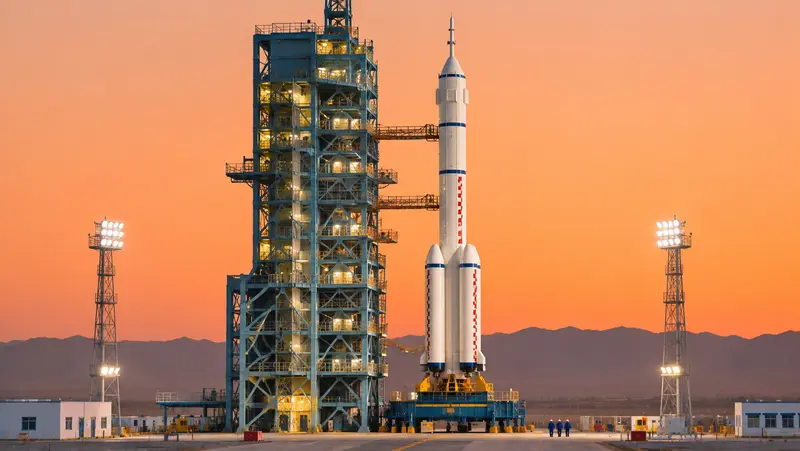
Pakistan's Muhammad Zeeshan Ali will become the first foreign astronaut to fly to China's Tiangong space station, when the Shenzhou-24 mission launches on Wednesday, 25 November 2026. The China Manned Space Agency named the crew at a news conference at the Jiuquan launch centre on Tuesday. Ali, a former Pakistan Air Force pilot, will fly as a payload specialist for about a week, alongside commander Tang Hongbo and flight engineer Wu Yi.
The Long March-2F rocket will lift off at 8:18 am Beijing time (00:18 GMT, 5:18 am in Pakistan) on Wednesday from the Jiuquan Satellite Launch Center in Gansu province in north-west China. The spacecraft will make a rapid, automated approach of about 3.5 hours and dock at the forward port of the Tianhe core module, according to agency spokesperson Zhang Jingbo.
The crew will return aboard Shenzhou-23 with its crew members. Lai Ka-ying and Zhang Zhiyuan will return with Ali, and Zhu Yangzhu will stay in orbit for a year. The stay on the station is about a week, and the whole flight may last around five days, according to one account.
The crew
Zeeshan Ali is 40. The commander, Tang Hongbo, is 51 and will be the first astronaut to board Tiangong three times, according to state television. Flight engineer Wu Yi is 39 and on his first flight. China has sent 27 astronauts from 11 crews to Tiangong. Ali is a payload specialist, a role that is for carrying out the science of the mission and not for flying the spacecraft.
| Item | Detail |
|---|---|
| Mission | Shenzhou-24 |
| Launch | Wednesday 25 November 2026, 8:18 am Beijing time, Jiuquan |
| Crew | Tang Hongbo (commander), Wu Yi (flight engineer), Zeeshan Ali (payload specialist) |
| Stay | About a week on Tiangong |
| Docking | Forward port of Tianhe, about 3.5 hours after launch |
Ali will carry out China-Pakistan experiments, install samples and equipment, and run tests. There are four joint projects in biotechnology and materials science, including an experiment with cyanobacteria, which are photosynthetic microorganisms, according to Pakistan's space agency and state television. The Pakistani agency says the four experiments take six to twelve months to complete. China's agency says the crew will carry out about 90 experiments in all.
The Space and Upper Atmosphere Research Commission of Pakistan, known as SUPARCO, and the China Manned Space Agency signed an agreement in Islamabad in February 2025 to train a Pakistani astronaut. Ali and a second Pakistani pilot, Khurram Daud, were named reserve astronauts on 22 April, and Prime Minister Shehbaz Sharif met them the next day. They joined the Astronaut Center of China in Beijing on 24 April and trained in centrifuges and simulators, in emergency and rescue drills, and in the Chinese language. Tang said Ali started with "virtually no foundation" in Chinese. Daud is not on this flight.
Ali said: "I carry the name of Pakistan on my shoulder, the hopes of 250 million Pakistanis," and "This mission is not a finish line; it is a launchpad." He also said that the friendship between China and Pakistan "is as vast as outer space."
The station
Tiangong is China's space station, assembled in orbit by 2022 around the Tianhe core module, with two laboratory modules attached to it. It orbits at roughly 400 kilometres above the Earth and is normally staffed by a crew of three, who are replaced about every six months by a new Shenzhou crew. Having a foreign astronaut visit for a short stay is a first for the station and for China's crewed programme.
The flight comes in the year when the two countries mark 75 years of diplomatic ties, and it follows a series of joint projects, including the China-Pakistan Economic Corridor. Pakistan's space agency has also been working with China on satellite launches and a lunar mission that is tentatively planned for 2028.
He will be the first foreign astronaut on the Tiangong station and, reports say, the first foreigner to fly in China's crewed programme. Reports differ on whether he is the first Pakistani in space: one says he is, while another notes that Namira Salim flew on a Virgin Galactic mission in October 2023 as a paying passenger. China is preparing a crewed lunar landing by 2030, and China and Pakistan are working on a lunar mission tentatively planned for 2028.
Why a payload specialist
Foreign astronauts who visit a space station for a short stay usually fly with a defined task, such as running experiments for their own country's space agency, and are not trained to operate the spacecraft. That is the role Ali will have, and it is why the mission's headline is the experiments and the first visit and not any change in how the station is run.
If the launch goes ahead on Wednesday, the crew will dock a few hours later and spend about a week on board. The China Manned Space Agency and SUPARCO are the official sources for the schedule and the experiments.
About the Author
A
Amita Sahani
Staff Writer
Amita Sahani writes for Wirony. Every story under this byline is reviewed and approved by an editor before it is published, and corrections are made openly.
A
4 min
What did you think?