/
S&P 500 falls 3.7% into a correction and the Nasdaq turns negative for the year
The S&P 500 fell 3.7% to 6,910.39 on 20 November and is now more than 10% below its 6 October record, a correction. The Nasdaq dropped 5.3% to 22,617.73 and is down for the year, and the Dow lost 949.73 points. The S&P 500 lost 8.6% on the week, its worst in over 18 months.
S
4 min
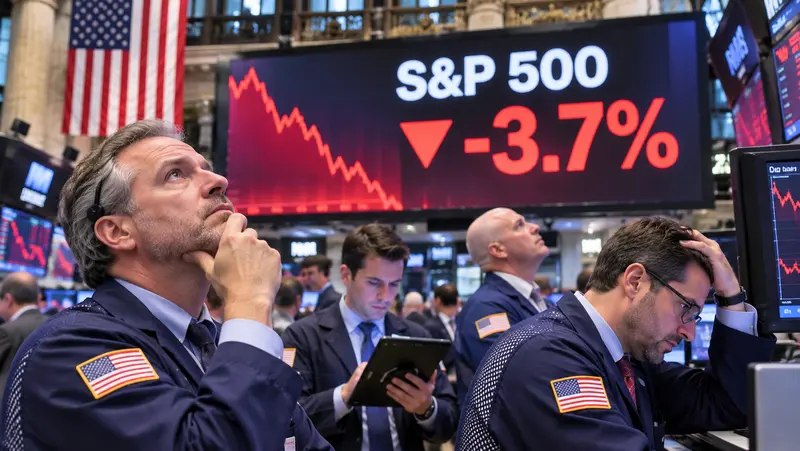
Wall Street had its worst session in months on Friday, 20 November 2026, as a sell-off in artificial intelligence shares pushed the S&P 500 into a correction and the Nasdaq composite into the red for the year. The S&P 500 fell 265.44 points, or 3.7%, to 6,910.39. The Dow Jones Industrial Average lost 949.73 points, or 1.9%, to 48,147.33, and the Nasdaq composite dropped 1,261.47 points, or 5.3%, to 22,617.73. The small-company Russell 2000 fell 73.32 points, or 2.8%, to 2,581.79.
What the numbers say
A correction is a fall of more than 10% from a recent high, and the S&P 500 is now more than 10% below its record close of 6 October. The last correction in the index was in March 2025, during the trade war with the United States' trading partners. The week was the S&P 500's worst in more than 18 months: it lost 651.28 points, or 8.6%.
The Dow lost 4,200.22 points, or 8%, on the week, the Nasdaq lost 2,518.54 points, or 10%, and the Russell 2000 lost 208.70 points, or 7.5%. The Nasdaq's fall pushed it below where it started the year: it is down 624.26 points, or 2.7%, in 2026. The S&P 500 is up only 64.89 points, or 0.9%, for the year, the Dow is up 84.04 points, or 0.2%, and the Russell 2000 is up 99.88 points, or 4%.
| Index | Friday close | Friday move | Week | Year to date |
|---|---|---|---|---|
| S&P 500 | 6,910.39 | down 3.7% | down 8.6% | up 0.9% |
| Dow Jones Industrial Average | 48,147.33 | down 1.9% | down 8% | up 0.2% |
| Nasdaq composite | 22,617.73 | down 5.3% | down 10% | down 2.7% |
| Russell 2000 | 2,581.79 | down 2.8% | down 7.5% | up 4% |
The sell-off came after several days of falls. Asian markets had already fallen on Friday after what traders called the S&P 500's sixth straight decline, and the Indian market's gains on the same day, driven by foreign inflows, stood out against it. The CBOE Volatility Index, Wall Street's fear gauge, touched a seven-month high earlier in the day.
The drop followed a week in which investors began to question how much money could be earned from the heavy spending on artificial intelligence. Anthropic's record share sale earlier in the week, which raised $81.3 billion, was followed by a sharp fall in its shares after the first day of trading. Strategists were split on whether the fall marks the top of the AI trade, and some warned that a downturn in the economy could make the damage worse.
What is not in the closing data
The closing figures do not tell how much of Friday's fall came from individual stocks. The figures reported here are index levels and do not include sector moves, the volume of trading, or moves in shares of individual companies, which are published by the exchanges at the close. The numbers in this article come from the closing values of the S&P 500, the Dow, the Nasdaq composite and the Russell 2000.
The Nasdaq's 10% fall on the week is a bigger weekly fall than that of the broader S&P 500, which says the pressure was concentrated in technology and artificial intelligence stocks, which carry a heavy weight in the Nasdaq.
Put together, the week's falls are large for indexes that had been near records. The S&P 500 gave up 651.28 points in five sessions and the Dow 4,200.22 points. The Nasdaq composite, which carries the heaviest weight in AI-related shares, fell by 2,518.54 points and is now below where it started 2026, while the Russell 2000 of smaller companies, down 7.5% on the week, is still up 4% for the year. The year-to-date gains of the S&P 500 and the Dow, 0.9% and 0.2%, have almost disappeared.

What it means for Indian investors
Indian shares closed at nine-month highs on Friday, before the US market opened, as foreign money moved into banks. The US sell-off will reach Indian screens when markets open on Monday, 23 November, through Gift Nifty and the opening trades in information technology stocks, which depend on US clients. Foreign portfolio investors, who have put record amounts into Indian equities in November, may also adjust their positions if US volatility stays high.
Whether the correction deepens depends on the next data points: US inflation and jobs readings, the Federal Reserve's meeting in December, and the earnings of the large technology firms that have led the market higher. A correction is a fall of more than 10%, and a bear market is a fall of 20% or more from the high, which is further away. At 6,910.39 the S&P 500 is more than 10% below the 6 October peak but still up for the year.
This article is for information only and is not investment or financial advice.
About the Author
S
Subhash Gupta
Desk Editor
Subhash Gupta is a writer at Wirony, contributing articles that are reviewed and verified by the editorial team before publication. The publication prioritises accuracy, editorial…
S
4 min
What did you think?