/
Nasdaq falls over 5.5%, wiping out about $2.5 trillion, as Democrats' win in Congress stirs fears of AI curbs
US technology stocks plunged on 5 November, with the Nasdaq Composite down over 5.5% and an estimated $2.5 trillion lost, on concerns that Democratic control of Congress could slow AI and data centre expansion. The S&P 500 fell 4.4% and the Dow over 3.4%. No bill is yet before Congress.
P
4 min
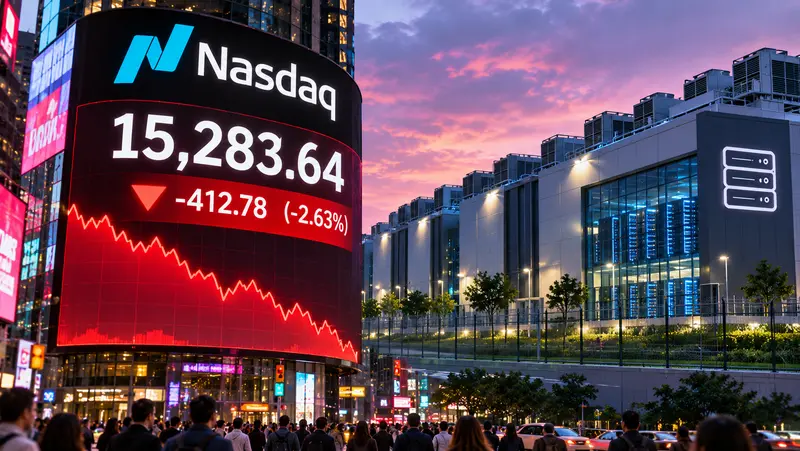
US technology stocks plunged on Thursday 5 November 2026 as investors reacted to the Democratic Party's victories in the midterm elections, which gave it control of both chambers of Congress. The Nasdaq Composite fell more than 5.5%, wiping out an estimated $2.5 trillion in market value, according to the report by India's state broadcaster. The S&P 500 dropped 4.4% and the Dow Jones Industrial Average declined more than 3.4%. Several Democrats had campaigned on restricting data centre expansion and strengthening oversight of the artificial intelligence industry.
It was a sharp reversal. A day earlier, the Dow had gained more than 3%, the S&P 500 1.6% and the Nasdaq more than 1.4%, as investors first welcomed the end of election uncertainty.
| US index | Wednesday 4 November | Thursday 5 November |
|---|---|---|
| Nasdaq Composite | over +1.4% | over −5.5% |
| S&P 500 | +1.6% | −4.4% |
| Dow Jones Industrial Average | over +3% | over −3.4% |
A fall of more than 5% in the Nasdaq in one session is rare. The fact that the broad S&P 500 fell by more than 4% shows how much the American market now depends on a small group of very large technology companies, whose fortunes are tied to spending on AI. When they fall, the index goes with them.
The $2.5 trillion figure is an estimate of paper value. It reflects what shares were worth at the close, and no cash has left the system. But falls of this size do affect pension accounts, company borrowing and business confidence.
Why it matters
The fear behind the sell-off is about what a Democratic Congress might do. So far, it is only that: a fear. The new Congress does not sit until January, no bill has yet been laid before it, and any law on AI or data centres would have to pass both chambers and be signed by President Donald Trump, who has generally favoured the industry's expansion. That gives critics of the sell-off a strong point. On the facts available, the market has priced in a risk well ahead of any actual rule, and such moves are often partly reversed.
Against that, it makes sense to ask why investors moved so hard. Valuations in AI companies depend on very large future spending on chips, power and buildings. Data centres already face local objections over electricity and water. If regulators slow approvals, or if Congress adds oversight, the timing of those future profits shifts, and small shifts in timing can mean large changes in today's prices. A market priced for perfection is vulnerable to any doubt. Chipmakers and data centre companies had started to fall a day earlier on the same concern.
Interest rates are not helping. The Federal Reserve held its target range at 3.75% to 4% on 28 October, after raising it in September. Two members, Lisa Cook and Beth Hammack, voted for a further rise. The Federal Open Market Committee's statement described economic activity as strong and inflation as elevated. High rates make future earnings worth less today, and that hits technology shares hardest. The Fed's minutes are due on 18 November.
What it means for India
The immediate effect on India was surprising. On Friday, the Sensex jumped 1,718 points to 81,028 and the Nifty 494 to 25,030, a seventh straight gain, in what the official report described as a defiance of weak global cues. India's main indices hold banks, carmakers and industrial firms in far larger weight than AI hardware, so they are less tied to this particular story, and lower oil prices have been a bigger factor at home.
That protection has limits. Indian IT services companies earn much of their revenue from American clients, and a lasting slowdown in technology budgets would reach them. Foreign funds that lose money in New York sometimes sell in emerging markets to raise cash. India's own hopes of attracting data centre investment also depend on global spending plans staying strong, and a change in American appetite would be felt there. On the other hand, tighter rules in America could push some projects abroad, and India is among the places that want them.
What to watch next
The first test is whether the fall continues. One day of panic is often followed by a bounce, and the following sessions will show whether large investors treat it as a chance to buy or as a turning point.
The second is what Democratic leaders actually say. Campaign promises are not bills, and the party's leaders in Congress may have little wish to be blamed for a market fall. Statements on AI oversight, permits or energy use in the weeks before January will be read closely.
The third is company spending. If the largest technology firms confirm their plans for data centres in their next statements, the panic may fade. If any of them trim those plans, the concern will look justified.
The fourth is the Federal Reserve. Two members already want higher rates, and a market slide of this size will feature in the debate at its next meeting.
For now, the record shows a very large one-day fall, based on an expectation of change and not on any change itself.
This article is for information and is not investment advice.
Sources
About the Author
P
Prateek Rawat
Staff Writer
Prateek Rawat is a contributor to Wirony. All articles published under this byline undergo editorial review and approval before publication, with any necessary corrections handled…
P
4 min
What did you think?