/
ISRO's GSLV-F18 places NVS-03 navigation satellite in orbit, restoring NavIC to its minimum four satellites
ISRO's GSLV-F18 lifted off from Sriharikota at 11:51 pm on 30 October and placed the NVS-03 navigation satellite in its intended orbit. The launch brings NavIC back to the four operational satellites needed for standalone positioning, after NVS-02 was stranded in orbit.
S
4 min
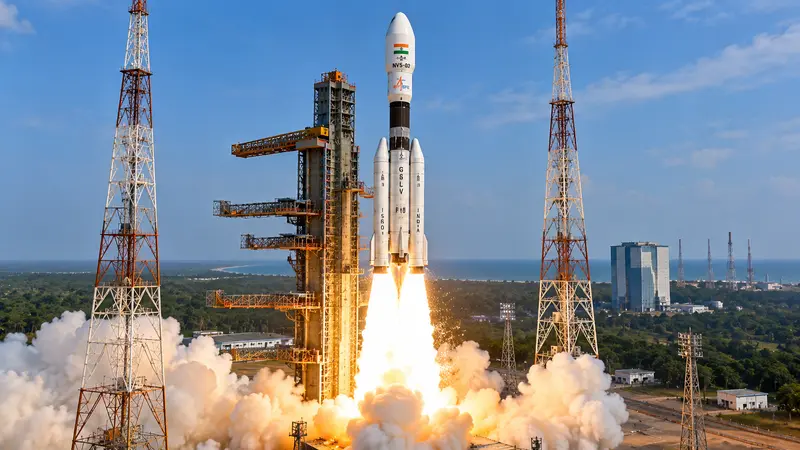
The Indian Space Research Organisation launched the NVS-03 navigation satellite on its GSLV-F18 rocket at 11:51 pm on Friday, 30 October, and placed it in the intended orbit. ISRO described the flight as a mission success, and its chairman said the launch restored NavIC, India's regional navigation system, to its minimum operational configuration of four satellites. The rocket lifted off from the Second Launch Pad at the Satish Dhawan Space Centre in Sriharikota, Andhra Pradesh. It was the 20th flight of the Geosynchronous Satellite Launch Vehicle.
The launch
The three-stage rocket, nearly 50 metres tall, placed NVS-03 in a geosynchronous transfer orbit, a long oval path ranging from about 170 km to about 37,023 km above the Earth, according to pre-launch details. The satellite weighs about 2,250 kg, though one report also gives 2,232 kg. Over the coming days it will use its own liquid propulsion system to raise its orbit and reach its final geosynchronous slot. ISRO will then run checks and begin commissioning the satellite for operational use.
What ISRO said
ISRO declared the mission a success, saying that GSLV-F18 had placed NVS-03 in the intended orbit. ISRO chairman V. Narayanan said the satellite was precisely injected into its intended elliptical orbit, that one of its indigenous atomic clocks was now in orbit, and that the launch had restored NavIC to its minimum operational configuration of four satellites. Space Minister Jitendra Singh congratulated the ISRO team.
NavIC, short for Navigation with Indian Constellation and formerly called IRNSS, provides positioning, navigation and timing services over the Indian mainland and about 1,500 km beyond its borders. The original design called for seven satellites supported by ground stations, at a reported cost of Rs 2,250 crore.
A July 2026 reply in Parliament said that only three satellites, IRNSS-1B, IRNSS-1I and NVS-01, were providing services. Four operational satellites are the minimum for standalone positioning, so NavIC could not offer it before this launch, although its timing services continued to work. Of the eleven satellites launched so far, one is retired, two never reached their intended orbits and several offer only one-way messaging.
NVS-02 reached transfer orbit in January 2025 but is stuck in an unintended orbit. Its tanks are full and its engine is sound, but it cannot fire, because the pyro valves never received their electrical signal. Neither the main engine nor the attitude thrusters could get fuel and oxidiser. The valves were fitted in backup pairs, and ISRO's review traced the fault to a disengaged contact in an oxidiser-line connector that cut off both paths.
Space Minister Jitendra Singh says the faults have been corrected, and the fix was tested on the CMS-03 communication satellite, which was launched on 2 November 2025. For NVS-03, ISRO changed the activation sequence of the propulsion valves before the flight, according to one report. NVS-04 and NVS-05 are in their final stages.
NVS-03 is the third satellite in ISRO's second-generation navigation series. It carries an indigenous atomic clock along with atomic clocks that were procured abroad. NVS-01, launched in May 2023, was the first Indian navigation satellite with a home-grown clock. NVS-03 adds an L1 navigation signal to the existing L5 and S-band signals, which ISRO expects to improve NavIC's compatibility with more receivers, including civilian and commercial ones.
More from TechnologyExplore Technology



In 2013 IRNSS-1A was launched with imported atomic clocks. In 2016 the clocks on the first-generation satellites began to malfunction. In May 2023 NVS-01, the first next-generation satellite, was launched with an indigenous rubidium atomic clock. In 2025 NVS-02 failed to reach its final orbit.
The system is used in transport, maritime navigation, disaster management, location-based services and timing synchronisation. One report cites more than 10,400 train locomotives, around 40,000 fishing vessels and more than 60 mobile handset models linked to NavIC applications or compatibility. India's limited access to GPS during the 1999 Kargil War was a motive for building it. NavIC is not a replacement for GPS, but it gives India an independent capability.
The satellite must still complete its orbit-raising and commissioning before it counts towards services. The reports found do not give a date for the start of services from NVS-03 or for the next NavIC launch beyond the statement that NVS-04 and NVS-05 are in their final stages. Space Minister Jitendra Singh congratulated the ISRO team.
S
4 min
What did you think?