/
Anduril and Qualcomm unveil BlueChip, a rugged laptop with about 90% US and allied parts; preorders in 2027
Anduril and Qualcomm announced BlueChip on 27 October, a rugged laptop for government and military buyers with a Snapdragon X chip made at TSMC in Arizona. About 90% of parts are US or allied, the display is still made in China, and Palmer Luckey expects a price about 20% above high-end PCs.
S
3 min
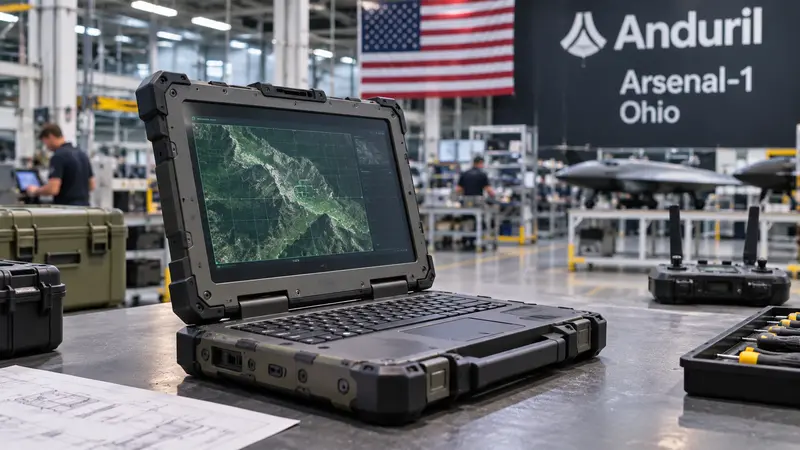
Anduril, the defence technology company known for drones and artificial intelligence software, and the chipmaker Qualcomm have announced BlueChip, a rugged laptop built mostly from US and allied parts. They announced it on 27 October 2026. Preorders are expected to open in 2027, and Anduril already has functional prototypes. The laptop is aimed at government agencies, the military, first responders and law enforcement, and its first model is the first of a planned BlueChip line.
The hardware
BlueChip is built around a Qualcomm Snapdragon X Series chip, which provides general-purpose processing, graphics and on-device AI, and which is made at TSMC's facility in Arizona, according to Qualcomm's chief executive. It uses the same architecture as other laptops, including Microsoft's Surface. The laptop is rugged and hardened to withstand rain, dust and harsh conditions, and because of this it will be heavy and have limits on battery life.
How American is it
Palmer Luckey, Anduril's founder, says that about 90% of the first generation's bill of materials is from the United States or allied countries, with a roadmap to full domestic production. One report describes the 90% as a share of procurement costs. Anduril wants every component to be made domestically, not just assembled in the United States, and the long-term aim is an option made entirely in the United States.
There are gaps. The display is made in China, according to the reports, although Anduril has found a US supplier for the display's cover glass. One report says that some power-management circuits have no non-Chinese source at present. Anduril plans to build the laptops at its Arsenal-1 facility in Ohio, and other facilities, including some work in California, may be involved. The arrangement is still in flux, one report says.
The target buyers are US government agencies, the military, first responders and law enforcement, mainly to meet rules that require government purchases of US-made computers. The selling point is a transparent, auditable supply chain. Luckey describes it as an anti-surveillance computer that gives the owner full control and visibility into its hardware and software. He suggested that the rugged design may not be price-competitive for typical consumers, though consumers may be able to order, possibly through a waitlist.

Anduril has tested the laptops with Windows and with two Linux distributions that are popular with the military, and it has integrated its Lattice software platform. It is working to support Windows applications, certain Linux distributions used by government and legacy government software.
No price has been announced. Luckey estimated that it would cost about 20% more than typical high-end PCs and said that in the near term it will be more expensive than a laptop made in China. Anduril cites rugged computers as a market of roughly $5 billion.
| Item | Status |
|---|---|
| Preorders | Expected in 2027 |
| Prototypes | Functional prototypes built |
| Full-rate production | Planned for next year |
| Government subsidies or contracts | None provided so far, according to one report |
| Funding | The two companies' own research money, amount not disclosed |
The reports found do not give production quantities or the total investment. They differ on whether the companies have government funding, and the one that addresses it says that none has been provided. The price is unknown, and the weight and battery life have not been specified.
S
3 min
What did you think?