/
Telangana High Court suspends Jangaon Collector's land order, objects to alleged use of AI to decide disputes
Justice N.V. Shravan Kumar suspended a Jangaon Collector's 8 September order after a farmer said it was passed without hearing him and drafted with AI tools. The court asked the Advocate General to explain action against officials. The Collector's side is not on record; next hearing 18 November.
S
5 min
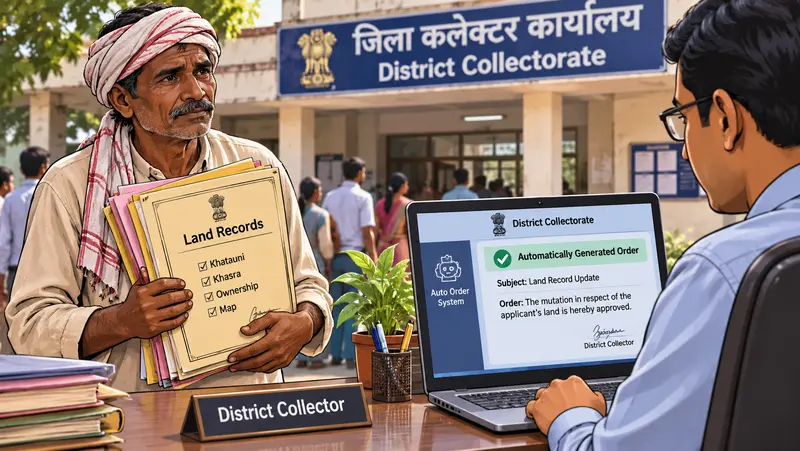
The Telangana High Court has suspended an order passed by the Jangaon district Collector on a land dispute and has taken what it called serious exception to the alleged use of artificial intelligence to decide such disputes. Justice N.V. Shravan Kumar passed the interim order on Tuesday 3 November in a writ petition filed by Medipalli Komuraiah of Peddamadur village in Devaruppula mandal. The Collector's order is dated 8 September. The court asked the Advocate General to explain what action is proposed against the officials concerned and issued notices to the Principal Secretary of the Revenue Department, the Collector, the Devaruppula Tahsildar and the private parties. The case returns on 18 November.
The central allegation is serious but it has not been proved, and it is important to say so. It is the petitioner's case, argued by his counsel, and the reports available so far do not carry the Collector's response or name any AI tool. What is on the record is the court's reaction to the allegation and the interim relief it granted.
What the petitioner alleges
Mr Komuraiah says the Collector resolved a revenue dispute on a grievance made by the opposing parties without giving him a hearing, which caused him serious hardship. His counsel told the court that the order was issued mechanically with the help of AI tools, without examining the facts or applying the mind of the deciding officer. The reporting also describes a wider allegation about how such orders are produced: that staff photograph the grievance applications that arrive at the district office, feed them into AI tools to generate responses or draft orders, and move on without verifying the facts or checking the documents. The article that carries this version says that officials are under pressure to close complaints within prescribed timelines, which makes a fast automated draft attractive.
If that description is accurate, the problem is not that a machine was involved. A Collector who decides a land dispute is exercising a quasi-judicial power, and the settled requirements for such a power are old and simple. The affected party must be given notice and a hearing, the decision must be based on the record, and the order must show reasons that come from an application of mind. An order drafted by software and signed without reading fails those tests regardless of the tool, and an order passed without hearing the other side fails them even if no tool was used.
What the court said and did
The court said that orders in land and revenue matters seriously affect the rights of ordinary people and farmers, and it asked how a Collector could act so carelessly in such a matter. It expressed strong displeasure at the officer's conduct. It also raised a broader concern that district administrations are increasingly using AI and automated platforms to dispose of grievance petitions, without checking whether the problems are actually resolved on the ground.

The relief was limited and typical of an early hearing. The court suspended the 8 September order, which restores the position before it while the case goes on. It sought explanations from the revenue department leadership and the local officials. It also directed the Advocate General, A. Sudarshan Reddy, to report the steps being taken. In court, the revenue department's counsel said the issue had come to the notice of the government pleader, who had written to the Advocate General's office seeking legal advice on the course of action. That indicates the state is treating the matter as a lapse to be examined and has not yet filed a defence of the order.
Why it matters beyond one village
The case arrives at a moment when Indian courts are writing the first rules for AI in their own work, while no equivalent rulebook for executive officers who decide disputes appears in the reporting. The Kerala High Court issued a binding policy for its district judiciary in July 2025 that prohibits the use of AI for legal reasoning or decision-making. It covers judges, judicial officers, court staff, interns and law clerks, and it requires courts to log any permitted use and keep an audit trail of the tools used and how the outputs were checked. A tracker of Indian court rules published in October 2026 lists three High Courts with AI rules in force, Kerala, Gujarat and Punjab and Haryana. The Supreme Court's AI committee released a draft framework on 3 June 2026 that is not yet binding, and the tracker also records a Supreme Court ruling of 2 July 2026 that set aside a tribunal judgment for relying on AI-generated citations that did not exist and asked the Bar Council to look at the problem. These are secondary summaries, and the primary orders should be checked for exact dates.
Those rules protect the courts. They do not reach a tahsildar, a revenue divisional officer or a Collector, who together decide a very large number of land disputes each year, mostly for people who cannot afford a lawyer. For a farmer, a revenue order is often the only decision anyone will make about his plot before it reaches a court years later. If automated drafting spreads in those offices because of targets for closing grievances, errors will not stay in one file. A hallucinated survey number or a missing party in a draft can change who owns land.
A workable standard would not ban the tools. It would require that the officer who signs an order has read the record, that parties are heard before an order is passed, that any use of AI in drafting is disclosed on the file, that logs are kept so that a court can see what was generated and what was changed, and that performance targets measure resolved disputes and not closed complaints. The court's questions on 18 November, and the Advocate General's answer on what action is proposed, will show whether Telangana is willing to write such a standard for its own officers before another case forces it to.
S
5 min
What did you think?