/
New Meghalaya cave gecko is named after Shillong's much-loved wooden bus
Scientists have described two new cave-dwelling geckos from Meghalaya. One is named Cyrtodactylus bossmit after Shillong's old wooden bus, and the other kremicola after the Khasi word for cave. The study, published on 25 November, takes the state's tally to nine.
P
4 min
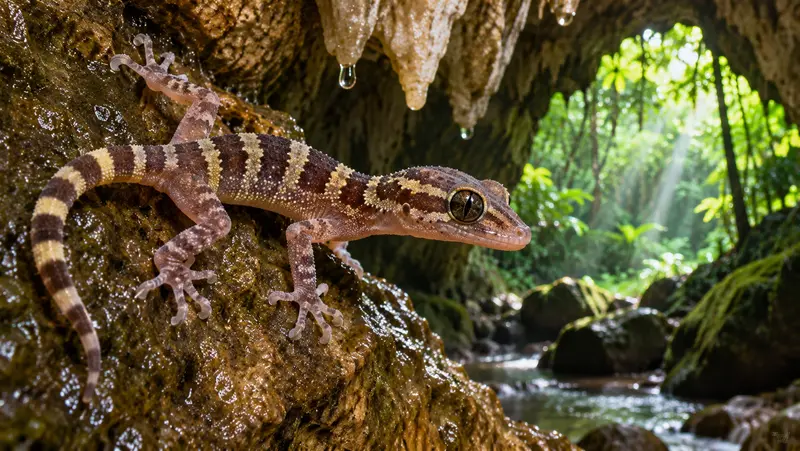
Scientists have described two new species of gecko living in and around caves in Meghalaya, and given one of them the name of a bus. Cyrtodactylus bossmit honours the old wooden bus of Shillong, while the second species, Cyrtodactylus kremicola, takes its name from krem, the Khasi word for a cave. The study was published in the journal Taprobanica on 25 November 2026.
| Feature | C. bossmit | C. kremicola |
|---|---|---|
| Named after | Shillong's wooden bus | Khasi word for cave |
| Key site | Maw Tynghiang Cave, Nongnah village | Rupasor Cave, Syndai village |
| District | South-West Khasi Hills | West Jaintia Hills |
| Longest body recorded | 81.7 mm | 83.6 mm |
| Known range | Parts of the Khasi Hills | One locality so far |
Both are moderately sized members of the bent-toed geckos, a large group recognised by their slender, angled toes. The measurements describe body length, so they should not be read as the length from nose to tail tip. A body of just over eight centimetres is roughly the length of an adult's middle finger.
Where they were found
Cyrtodactylus bossmit is recorded from Maw Tynghiang Cave near Nongnah in the South-West Khasi Hills, and the researchers also link to it a site called Wahlong Byrong in the East Khasi Hills, along with earlier populations around Sohra and Umdohlun. Cyrtodactylus kremicola is so far known only from Rupasor Cave at Syndai in the West Jaintia Hills. The animals are associated with limestone outcrops, caves, rock crevices and the forest around them.
The Bossmit is a long-standing symbol of Shillong, a wooden-bodied bus woven into the daily life and identity of the city. Scientists often name species after places, people or features of local culture, and choosing the bus ties a small animal to something residents recognise at once. The second name takes the same local route through language, pointing to where the animal lives.
The work began with a fresh look at Cyrtodactylus khasiensis, a gecko first described from the Khasi Hills by the naturalist Thomas C. Jerdon in 1870. For a long time, similar-looking animals from different parts of the hills were placed under that single name. The team compared physical features, including the arrangement of scales, body proportions, the number of pores in front of the vent and the patterns on the back, and combined this with analysis of mitochondrial DNA.
The result splits what had looked like one animal into distinct lineages. The population at Arwah Cave in the East Khasi Hills is treated as the true Cyrtodactylus khasiensis. Populations from Sohra and parts of the South-West Khasi Hills move to Cyrtodactylus bossmit.
| Researchers | Institution |
|---|---|
| Cynthia M. Umlong and Holiness Warjri | Assam Don Bosco University |
| Manmath Bharali and Arup K. Hazarika | Cotton University |
| Madhurima Das and Jayaditya Purkayastha | Help Earth |
Nine species and counting
With the two additions, Meghalaya has nine recognised species of Cyrtodactylus. That is a large number for one small state and reflects its broken landscape of ridges, gorges and cave systems, where populations can become isolated and drift apart over long periods. Similar looks can hide long separation, which is why genetic comparison has uncovered many species across north-east India that were once lumped together.
A species has to be recognised and named before it can be assessed for conservation. An animal known from a single cave is especially exposed, because damage at that one place could affect the whole known population. Caves in the region face general pressures such as limestone quarrying, coal mining in parts of the Jaintia Hills, forest clearing and poorly managed tourism. These are broad risks to cave habitats; how each of them affects the two new geckos has not been established.
More from ScienceExplore Science


Much about the animals' lives remains to be studied, including what they eat in these particular caves, when they breed, how far they range from cave mouths and how many there are. Bent-toed geckos are generally active at night and feed on insects and spiders, often near the dim zone at a cave entrance, but observations specific to the new species are needed before drawing conclusions.
Why caves matter
Caves are small, stable worlds: darker, damper and more even in temperature than the forest outside. Animals that rely on them can be cut off from other populations by only a few ridges or valleys. The Ministry of Environment, Forest and Climate Change oversees wildlife law at the national level, while forest land and local cave sites are managed with state authorities and, in Meghalaya, often with community landholders whose cooperation shapes any protection.
Cave visitors can help by staying on marked routes, avoiding handling wildlife, keeping lights off resting animals and leaving no litter. Wild reptiles should not be collected or traded. Questions about protected wildlife and cave access can be directed to the state's Forest and Environment Department. Further surveys of the hills may well show whether other caves hold populations of either species, or of others still waiting to be described.
About the Author
P
Prateek Rawat
Staff Writer
Prateek Rawat is a contributor to Wirony. All articles published under this byline undergo editorial review and approval before publication, with any necessary corrections handled…
P
4 min
What did you think?