/
SpaceX catches Starship upper stage with tower arms in Texas after orbit
SpaceX caught the upper stage of Starship with the Mechazilla tower arms at Starbase, Texas, after the 22-hour Flight 15 orbital test. The booster was waved off and splashed down in the Gulf. In-orbit refuelling remains unresolved.
S
6 min
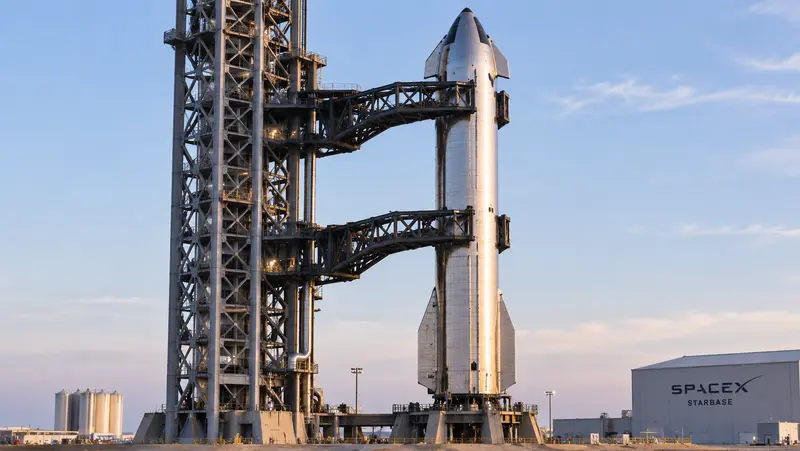
SpaceX has caught the upper stage of its Starship rocket with the mechanical arms of the launch tower at Starbase, Texas, bringing the spacecraft back from orbit and into the grip of the structure the company calls Mechazilla. The catch came at the end of Starship Flight 15, an orbital test in which the ship circled the Earth and then flew back to the site it had left. As of Sunday 15 November, it stands as the first time an upper stage has been recovered this way.
The tower's arms had caught Starship's Super Heavy booster three times on earlier flights. They had never held the ship. Flight 15 changed that.
The vehicle is 171 feet tall, and it was taken out of the air rather than set down on a pad or lowered into the water. SpaceX has not been the only party watching the result: the footage of the arms closing around the ship has been shared widely, and coverage of the flight has been built around that single image.
The whole journey, from launch to catch, took 22 hours. Some of that time was spent in Earth orbit, where the ship released payloads including Starlink satellites. After the deployments it began a controlled descent toward Texas and a return-to-launch-site manoeuvre, a pinpoint approach that brought it back to Starbase and lined it up with the tower.
The day was not a clean sweep. The Super Heavy booster that flew with the ship was waved off from its own return and came down in a guided splashdown in the Gulf.
A 22-hour trip that ended in the arms
A return to the launch site is a different job from landing somewhere convenient. The ship has to leave Starbase, travel around the planet, shed its speed and arrive back at a fixed point with enough accuracy for a tower to reach it. On this flight the ship did that, and the arms were in position when it arrived.
The orbital portion of Flight 15 is easy to overlook beside the catch, but it was a working part of the mission. The ship carried Starlink satellites and other payloads, and it put them out while in orbit. Only after that did it turn for home. That order matters, because it means the ship was flying as a working vehicle, with cargo to deliver, and not simply performing a stunt for the cameras.
The ship's height gives a sense of what the tower was asked to do. At 171 feet, it is a large vehicle to bring down by guidance alone, and the mechanical arms had to take hold of it at the end of a descent that began in orbit. The catch is described as midair because the ship was seized by the arms as it arrived, with nothing underneath it.
The 22-hour figure covers the full span between departure and recovery. Over that period the ship went from the ground to orbit, released its payloads, descended under control and reached the tower. Every stage had to work for the next to be possible, and the final stage left no room for a second attempt at the same approach.
Starbase is both the starting point and the finishing point, which is what return-to-launch-site means in practice. The ship did not travel to a different site to be recovered. It came back to the tower it had left behind, and the tower was ready for it.
The booster did not return to the arms
While the ship was caught, the booster took a different route. The Super Heavy's own return manoeuvre was waved off, and the stage made a guided splashdown in the Gulf instead of coming back to the arms.
That makes Flight 15 a split result. One stage was caught and the other was not. The booster is the part the tower has already caught three times on earlier flights, so its catches are no longer new. The ship is the part the tower had never held, and that is the stage it held this time.
The difference between the two stages shapes how the flight should be read. A booster is the first stage of the rocket, and it works its way back to the tower after launch. The ship is the upper stage, the part that goes into orbit and has to return from there. Catching it means bringing back the vehicle that has done the more demanding part of the flight.
The material does not say why the booster manoeuvre was called off, and no explanation has been given for the decision to wave it off. What is stated is the outcome: a guided splashdown in the Gulf. The word guided indicates that the booster was still under control as it came down, and that its end in the water was a planned fallback and not an uncontrolled loss.
The flight therefore ran as a sequence. The booster and ship launched together. The ship went into orbit and deployed its payloads. The booster came down in the Gulf. The ship made its descent, flew its pinpoint return and was caught at Starbase.
Taken together, the two outcomes show where the system stands. The arms can reliably take a booster, having done so three times. They have now taken a ship as well, though only once, and that single catch is the entire record for the upper stage.
Refuelling remains the open question
Coverage of the catch has taken two broad lines. One treats it as a futuristic spectacle, a tower snatching a spacecraft out of the sky after a trip around the planet. The other looks at what the catch does not settle, and in particular at in-orbit refuelling, which remains a hurdle for the programme.
Flight 15 did not attempt to clear that hurdle. Its orbital phase was given over to deploying Starlink satellites and other payloads, not to any transfer of propellant. The catch shows that the ship can return to its launch site from orbit, and it says nothing about whether the vehicle can be refuelled once it is up there.
For anyone following the programme, the practical change is in the question being asked. Whether Starship's upper stage can come home from orbit and be caught by the tower at its launch site now has an answer from this flight. Whether the vehicle can be refuelled in orbit still does not.
The catch also changes the picture for the tower itself. Until now, Mechazilla had only held boosters. It has now held a vehicle that went all the way around the Earth, and it did so at the same site where the ship started its trip.
SpaceX had not, in the material available, set out a date for the next Starship flight or described what it intends to attempt on it. Nor has it said what condition the ship was in after the catch, or what inspections will follow. Those details will shape what the company tries next, and they have yet to be set out.
What stands is the result. A 171-foot ship went to orbit, delivered Starlink satellites, came back in 22 hours and was held by the arms of a tower in Texas. The booster that launched it ended in the Gulf, and the question of refuelling in orbit is still to be answered.
About the Author
S
Subhash Gupta
Desk Editor
Subhash Gupta is a writer at Wirony, contributing articles that are reviewed and verified by the editorial team before publication. The publication prioritises accuracy, editorial…
S
6 min
What did you think?