/
Qatar and Turkey sign mutual defence pact in Istanbul on 13 November
Turkey and Qatar signed a mutual defence agreement in Istanbul on 13 November, the Turkish presidency said. It covers collective defence, industry, counterterrorism and a $5 billion trade goal, but sets out no automatic military triggers.
S
5 min
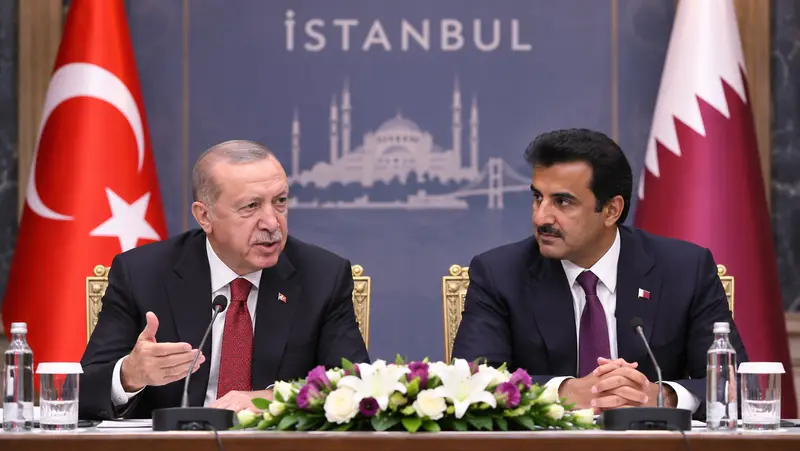
Turkey and Qatar signed a mutual defence agreement on Friday 13 November, the office of Turkish President Recep Tayyip Erdoğan said, as he met Qatar's Emir, Sheikh Tamim bin Hamad Al Thani. The signing took place in Istanbul during a session of the Türkiye-Qatar Supreme Strategic Committee, which the two leaders chaired together.
The agreement commits each country to a shared posture, and to consultation with the other, if either faces an armed attack from outside. It also covers cooperation in the defence industry, a joint stance against terrorism, and trade and energy ties. The announcement came amid regional tensions, and only a day before this report was filed it was being described across Europe and the Middle East as a new defence alliance between the two states.
The timing matters. The security arrangements of the Gulf and the wider Middle East are being reshaped quickly, a process set off by the Iran war and by signals from the United States about its own role. Against that background, Ankara and Doha have chosen to turn a long political and military partnership into a written mutual commitment.
One question has followed the announcement more closely than any other: does the pact mean that one country must go to war if the other is attacked? The published material does not answer it, and the answer turns on what the agreement says about triggers and obligations.
What the two governments agreed
Collective defence and deterrence form the first of four pillars. Both nations commit to a common posture and to mutual consultation against any external armed attack aimed at either of them. Analysts have read this chiefly as a framework for regional deterrence, a signal to outside powers, rather than a promise of automatic military action.
That reading rests on what the joint communique leaves out. It establishes political and defence solidarity between the two capitals. It does not lay out operational triggers, and it does not describe any mechanism for automatic military intervention if one partner is hit. How consultation would work in a crisis, and who would decide what, has not been set out in public.
The second pillar is cooperation in the defence industry. The two sides will expand work in military manufacturing, joint exercises, the training of personnel and exchanges on security policy. Future collaboration is expected to span drones, armoured vehicles and missile defence systems. No contract, programme or delivery date for any of these has been announced, so the list describes direction rather than commitment.
The third pillar is counterterrorism. Both governments reaffirmed a joint commitment to fighting "terrorism in all its forms and manifestations". The wording is general and names no group, country or operation.
The fourth pillar is economic. The communique sets a goal of raising bilateral trade to $5 billion and calls for stronger energy cooperation, with particular attention to liquefied natural gas. It gives no date by which the trade figure is to be reached, and it does not state the current level of trade.
The agreement did not come out of nowhere. Turkey and Qatar have coordinated on defence and politics over a period of years, and Turkey already has a military base in Qatar. The new text puts a formal, reciprocal footing under that relationship, where much of it previously rested on bilateral arrangements and shared political outlook.
The Supreme Strategic Committee was the setting for the signing, and it was chaired by Erdoğan and Sheikh Tamim in person. Having the Turkish president and the Qatari emir preside together gave the document the weight of a leaders' decision, not a ministerial one. The Turkish presidency's office was the body that made the announcement.
The pact also arrives alongside other defence alignments involving Turkey and its regional partners. Recent multi-state pacts link into a broader regional security architecture, and the Turkey-Qatar agreement sits within that wider pattern instead of standing apart from it. The material available does not name those other pacts or say how the new agreement would interact with them.
Taken together, the four pillars show how the two governments chose to present the relationship. Security, industry, counterterrorism and commerce appear in one communique, which suggests Ankara and Doha see them as parts of a single partnership. Energy is a case in point: a stated interest in liquefied natural gas appears next to the language on mutual defence, not in a separate economic document.
Detail still to come
What follows from here is mostly a matter of implementation. The communique fixes the direction, but the working arrangements have yet to be described: which joint exercises come first, how training of personnel would be organised, and which industrial projects, if any, move from intention to signed contract.
The consultation clause is the one most likely to draw scrutiny. A commitment to consult after an external armed attack is not the same as a commitment to fight, and the communique stops at the first. Analysts who describe the pact as deterrence are, in effect, pointing to that gap between a shared posture and a binding obligation to act.
Further detail would be expected from the Turkish presidency and from the Qatari government, the two parties to the agreement. Until either publishes more, what can be stated with confidence is limited to the signing, the date, the two leaders who presided, and the four areas the communique covers.
Those four areas are collective defence, defence industry, counterterrorism, and economic and energy ties. The trade goal of $5 billion is the one number in the announcement, and the pledge to consult after an external attack is its central security commitment. How either is turned into practice will be settled in later statements, not in the signing itself.
About the Author
S
Subhash Gupta
Desk Editor
Subhash Gupta is a writer at Wirony, contributing articles that are reviewed and verified by the editorial team before publication. The publication prioritises accuracy, editorial…
S
5 min
What did you think?