/
Arab parties back Eisenkot, giving him 67 recommendations to Netanyahu's 53, but that is not yet a coalition
Israel's Joint List said on 5 November it would recommend Gadi Eisenkot for prime minister, joining Ra'am and giving him 67 of 120 Knesset members against Benjamin Netanyahu's 53. President Herzog will now decide. Eisenkot had earlier said Arab parties did not meet his coalition conditions.
A
4 min
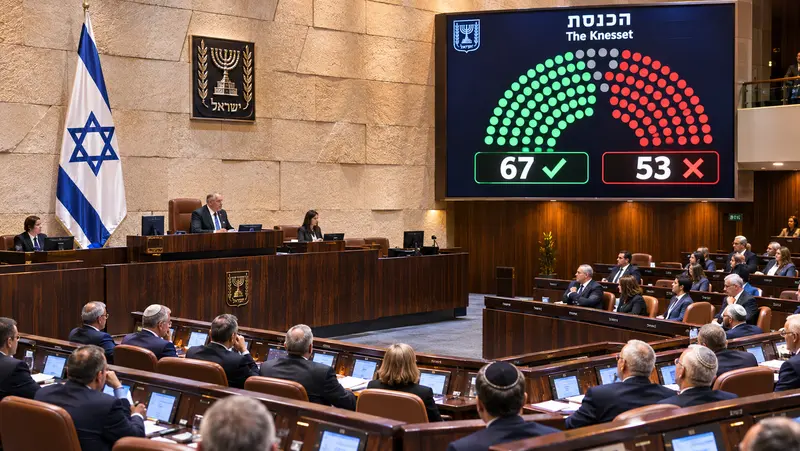
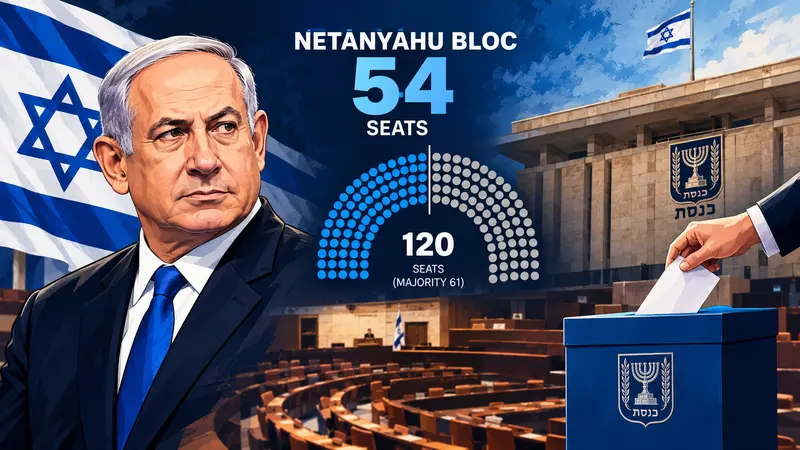
Former military chief Gadi Eisenkot now has the recommendations of 67 of the 120 members of Israel's Knesset to be the country's next prime minister, after the Joint List said on 5 November 2026 that it would formally back him in talks with President Isaac Herzog. Its 11 lawmakers join the eight members of Ra'am, who had already done so. Prime Minister Benjamin Netanyahu's bloc has 53, according to the figures reported on 6 November by India's state broadcaster, citing the consultations. The Central Elections Committee's results gave the two blocs 53 and 48 seats, with 19 for Arab-led parties.
On the numbers, this is a remarkable moment. For the first time in this election cycle, a candidate other than Netanyahu has a clear majority of recommendations. It does not, however, make Eisenkot prime minister.
What 67 means, and what it does not
A recommendation is a statement to the president about who should try to form a government. It is not a promise to join that government or to vote for it.
The arithmetic has three layers.
| Group | Seats | Running total |
|---|---|---|
| Eisenkot's bloc | 48 | 48 |
| Ra'am | 8 | 56 |
| Joint List | 11 | 67 |
A governing majority needs 61. So Eisenkot needs both Arab-led groups, or some of their members, or a defection from the other side. Without the Joint List he falls five short, and without either he falls 13 short.
The difficulty is that Eisenkot had earlier opposed including Arab parties in his government, saying they did not meet his conditions for a coalition. The backing has come anyway, and in that sense it may say more about opposition to Netanyahu than about agreement with Eisenkot. There are possible ways around this. A minority government supported from outside by Arab-led parties has been discussed in Israeli politics before. Ra'am also has experience of this, having joined a governing coalition in 2021. But each such route carries risk. Some in his bloc may balk, and the right will attack any dependence on Arab votes.
Netanyahu's camp has its own problem. With 53, he is eight short and, as things stand, has no obvious partners left to approach. His best route may be to wait for his opponents' coalition to fail.
Herzog has been meeting factions and will appoint the candidate who, in his judgment, has the best chance of forming a government. That is a judgment and not a count, although presidents have nearly always followed the numbers. The chosen candidate will have 28 days, with a possible 14-day extension. Failure could lead to another election.
In theory, he could weigh the fact that the Joint List's support may not translate into a working coalition. In practice, it would be highly unusual to pass over a candidate backed by a clear majority of the Knesset, and any such decision would itself become a political crisis.

Why it matters
The result of these talks matters far beyond Jerusalem. Israel has a contested ceasefire in Gaza, and the UN warned this week of a security vacuum in southern Lebanon, where peacekeepers cease operations at the end of the year. Iran has sent new conditions to the United States. A change of leadership after one of the longest careers in Israeli politics would change the country's dealings with all of them, though Eisenkot, a former chief of staff, is unlikely to be a soft voice on security.
For Arab citizens of Israel, about a fifth of the population, the moment has its own weight. Arab-led parties are in a position to shape who governs, and they have chosen to use it. Their voters will want something in return, on policing, housing and budgets, and that will be the real test of whether the recommendation becomes a partnership.
Sceptics warn that the coalition that emerges could be fragile. Israel's last broad anti-Netanyahu government, formed in 2021, lasted about 18 months. However, Eisenkot's supporters will argue that a turnout of nearly 78%, the highest since 1999, shows a country that wants change and may tolerate an unusual arrangement to get it.
For India, relations with Israel in defence and technology are likely to continue under any government, and New Delhi will be watching for stability in the region and its effect on energy.
What happens next
The first step is Herzog's decision, which is expected once consultations end. If Eisenkot receives the mandate, the 28-day clock starts, and the talks shift from names to terms: who gets which ministry, what is said about Arab parties' role, and what happens to the laws and budgets that divide the camps.
Watch for three things. One is whether Eisenkot says anything new about working with Arab-led parties. Another is whether any member of Netanyahu's bloc signals a willingness to cross over. The third is how the smaller parties in Eisenkot's camp respond, since a coalition can fail as easily from within as from outside.
Sources
- Israel: Arab parties agree to back Yashar party leader Gadi Eisenkot as PM (All India Radio)2026-11-06
- Israeli President Isaac Herzog holds consultations with Knesset factions (All India Radio)2026-11-05
- Israel election final results leave both ruling and opposition blocs short of majority (All India Radio)2026-10-30
About the Author
A
Amita Sahani
Staff Writer
Amita Sahani writes for Wirony. Every story under this byline is reviewed and approved by an editor before it is published, and corrections are made openly.
A
4 min
What did you think?