/
ULA's Vulcan rocket fails ten minutes after launch, destroying 40 Amazon Leo satellites
ULA's Vulcan rocket failed about ten minutes after lifting off from Cape Canaveral on 15 November and never reached orbit, destroying all 40 Amazon Leo satellites on its first Leo mission. ULA calls it an anomaly and has not given a cause.
A
4 min
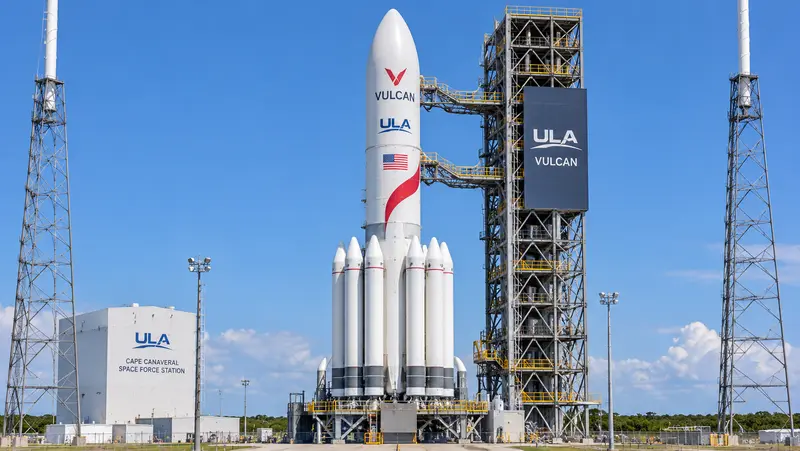
United Launch Alliance's Vulcan rocket failed about ten minutes after lifting off from Cape Canaveral on Sunday, 15 November 2026, and did not reach orbit. The rocket was carrying 40 Amazon Leo satellites on the first Vulcan launch for the company's broadband network, and all of them were destroyed. ULA said an "anomaly" occurred and that it would share more details later. It has not given a cause.
Amazon Leo said in a post on X on the day: "There is risk with any launch, and that's especially true for inaugural missions like LV-01." It said it believes ULA, which it called a trusted partner, will learn from the mission. Amazon has not issued a press release, and it has not said what the satellites cost, whether they were insured or whether its schedule changes.
The mission, minute by minute
The mission is listed by ULA as Vulcan Leo 1, or LV-01. The launch window ran from 12:11 to 12:40 pm Eastern time (1711 to 1740 UTC) from Space Launch Complex-41 at Cape Canaveral Space Force Station in Florida. The rocket was a Vulcan VC6L, the configuration with six GEM 63XL solid rocket boosters, two BE-4 engines on the first stage burning liquefied natural gas, and a Centaur V upper stage with two RL10 engines, topped with a payload fairing 21.3 metres long. It carried 40 satellites, the largest batch Amazon has tried to fly.
About ten minutes into the flight, the vehicle suffered the failure. Preliminary accounts say there was a problem during the burn of the Centaur upper stage and that the first stage burned longer than planned. Both details are preliminary, and ULA has confirmed neither. The Northrop Grumman solid boosters, which had caused problems on two earlier Vulcan flights, appear to have performed normally this time.
| Item | Detail |
|---|---|
| Launch | Sunday, 15 November 2026, Space Launch Complex-41, Cape Canaveral |
| Vehicle | Vulcan VC6L with six solid boosters |
| Payload | 40 Amazon Leo satellites |
| Failure | About ten minutes after liftoff; the rocket did not reach orbit |
| Cause | Not confirmed; ULA reports an anomaly |
A launch failure of this kind is costly in a particular way. A rocket that fails in flight is lost together with its payload, so engineers depend on telemetry, the data the vehicle sent back until it stopped. Investigators review that data, compare it with the flight plan and examine the hardware of earlier flights. The Vulcan first stage uses two BE-4 engines built by Blue Origin, and the upper stage uses engines from a different maker, so the first job is to find which system departed from plan. In the United States the Federal Aviation Administration licenses commercial launches and normally oversees the investigation, and the Space Force has its own interest because Vulcan is meant to carry national security payloads.
What the failure means for ULA
This was the first of 38 Vulcan launches that Amazon has bought, which are meant to carry more than 1,500 first-generation satellites, more than any other rocket in the programme. It followed eight successful Atlas V missions for Amazon. The loss is reported to be ULA's first total mission failure since the company was formed in 2006 as a joint venture of Boeing and Lockheed Martin. Vulcan has had a difficult record in other respects. The US Space Force paused Vulcan national security launches after a booster nozzle problem in February, and a second Vulcan mission for Amazon, which had been expected within weeks, now depends on ULA's investigation.
What it means for Amazon Leo
Amazon Leo is a network of satellites in low Earth orbit that is meant to provide broadband internet to homes, businesses and governments, in competition with existing satellite internet services. A network of this kind needs hundreds of satellites in orbit before it can offer continuous coverage, which is why launch cadence matters so much to the schedule. Before this failure Amazon had launched 396 satellites on 14 missions since April 2025 and had built more than 1,000. It must deploy and operate all 3,232 first-generation satellites by 30 July 2029 under its licence from the Federal Communications Commission. In June the regulator allowed deployment to continue after Amazon missed an earlier target of having about half the constellation in service. Satellites that are not operating by the deadline temporarily lose priority in key spectrum bands.
Amazon's last quarterly statement promised initial service later this year. Whether the loss of 40 satellites changes that has not been said. The company has other launch contracts, including Ariane 6 and Falcon 9 rockets and 24 reservations on Blue Origin's New Glenn, which has been grounded since an explosion in May. The next Leo launch is an Ariane 6 carrying 36 satellites, targeted for 23 November at the earliest from French Guiana.
For readers outside the space industry, the practical point is that the loss delays a service that is meant to compete with existing satellite internet networks, and that nothing on the ground is affected. The satellites were new and had not yet entered service, so no customers lost connectivity. What happens next depends on the findings of ULA's investigation, which will decide how soon Vulcan can fly again for Amazon and for the Space Force.
About the Author
A
Amita Sahani
Staff Writer
Amita Sahani writes for Wirony. Every story under this byline is reviewed and approved by an editor before it is published, and corrections are made openly.
A
4 min
What did you think?