/
Shenzhen, APEC host city, puts driverless taxis and robots on show for China
Shenzhen, host of this year's APEC summit, is presenting driverless taxis, robots and tech firms as proof of China's ambitions. The summit comes amid US-China rivalry in AI, with a trade truce extended until January.
P
4 min
Shenzhen, the Chinese technology hub hosting this year's Asia-Pacific Economic Cooperation (APEC) summit, is giving visiting delegates and journalists a close look at its driverless taxis, robots and home-grown software, all offered as evidence of China's technological ambitions.
Chinese President Xi Jinping will welcome representatives from APEC's 21 members, among them U.S. President Donald Trump and Russia's leader Vladimir Putin. The city's role as host puts its technology sector in front of an audience it rarely gets in one place.
The timing carries weight. China and the United States are competing for leadership in technologies such as artificial intelligence, a rivalry tied up with disputes over tariffs and access to critical minerals. A trade truce between the two countries was recently extended until January.
Shenzhen's own history is part of the argument. It began as a testing ground for market-oriented reforms and has become a centre where artificial intelligence, robotics, electric vehicles and autonomous driving are taking shape. Its rise mirrors China's emergence as a global economic competitor.
A taxi with nobody at the wheel
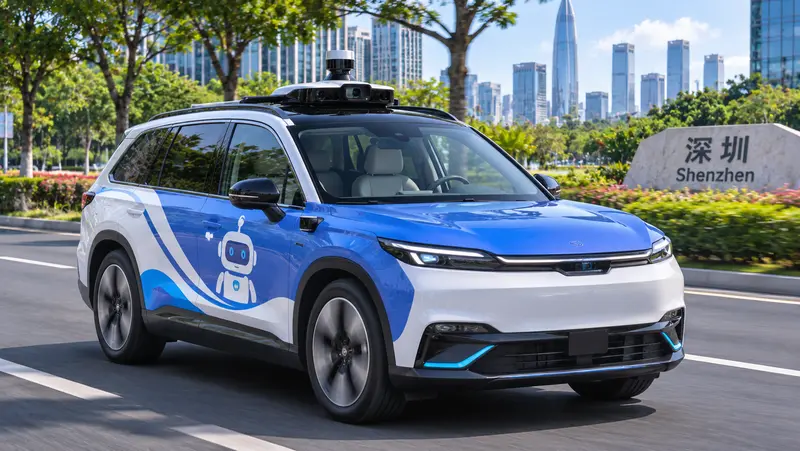
For a first-time visitor, the clearest sign of that shift is a short ride. The app counts down to one minute before the taxi arrives. A blue and white SUV with a small robot graphic on its sides then approaches through light traffic. It looks like any other car, except that no one is behind the wheel.
Pony.ai is among the companies running driverless fleets in Shenzhen, and its vehicles carry a robot mascot called "Popo". The cars depend on dense sensor arrays that combine dozens of lidar, camera and radar units, giving a 360-degree view that reaches hundreds of metres around the vehicle.
Driverless rides and drone delivery networks are regular fixtures of western Shenzhen. During the summit days, though, some services were temporarily scaled back or restricted in certain areas.
Shenzhen is known as a place to see driverless taxis, robots and electric vehicles, although some of the technologies involved cannot be seen from the street. The robotaxi is simply the easiest piece of a wider effort to photograph.
Some of these advances can now be found in other Chinese cities. Even so, Shenzhen has long been counted among the country's leading technology centres, and it is the base for several of its best-known companies: the telecommunications firm Huawei, the electric vehicle maker BYD, and the internet and gaming giant Tencent.
From fishing village to special zone
The city's change of fortune dates to 1980, when China was opening up its economy. Then-leader Deng Xiaoping declared the former fishing village one of the country's first special economic zones. Inside those zones, the Communist Party would allow free enterprise.
That decision set Shenzhen apart from most of China at the time, and it is the reason the city is so often used as shorthand for the country's economic turn. Four decades on, the place designated for market experiments hosts a gathering of leaders from across the Asia-Pacific.
Gary Ng, senior economist for Asia Pacific at the French bank Natixis, said the city carries symbolic weight. "Shenzhen is one of the most important symbols of China's reform and opening up through its strong global role in trade, manufacturing, and innovation," he said.
The three companies most closely tied to the city each work in a field where Beijing and Washington are competing. Huawei is a telecommunications firm, BYD builds electric vehicles, and Tencent runs internet and gaming businesses. Their presence gives the host city a link to the technology contest that hangs over the summit.
That contest is also why the setting matters beyond ceremony. Leaders arriving for the summit are meeting in a city that stands for the policy shift that made China's present economy possible, at a time when the world's two largest economies are negotiating over trade and technology.
Tours for visiting journalists
Reporters covering the summit have been taken to places where Shenzhen says its technology is put to everyday use. One stop was the Harmony Ecosystem Innovation Center, a hub for China's own Harmony smart operating system. The centre illustrates how the software is applied in settings ranging from smart factories to connected homes.
Another was Tencent's headquarters campus in Qianhai, which is still expanding and is due to be fully completed by 2030. The campus serves as a living testbed for AI-driven campus management, service robots and autonomous shuttles. Visitors see those systems running in daily use rather than in a demonstration hall.
The two stops cover different ground. The Harmony centre is about software that sits inside factories and household devices, while the Qianhai campus is about machines moving through a working workplace. Together they give the visiting press a picture of a technology sector that extends well beyond the robotaxis on the streets.
For the host, the arrangement is straightforward. Delegates and journalists who came for a summit of Asia-Pacific economies can ride in a car without a driver, watch a robot at work and walk through a campus that Tencent is still building out.
About the Author
P
Prateek Rawat
Staff Writer
Prateek Rawat is a contributor to Wirony. All articles published under this byline undergo editorial review and approval before publication, with any necessary corrections handled…
P
4 min
What did you think?