/
ASEAN leaders condemn Myanmar violence and extend ban on its leader
ASEAN leaders meeting in Manila on 15 November said Myanmar has not complied with the 2021 peace plan and kept its leader and foreign minister barred from summits until there is meaningful progress.
S
4 min
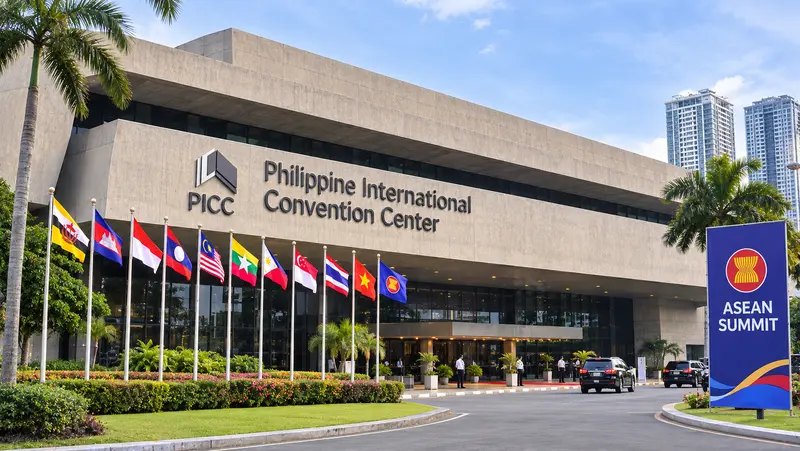
Southeast Asian leaders said on Sunday, 15 November 2026, that Myanmar has failed to comply with a 2021 peace plan and that its military and other armed groups are still attacking civilians. As a result, they extended a ban on Myanmar's leader attending the bloc's annual summits.
The rebuke came as leaders of the Association of Southeast Asian Nations opened their yearly summit meetings in the Philippine capital, Manila. Their first order of business was a review of how far Myanmar's military-backed government had got with the five-point peace plan. Myanmar is one of the 11 members of the regional bloc.
The leaders reiterated what they called "deep concern" over insufficient progress in carrying out the plan. They urged all parties and stakeholders in Myanmar, "in particular the armed forces, security forces and armed groups to de-escalate violence and stop targeted attacks against civilians and civilian infrastructure and enhance trust-building efforts."
How the ban works
The restriction covers two posts: Myanmar's leader and its foreign minister. Both stay barred from ASEAN summit meetings "until there is meaningful progress in the implementation" of the peace plan, the leaders said.
In practice, Myanmar can send only lower-level career diplomats to the bloc's meetings, including the ones now under way in Manila. Han Win Aung, the director-general of Myanmar's ASEAN Affairs Department, was at the 49th summit retreat sessions on Sunday and at a separate interface between the leaders and representatives of the ASEAN Inter-Parliamentary Assembly at the Philippine International Convention Center in Pasay City. He appeared in the group photograph alongside the heads of government.
The leaders posing with him were Malaysian Prime Minister Anwar Ibrahim, Thai Prime Minister Anutin Charnvirakul, East Timorese Prime Minister Xanana Gusmao, Vietnamese Prime Minister Le Minh Hung, Philippine President Ferdinand Marcos Jr., Singapore Prime Minister Lawrence Wong, Brunei's Sultan Hassanal Bolkiah and Indonesian President Prabowo Subianto. Cambodia was represented by Deputy Prime Minister Hangchuon Naron and Laos by Prime Minister Saleumxay Kommasith.
What the plan asks for is specific. Among other measures, it calls for an immediate end to hostilities and for dialogue mediated by the bloc's special envoy. The leaders' language shows that neither step has taken hold.
Summit documents also set out a calibrated, progress-based pathway. It leaves open the possibility of gradually restoring Myanmar's full political participation, but only if there is verifiable, sustained action toward ending the fighting and starting a national dialogue. Until then, the political ban stands.
The consequences of the conflict have already reached the bloc's own calendar. Myanmar had been due to hold ASEAN's rotating chair, but it was passed over because of the civil war, and the chairmanship went to the Philippines, this year's host.
Roots of the plan and the toll
ASEAN leaders proposed the five-point plan in April 2021. The aim was to ease the violence that broke out after the army seized power from the elected government of Aung San Suu Kyi. The takeover set off widespread pro-democracy protests, which were brutally put down. That in turn led to armed resistance and a civil war that has since spread across much of the country.
Outside the summit hall, the pressure on the military-backed government has come from other directions. Last month, a United Nations human rights investigator said the government was intentionally attacking civilians to terrorise them and force them into submission. The summit statement's call to stop "targeted attacks against civilians and civilian infrastructure" echoes that charge.
The human cost is tracked by the Assistance Association for Political Prisoners, an independent organisation that keeps detailed tallies of arrests and casualties linked to the civil war. Its figures show more than 8,600 people have been killed and 32,406 arrested by Myanmar's security forces.
On Sunday, activists and student protesters also demonstrated against Myanmar President Min Aung Hlaing at a building in Quezon City in the Philippines, holding signs and banners. Photographs from the day show the protest running in parallel with the leaders' sessions.
Where the bloc stands
The decision keeps ASEAN to the position it has held since the plan was drawn up: engagement with Myanmar's government is conditional, and the condition is movement on the plan's terms. The leaders did not announce sanctions or new demands on Sunday. They restated the existing ones, named the groups they want to stop attacking civilians, and left the ban in place.
That the statement names the armed forces and security forces first, then armed groups more broadly, is notable for a bloc that often words its positions cautiously. It places responsibility on the military-backed government's own forces while also addressing the armed opposition, and it asks all of them to pull back from attacks on civilians and on civilian infrastructure.
The summit meetings in Manila are continuing. For now, the military-backed government remains a member with a reduced seat: present at the table through career diplomats, absent at the level where decisions are made. The leaders have set no date for revisiting the ban. They tied its end to meaningful progress in carrying out the plan, and left the bloc to judge that.
About the Author
S
Subhash Gupta
Desk Editor
Subhash Gupta is a writer at Wirony, contributing articles that are reviewed and verified by the editorial team before publication. The publication prioritises accuracy, editorial…
S
4 min
What did you think?