/
Supreme Court: the 24-hour custody clock starts at actual detention, not at the formal arrest
Justices Ujjal Bhuyan and Atul S. Chandurkar have held that the 24-hour limit in Article 22(2) runs from the moment liberty is curtailed, not when police record an arrest. Anyone held longer without a magistrate's order must be released at once. It follows a September ruling by the same bench.
A
5 min
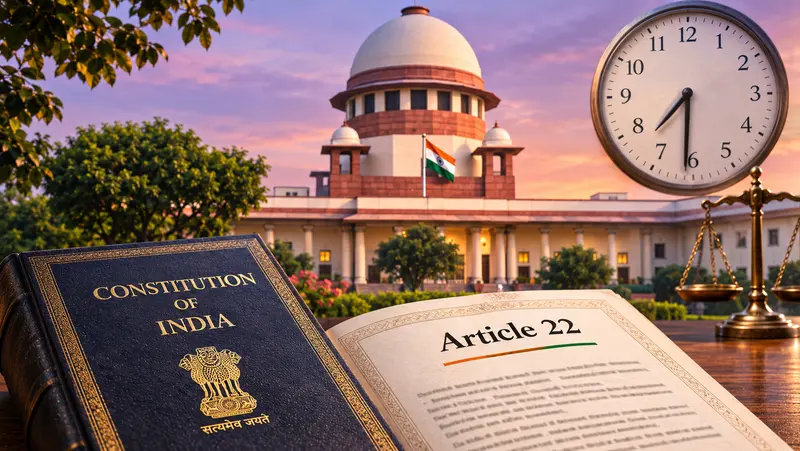
The Supreme Court has held that the 24-hour period within which an arrested person must be produced before a magistrate starts at the moment of actual detention, when the person's liberty is curtailed, and not when the police formally record an arrest. A bench of Justices Ujjal Bhuyan and Atul S. Chandurkar said so while hearing appeals by four persons against a Tripura High Court decision that denied them bail in a case under the NDPS Act. The ruling was reported on 5 November 2026.
The court rejected the distinction between detention and formal arrest for this deadline. Treating the period as beginning only after search, seizure and a formal arrest was entirely unconstitutional, it said. If detention goes on beyond 24 hours without production before a magistrate, the person must be released immediately.
What Article 22(2) says, and the gap the ruling closes
Article 22(2) of the Constitution requires that every person arrested and detained in custody be produced before the nearest magistrate within 24 hours, excluding the time needed for the journey from the place of arrest to the court. No one can be held beyond that period without a magistrate's authority.
The purpose is simple. A judicial officer, and not the police, must decide quickly whether continued custody is justified. The practical weakness has always been the start of the clock. A person may be stopped at a checkpoint, taken to a police station or held during a search, and the arrest memo may record a time many hours later. In NDPS cases, where searches and seizures can run long, the difference can be substantial. If the clock begins only when the paperwork says so, the 24-hour guarantee can be shortened on paper while a person is in fact in custody for much longer.
The bench has now closed that route. The test is factual: when was this person's liberty curtailed? From that point, 24 hours run, and the time must be calculated from the date and time of actual detention.
How it fits with the September judgment
The same two judges laid the groundwork in Jaskaran Jeet Singh Deol v. State of Punjab, decided on 21 September 2026 and reported as 2026 INSC 1022. That appellant was arrested at 7.55 am on 17 May 2026, produced before a duty magistrate at noon the next day, more than 24 hours later, and released at 3 pm after the magistrate held the arrest illegal for failure to give written grounds of arrest. The real dispute was over what the police could do next.
The court set out a clear procedure, building on its earlier ruling in Mihir Rajesh Shah. An accused released because of a breach of Article 22 cannot simply be picked up again by the same officers. If the investigating agency still believes custody is needed, it must apply to the magistrate, giving reasons for the re-arrest and an explanation for the earlier breach. The application must carry the endorsement of the officer's immediate superior, so that the superior knows a constitutional provision has been violated. The magistrate should decide, preferably within a week, after following natural justice. "It must have the judicial imprimatur," the court said of the power to re-arrest.
It added that the same procedure applies to a breach of Article 22(2), and that a High Court may, depending on the facts, direct payment of compensation as a public law remedy, leaving the person free to file a civil claim. The court ordered that the judgment be sent to all Directors General of Police, High Court registrars and state judicial academies.

Taken together, the two rulings form a compact rule. The clock starts when liberty is curtailed. If it runs out, release must follow. A fresh arrest then needs a magistrate's permission. And the police may have to pay for the breach.
Why it matters
The effect is widest in cases that begin with a stop or a search, not a warrant: NDPS, excise, customs, cyber and economic offences. In such cases, the arrest memo has often been treated as the starting point. Police forces will now have to record the actual time a person was stopped and kept from leaving, and defence lawyers will be able to test that time against call records, CCTV, station diaries and the seizure papers.
The ruling does not mean that every investigation falls apart. The court's remedy is release from illegal detention. It does not decide guilt, and in the September case it said it was expressing no opinion on the merits of the accusation. Investigators keep the power to seek custody through a magistrate. Critics in law enforcement will argue that complex searches take time and that a strict clock will hamper serious cases, particularly under laws with tight bail conditions. However, the court's reply in September was blunt: the constitutional procedure must be rigorously observed, however strange that might sound to some.
Article 22 also has limits. The 24-hour rule does not apply to enemy aliens or to persons held under preventive detention laws, which have their own safeguards, and journey time to the magistrate is excluded.
The practical steps follow directly from the rulings. Note the exact time and place the person was stopped or taken away, and who was present. Ask for the arrest memo and check the time written on it. Tell the lawyer and, at the first production, tell the magistrate if the recorded time is wrong. The September judgment records the argument, drawn from the court's old ruling in Khatri v. State of Bihar, that magistrates are duty bound to ensure compliance with Article 22(2) of their own accord, and the court directed that the judgment also go to judicial academies.
The written judgment in the Tripura appeals had not been located on the court's website at the time of writing, so its precise wording, and any further directions, should be read when it is published. This article is for information and is not legal advice.
Sources
About the Author
A
Amita Sahani
Staff Writer
Amita Sahani writes for Wirony. Every story under this byline is reviewed and approved by an editor before it is published, and corrections are made openly.
A
5 min
What did you think?