/
Israel election: Netanyahu's bloc at 53 seats, eight short of majority; Eisenkot's bloc on 48; deadlock likely
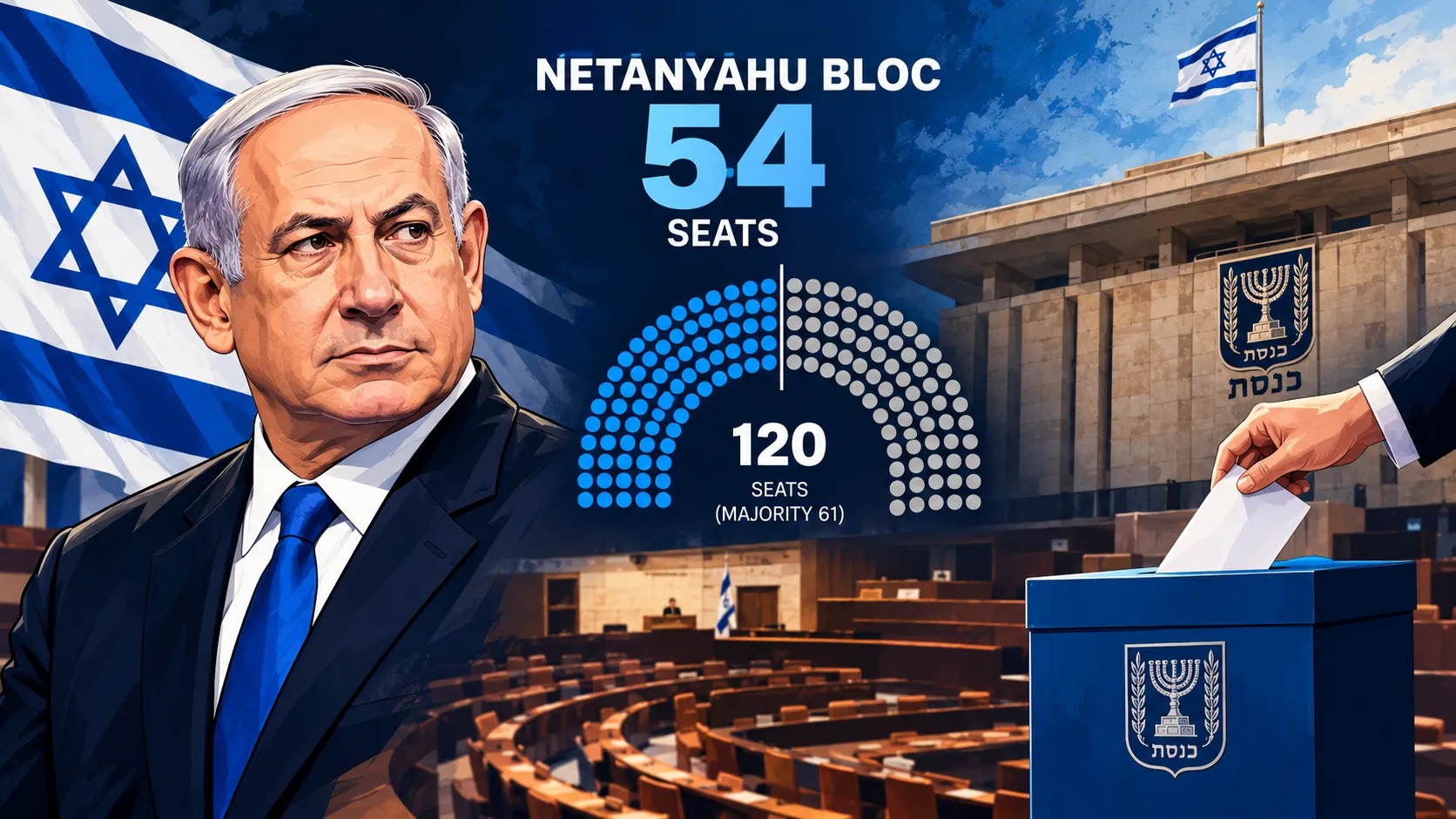
With about 93% of polling stations counted, Netanyahu's right-wing and religious bloc has 53 seats, eight short of 61, Eisenkot's bloc 48 and Arab parties 19. Likud leads with 26. More than 500,000 double-envelope ballots remain, and Israel may stay under a caretaker government.
A
4 min
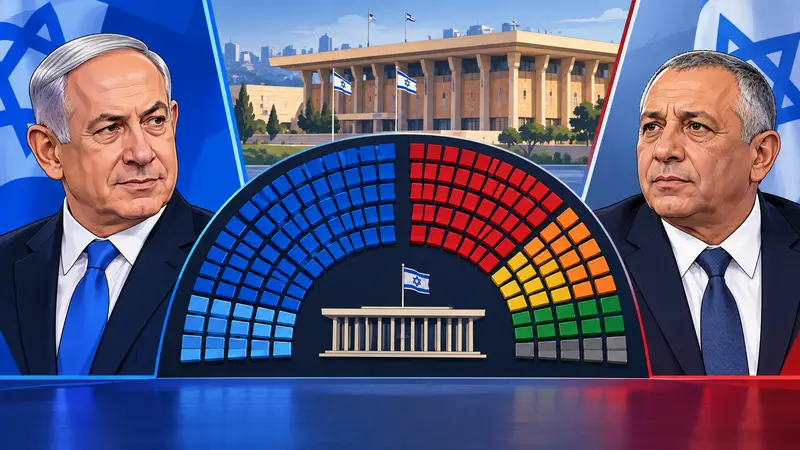
Israel's election has produced a deadlock. With about 93 per cent of polling stations and 85.6 per cent of votes counted by Wednesday night, Prime Minister Benjamin Netanyahu's right-wing and religious bloc had a projected 53 seats in the 120-seat Knesset, eight short of the 61 needed for a majority. Former military chief Gadi Eisenkot's bloc had 48, and the mainly Arab parties together had 19. Voting took place on Tuesday, 27 October, in the 26th Knesset election.
The seats so far
Netanyahu's Likud is the largest party with 26 seats, followed by Eisenkot's Yashar! with 21. The figures below are projections from the count, and some of them changed during the day.
| Bloc | Party | Seats |
|---|---|---|
| Netanyahu bloc | Likud | 26 |
| Netanyahu bloc | Religious Zionism-Zehut | 6 |
| Netanyahu bloc | United Torah Judaism, Shas, Otzma Yehudit | 7 each |
| Opposition bloc | Yashar! (Eisenkot) | 21 |
| Opposition bloc | Beyachad (Bennett and Lapid) | 12 |
| Opposition bloc | The Democrats (Yair Golan) | 8 |
| Opposition bloc | Yisrael Beytenu (Avigdor Liberman) | 7 |
| Arab parties | Joint List | 12 to 13 |
| Arab parties | Ra'am | 6 to 7 |
Ra'am rose from four seats to six early on Wednesday, partly because of results from towns such as Rahat. Two small parties missed the electoral threshold, with the Reservists-Economic list short by 19,803 votes and Amcha Israel by 54,888 votes.
What is still to be counted
The Central Elections Committee expects more than 500,000 double-envelope ballots, which include votes from soldiers and others who vote outside their assigned stations. Counting them runs from around midnight on Wednesday to Thursday evening. The committee said that it is too early to judge their effect on the seats, and the results will be nearly final but not fully certified until further checks next week. The army said that 79.9 per cent of its personnel voted, a rise of 6.2 per cent from the previous election.
The statements
Eisenkot said that his side had made history and that the public had chosen change, and he called on Netanyahu to step down. He has rejected serving under Netanyahu, including in a rotation arrangement. Netanyahu, speaking in Jerusalem, called for Zionist forces to unite and thanked his loyal partners in the outgoing coalition. Yair Golan of the Democrats said that Netanyahu had lost and that the opposition reaches 65 seats when the Arab parties are counted, though the figures above add up to 67. Joint List chairman Yousef Jabareen said that his party is ready to use its strength to remove the Netanyahu government.
Neither side has a path to 61 seats without the other or without the Arab parties. A unity government of Netanyahu and Eisenkot looks unlikely, and other opposition leaders have ruled out joining a coalition led by Netanyahu. Opposition figures are reluctant to rely on the Arab parties, which complicates the other route. Exit polls raised the possibility of a minority government that could win a confidence vote without 61 seats. The deadlock could lead to another election, though talks could still produce a deal.
Sources say that US President Donald Trump does not want Itamar Ben-Gvir, and probably not Bezalel Smotrich, in Netanyahu's next government. Netanyahu has reportedly assured both that he will not abandon them.
Eisenkot wants the leader of the largest opposition party to be the bloc's candidate for prime minister, which would be his own Yashar!, and no agreement on this has been announced. Disagreement among the opposition parties over whether to depend on the Arab parties is the other obstacle to a government without Netanyahu.
Israel could remain under a caretaker government during the talks. It keeps the same formal powers but is expected to show restraint on decisions that cannot be reversed. A decision on war has to be approved by the government or the security cabinet, not by the prime minister alone, and officials assess that any military action would receive unanimous approval. The shekel weakened as the results came in.
The President decides which candidate is asked first to try to form a government, once the official results are in. The count of the double-envelope ballots on Thursday could move a seat or two between the blocs. For India, the outcome matters because of the conflict in West Asia, in which 22 Indians have died, and because of trade and defence ties with Israel, though no change in policy is expected before a government is formed.
A
4 min
What did you think?