/
IMF says rupee should be India's first line of defence against energy shocks; El Niño a risk to 7% growth
The IMF wants India to let the rupee adjust freely to energy-price shocks, saying flexibility is preferable to heavy intervention. It would consider tighter policy if sharp depreciation lifts inflation. Its 7% growth projection faces a downside risk from a possible super El Niño.
A
4 min

The International Monetary Fund has told India that the rupee should be the first line of defence against energy-price shocks, and that the currency should be allowed to adjust freely instead of being propped up by heavy intervention. The Fund also flagged weather, including a possible super El Niño, as a downside risk to its projection of 7% growth for India in both FY27 and FY28.
What the IMF said about the rupee
The Fund said that the rupee should be the first line of defence in the face of the ongoing energy shocks, and that it wants the currency's value to adjust freely because this is important for India's economic adjustment. It said that foreign exchange intervention can be appropriate when markets become disorderly, in line with its Integrated Policy Framework, but that for India exchange rate flexibility is the preferable response.
At a media briefing in Mumbai on Wednesday, 21 October, Krishna Srinivasan, director of the Fund's Asia and Pacific Department, said the recommendation to countries was to use the exchange rate as the primary line of defence in the light of persistent shocks. He said that foreign exchange interventions had not been especially effective beyond the short term in addressing the oil shock.
The Fund also said that if a sharp fall in the rupee were to push up inflation across the economy, it would consider tighter monetary policy to preserve price stability.
What the RBI has done
The Reserve Bank of India has sold dollars from its reserves to support the rupee. It has set up a special facility to supply dollars to oil companies and has adjusted reserve requirements for large hedge positions. The rupee fell to near-record lows earlier in October and has since recovered about 2% after the central bank's steps, according to one report, which does not give an exact exchange rate.
Ranil Salgado, the Fund's senior representative for India, Bhutan and the Maldives, said the central bank's foreign exchange measures announced in June were largely favourable because they helped attract capital inflows. In June, India cut taxes on foreign investment in government bonds, and it raised USD 134 billion through a dollar deposit initiative aimed at the Indian diaspora.
Growth and the El Niño risk
The Fund had earlier projected growth of 7% for India in both FY27 and FY28. In its report titled Resilience Under Strain, Urgent Choices, it said that India's growth had remained robust, supported by domestic demand and services, despite higher oil prices. It said that weather events, including what it called a super El Niño, are a downside risk. These risks have not yet materialised, it said, and will be reassessed in its January World Economic Outlook update.
The Fund explained how a poor weather outcome would feed through. Worse-than-expected weather could lower crop yields, weigh on activity, particularly in rural areas, and raise food price inflation, which would reduce household purchasing power.

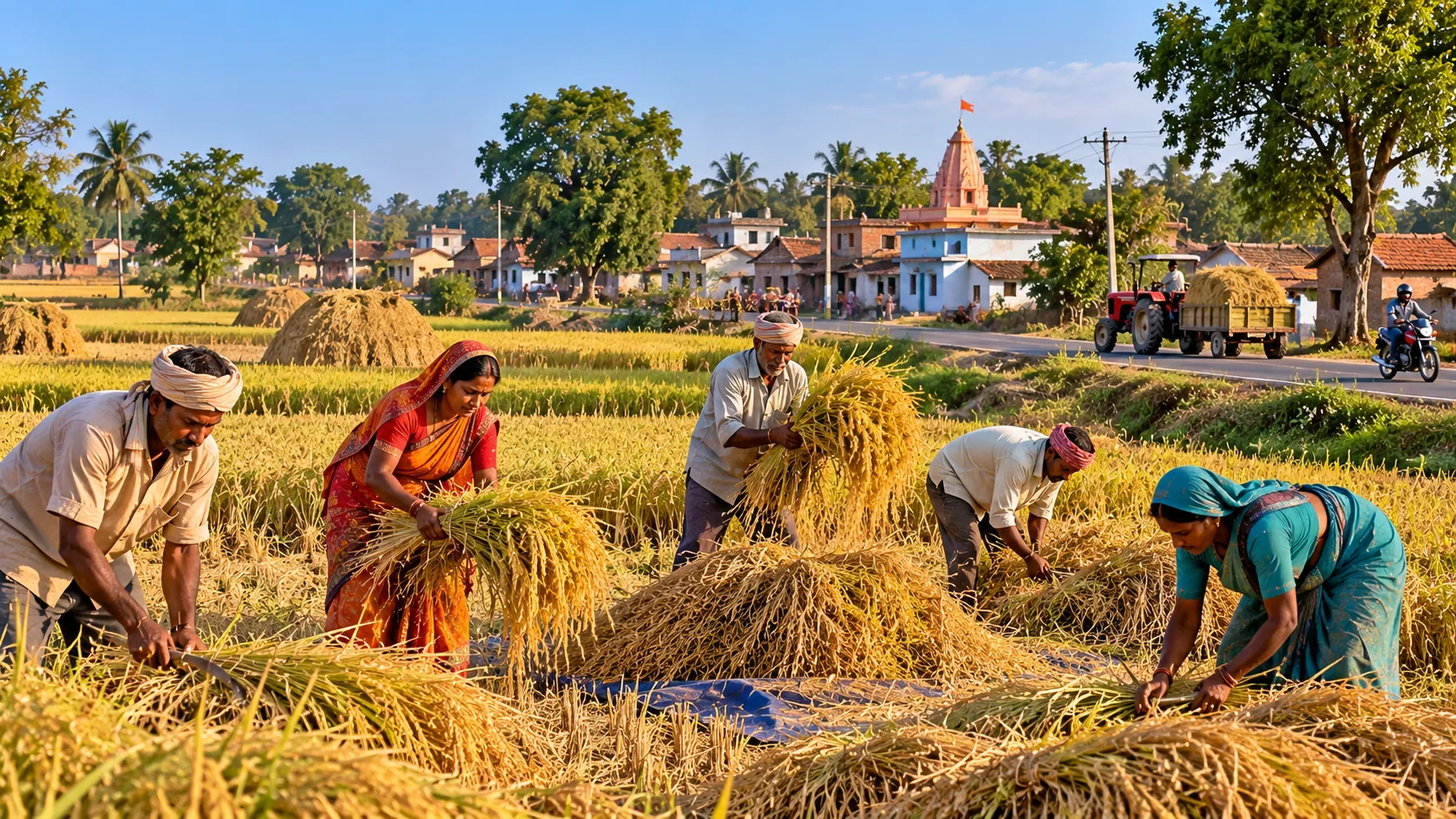
The Fund raised India's growth projection for 2026-27 to 7.0%, which is 60 basis points above its July estimate, citing stronger-than-expected momentum from resilient domestic demand and robust services activity. The Reserve Bank of India's October bulletin, released on 23 October, takes a similar view. It says the economy is anchored by solid fundamentals and policy steps that cushion downside risks, and that growth has been supported by domestic demand and services even though India is a net energy importer. Kharif sowing ended above normal, even though the southwest monsoon was deficient and uneven.
The bulletin also records the pressure points. Headline consumer price inflation rose in September on broad-based increases in food, fuel and core components, and the bulletin said it showed signs of greater generalisation across commodities. It called for a commensurate change in the monetary policy stance. On the external side, merchandise exports grew at a double-digit rate in the first six months of the year and the trade deficit narrowed in September, and strong inflows under the FCNR(B) swap window boosted forex reserves. The rupee had a depreciating bias until early October and then gained after central bank measures to curb speculative activity in the forex market.
The same report projects global growth of 3.1% in 2026 and 3.4% in 2027. Global inflation is expected to reach 4.7%, driven mainly by higher energy and food prices.
The advice is a statement of principle, not a prediction of where the rupee will go. The Fund is saying that a currency that moves with the shock absorbs part of it, and that reserves should be kept for moments when the market stops working properly. The central bank has so far used both approaches, selling dollars while also taking steps to bring in capital. The reports found do not say whether the central bank intends to change its approach, and they give no figures for its reserves or for the amount of dollars sold.
The Fund said it will reassess the weather risks to growth in its January update.
A
4 min
What did you think?