/
Aavin raises prices of ghee, butter, curd and sweets from 28 October ahead of Diwali; milk packets unchanged
Tamil Nadu's Aavin has revised the prices of 63 to 67 milk products from 28 October, among them ghee, butter, curd, milkshakes and sweets, citing higher raw material and operating costs. A 100 g butter pack goes to Rs 70 and 250 g of gulab jamun to Rs 115. Reports say milk packets are not affected.
A
4 min
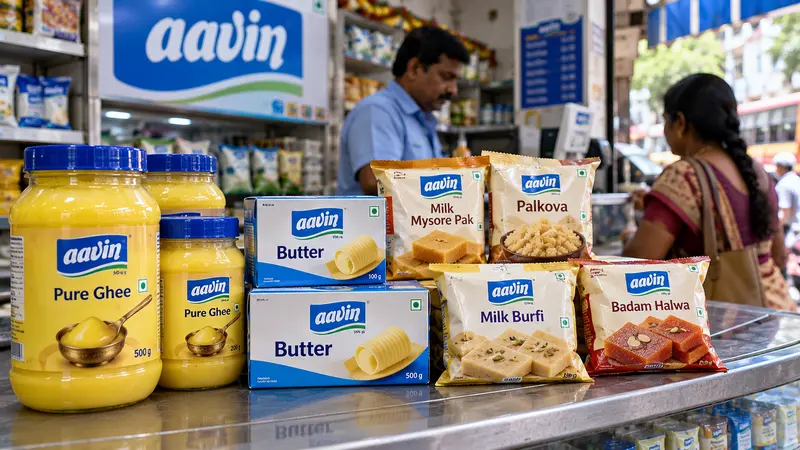
Aavin, the milk cooperative of Tamil Nadu, has raised the prices of dozens of its milk products from 28 October, just before Diwali. The Tamil Nadu Co-operative Milk Producers' Federation issued the circular on Tuesday, 27 October. It covers ghee, butter, curd, milkshakes and sweets, and the federation says it was forced to act by a notable increase in raw material costs, procurement expenses and other operating costs. Reports say that the prices of regular packets of milk are not changed.
The number of products
Sources do not agree on how many products are covered. One report says the revision covers 67 products, while others speak of 63. The difference may be a matter of how variants and pack sizes are counted. The effective date of 28 October is the same in all the reports, and the circular applies across the state.
The reports give these figures for the revised prices.
| Product | New price |
|---|---|
| Butter | Rs 70 per 100 g |
| Ghee | Rs 55 for a 50 ml jar, up to Rs 4,000 for a 5 litre pack |
| Ghee, bulk | Rs 13,000 for a 15 kg tin |
| Gulab jamun | Rs 60 for 125 g; Rs 115 for 250 g |
| Rasagulla | Rs 50 for 100 g; Rs 95 for 200 g |
| Mysore pak | Rs 160 for 250 g |
The old prices are given differently in different reports. For butter, the 100 g pack rises from Rs 60 to Rs 70 in most of them. For ghee, the 100 ml pack goes up from either Rs 80 or Rs 85 to Rs 95, and one source says the 200 ml pack goes to Rs 180 from Rs 160. Gulab jamun in the 250 g pack goes to Rs 115 from Rs 100, and Mysore pak to Rs 160 from Rs 140. Curd and milkshakes also cost more. Buyers should check the price list on the pack or in the Aavin parlour, since the figures in the news reports are not an official list.
The timing
The increase comes in the week before Diwali, which is the time of the year when the demand for ghee, butter and sweets is at its highest. Households use ghee in cooking and in prayers, and sweets are bought in large quantities for gifts. The federation has not explained why it chose this date, but the effect is that the largest buying season of the year will be at the new prices.


It is also the first increase in the prices of ghee, butter and other products since the present government of Chief Minister C. Joseph Vijay took office, according to one report, which makes it a political issue as well as a commercial one. The opposition has not yet reacted in the reports that are available.
The federation points to the rising price of the raw material, which in the dairy trade means milk fat and milk solids. Dairy cooperatives pay farmers a procurement price, and when that rises, the cost of making ghee and butter rises faster, since it takes a large quantity of milk to make a kilogram of ghee. Costs of packaging, transport and power add to the pressure. The federation has also kept the price of milk, which is the product that most households buy every day, from going up, according to the reports, and a rise in the price of the processed products is one way of covering the cost without touching the price of milk.
For a household that uses a small amount of ghee and butter, the change is a matter of a few rupees on each pack, but the total effect will be noticeable for families that buy sweets in bulk or run small food businesses. The reports say that the increase will affect household monthly grocery budgets across the state.
Private brands that compete with Aavin have their own prices, and the change may narrow or widen the gap with them. Aavin has a reputation for lower prices than private brands, and customers will watch whether that remains so. For the farmers who supply milk to the cooperative, a higher price for products can support a better procurement price, though the reports do not say whether any change in what the farmers are paid is planned.
About the Author
A
Amita Sahani
Staff Writer
Amita Sahani writes for Wirony. Every story under this byline is reviewed and approved by an editor before it is published, and corrections are made openly.
A
4 min
What did you think?