RBI governor warns next financial crisis could begin with cyberattack or tech failure
RBI Governor Sanjay Malhotra warned on Oct 3 that the next financial crisis could be triggered by cyberattacks, tech failures or geopolitics, not banks. The caution comes as the rupee weakens and portfolio outflows persist, with IMF risk reports due this month.
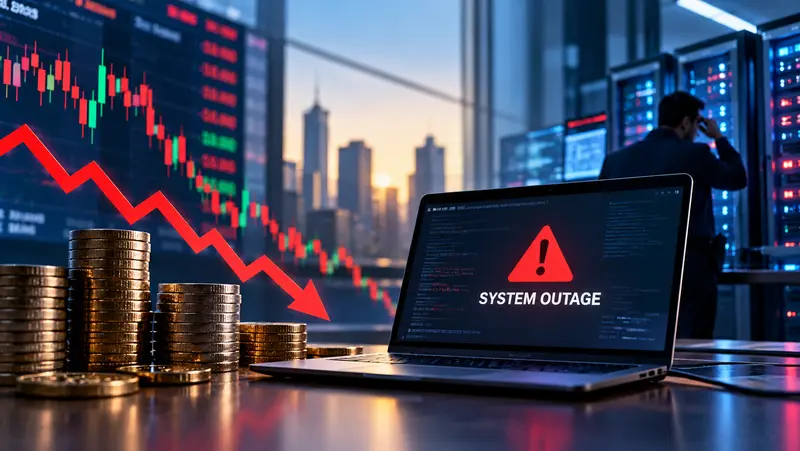
Reserve Bank of India Governor Sanjay Malhotra warned on October 3 that the next financial crisis could be sparked by a geopolitical shock, a cyberattack or a technology failure, arguing that modern finance is now vulnerable to disruptions that begin outside banks and spread rapidly through markets, payments and critical service providers.
Speaking at the Kautilya Economic Conclave in New Delhi, Malhotra said the system’s current strength should not be mistaken for permanent safety. “Today’s resilience may not necessarily imply tomorrow’s immunity,” he said, urging regulators and financial firms to keep scanning for weak spots and to invest in crisis readiness across the wider financial ecosystem.
The remarks land at a moment when India is not facing a declared banking panic or a run on deposits, but when several familiar pressure channels are visible at once: a weaker currency, foreign portfolio outflows, and tighter global financial conditions. Together, they have sharpened public debate over what a “financial crisis” would look like in India in 2026, and whether the biggest risks now sit in code, connectivity and cross-border shocks rather than in loan books alone.
A crisis that starts outside banks
Malhotra framed financial stability as the ability to absorb shocks and contain damage, rather than the ability to prevent shocks altogether. He pointed to the experience of the past two decades, warning that stress can build quickly and take years to unwind.
“Our experience of the past two decades offers an important lesson: banking stress can build quickly and take years to resolve. It took nearly a decade to clean up the legacy of excessive lending and NPAs from the early 2000s. We cannot afford to become complacent; the economic and financial costs of allowing vulnerabilities to build up are simply too high,” he said.
In his view, the next crisis trigger may not come from a conventional bank failure. Instead, he suggested a chain reaction could begin with a war or other geopolitical event, or with a cyber incident or technology breakdown that disrupts trading, payments or access to liquidity. The warning extends beyond lenders to financial markets, payment networks, technology infrastructure and the third-party vendors that keep those systems running.
He also flagged risks tied to artificial intelligence, saying it can worsen cyber threats and introduce new vulnerabilities through faulty models, dependence on outside suppliers and weaker human oversight. Reports also quoted him as cautioning about high prices in AI-related stocks and the possibility that a pullback in spending or weaker earnings could set off a sharp drop in asset prices.
The central message was preventative: strengthen the plumbing before it fails. That includes operational resilience, contingency planning and faster recovery when systems go down.
Stress signals, not a crash
Even without a single “crisis day,” recent market moves have fed anxiety. On October 1, the rupee ended at 96.31 per US dollar, with reports attributing the slide to elevated crude prices, rising US yields and foreign investor selling. Traders also said the RBI sold dollars to limit the fall.
The same reporting described a rough month for equities, saying the Sensex and Nifty 50 fell 6% in September. Separate reporting put the scale of foreign portfolio selling in starker terms: foreign portfolio investors pulled out ₹36,000 crore from Indian equities in September, with total withdrawals in 2026 at ₹2.69 lakh crore.
None of those data points, on their own, confirms a systemic breakdown. But they map the usual routes by which financial stress can become self-reinforcing. A weaker currency raises the local cost of imports and can complicate inflation control. Higher global yields tighten funding conditions and can pull capital toward dollar assets. Persistent outflows can amplify market swings and strain liquidity during periods of risk aversion.
Liquidity conditions at home have also drawn attention. On September 29, it was reported that the RBI absorbed more than Rs 6 lakh crore from the banking system through variable rate reverse repo auctions during the month. Such operations are a routine part of liquidity management, but they are closely watched when currency pressure and global tightening coincide.
Outside the market headlines, the phrase “financial crisis” is also being used in a more literal, household sense. Local reports from Uttar Pradesh described farmers in Raebareli district facing an “economic crisis” after waterlogging damaged paddy crops, leaving families worried about daily expenses and children’s school fees. In Bihar’s Munger, another local report said principals at 14 colleges had gone without salary for four months amid issues tied to pending National Pension System contributions.
Those episodes are not evidence of a national financial-system crisis. They do, however, show how quickly financial stress becomes real for households when income is disrupted, costs rise or institutional payments stall.
What to watch in October
Malhotra’s warning aligns with a broader international theme: that operational and geopolitical shocks are becoming a more prominent source of financial instability. Australia’s central bank, in its October 2026 financial stability review, said global and operational vulnerabilities were mounting even as it judged its own system resilient.
The International Monetary Fund has also described the global environment as more “shock-prone,” with high uncertainty and elevated debt levels complicating the task of maintaining stability.
Fresh global risk analysis is due soon. The IMF’s Global Financial Stability Report package is scheduled to roll out in stages during the IMF and World Bank annual meetings in Bangkok. The calendar includes:
- Chapter 2, “Hedge Funds and Financial Stability,” scheduled for release on October 6.
- Chapter 3, “Tokenization of Financial Assets: Opportunities and Risks,” scheduled for October 8.
- The main launch of the October 2026 report scheduled for October 13.
For Indian policymakers and market participants, those releases will be watched for how they assess cross-border spillovers, the resilience of non-bank finance, and the operational risks that could transmit shocks through payments and market infrastructure.
For now, the RBI governor’s message was less a prediction of imminent collapse than a push to widen the definition of financial stability. In a system where trading, credit and payments depend on always-on technology and complex vendor chains, a crisis may start with a keyboard, a cable or a conflict far from Dalal Street, and reach balance sheets only after the damage is already in motion.
What did you think?