/
Royal Enfield reveals Himalayan 750 ahead of EICMA, cruise control and 750cc twin expected
Royal Enfield revealed the Himalayan 750 on 2 November 2026 ahead of EICMA in Milan. The 750cc parallel-twin adventure tourer is expected to bring cruise control, traction control and a colour TFT with Maps. An India debut is expected around Motoverse later in November, with pricing anticipated a...
R
4 min
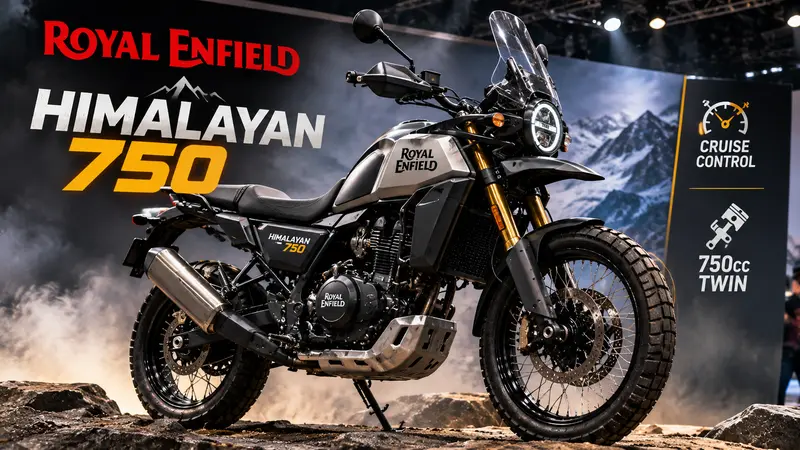
Royal Enfield has pulled the wraps off the Himalayan 750 on 2 November 2026, giving the clearest look yet at what is set to become the biggest-capacity motorcycle in its production line-up and its first parallel-twin adventure tourer.
The reveal comes days before EICMA 2026 opens in Milan on 3 November, where the company is expected to share detailed specifications and positioning. An India-facing debut is expected later this month around Motoverse, where Royal Enfield typically uses the stage to lock in launch timing and variants.
Bigger Himalayan, new electronics
Visually, the Himalayan 750 keeps the upright, go-anywhere stance associated with the Himalayan name, but it looks notably larger than the Himalayan 450. The new bike has a wider, more sculpted fuel tank, a tall windscreen, and a chunky lower bash plate that signals its off-road intent. The overall silhouette suggests a motorcycle aimed at long days in the saddle, with the added bulk and road presence that comes with a bigger engine and touring hardware.
Equipment levels also move the Himalayan line into territory Royal Enfield has not offered before from the factory. The Himalayan 750 is expected to get ride-by-wire, multiple riding modes and traction control, along with cruise control. Reports also point to an available tyre pressure monitoring system (TPMS), a feature still rare in this price band in India.
A circular full-colour TFT display is expected to handle the bike’s connected features. The interface is set to include Google Maps navigation and smartphone pairing, alongside a USB Type-C charging port aimed at riders who rely on phones, action cameras and GPS devices while travelling.
Parallel-twin power and touring hardware
At the centre of the new model is a 750cc parallel-twin engine. Early reports describe it as an oil-cooled unit paired with a six-speed gearbox and a slip-and-assist clutch, a combination designed to make highway speeds easier to hold and reduce fatigue during long stints.
While Royal Enfield has not released performance figures in the material available so far, the Himalayan 750 is being positioned above the Himalayan 450 as the brand’s most powerful adventure tourer. The move also plugs a gap for riders who want more relaxed overtakes and stronger cruising ability than single-cylinder adventure bikes typically provide.
Chassis and braking hardware appear to have been upgraded to match the step up in output and weight. The bike is expected to run twin front disc brakes with ByBre calipers, a single rear disc, and dual-channel ABS with a switchable rear function for loose surfaces. Suspension details have not been formally confirmed in the available information, but reports around the EICMA build-up have pointed to upside-down front forks.
Wheel options are expected to split the range into two clear personalities: a road-biased version with alloy wheels and an off-road-oriented version with cross-spoke wheels. That two-pronged approach mirrors how many global adventure models are sold, giving buyers a choice between easier tubeless road use and more trail-friendly hardware.

Colour options have also been signalled early. The motorcycle has been shown in five shades: Antarctic Silver, Siberia White, Viking Bronze, Tectonic Black and Aztec Green.
What to expect at EICMA and in India
EICMA runs from 3 to 8 November, and the Himalayan 750 is among the models expected to draw particular attention from Indian buyers because of its likely near-term arrival. The event should bring clarity on specifications, variant structure and the feature list that will make it to production.
For India, the next milestone is expected around Motoverse in Goa later in November. Reports have suggested a late-month debut window, though Royal Enfield has not published an official India launch date in the information available here.
Pricing is also still in the expectation stage, but early indications place the Himalayan 750 at ₹4.5 lakh to ₹5 lakh (ex-showroom). That would position it above the Himalayan 450 and into a space where buyers cross-shop middleweight adventure motorcycles on touring comfort, electronics and service reach as much as on outright power.
If those expectations hold, the Himalayan 750 will mark a shift for Royal Enfield’s adventure portfolio. The Himalayan 450 established a modern base with a new platform and a tech-forward cockpit, and the 750 now looks set to add the kind of electronic rider aids and long-distance features that Indian riders have largely had to seek in more expensive imports.
The remaining questions are the ones EICMA is expected to answer: final output figures, kerb weight, fuel capacity, and whether the full suite of rider aids, including cruise control and TPMS availability, will be standard across variants or reserved for higher trims. For now, Royal Enfield has made the intent clear: the Himalayan is growing up, and it is getting serious about the highway.
R
4 min
What did you think?