/
Supreme Court stays Madras High Court order putting Chidambaram Nataraja temple under a judges' board
A bench of Justices Aravind Kumar and Vipul Pancholi on 4 November stayed the Madras High Court's 30 October order that put the Chidambaram temple under a five-member board led by retired judges. The Podhu Dikshitars argue the order breaches their Article 26 right. Notice has been issued.
R
5 min
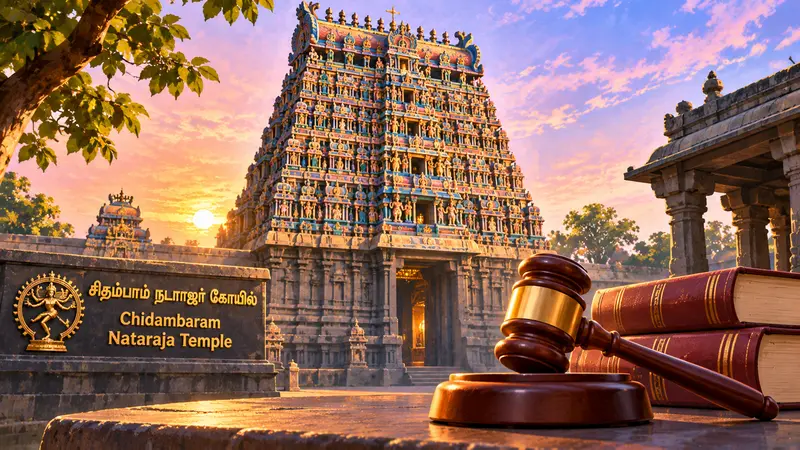
The Supreme Court on Wednesday 4 November stayed, for now, a Madras High Court order that handed the administration of the Chidambaram Nataraja temple to a five-member board led by retired judges. A bench of Justices Aravind Kumar and Vipul Pancholi issued notice on the appeal of the Podhu Dikshitars, the hereditary priests who manage the temple, and restored the position that existed before the High Court's judgment of 30 October. The bench also questioned whether the rules normally applied to public temples fit this one, according to the hearing in court. The State of Tamil Nadu urged the bench to defer interim relief until it filed its reply and raised concerns about the temple's accounts.
The dispute involves a question that Indian courts have been asked for decades: when can the State, or a court, take over the management of a temple, and what does Article 26 of the Constitution protect?
What the High Court ordered
A Division Bench of Justices G. Jayachandran and E. Manoharan disposed of a batch of writ petitions on the temple's administration, which began with a challenge to a 2022 government order allowing devotees to climb the Kanagasabai Mandapam for darshan. The bench found maladministration and held that judicial intervention was necessary. It constituted a Board of Management to take over the temple until the lapses it found were corrected.
The board has five members. Retired High Court judge Justice V. Bharathidasan is the chairman and Justice R. Suresh Kumar the co-chairman. C. Rajendran, a retired IAS officer, is a member, and the Secretary of the Podhu Dikshitars and the Secretary of the Hindu Religious and Charitable Endowments Department sit on it by virtue of office. Its tasks included overseeing properties and financial accounts, conserving the heritage structures, retrieving encroached properties, recovering rental arrears, keeping proper accounts and ensuring equal darshan for devotees at the Kanagasabai. The court left the daily rituals and the periodic festivals to the Dikshitars, subject to established custom.
The findings behind the order were serious. The bench noted damage to parts of the temple from modern construction, accounts and property records that needed scrutiny, and the commercial use of a hall within the premises that it likened to a food court. Some accounts of the judgment add that the Dikshitars had not shared full income accounts for more than twelve years, which the priests dispute.
The Article 26 argument and the 2014 ruling
The Dikshitars say that the order interferes with their right under Article 26 of the Constitution to manage their own affairs in matters of religion and to administer their property. Article 26 gives every religious denomination the right to establish and maintain institutions, to manage its own affairs in matters of religion, and to own and administer property "in accordance with law". The Supreme Court has long drawn a line between the two sides of that clause: the State may regulate the administration of a denominational institution, for example to stop mismanagement, but it may not take away the denomination's right to administer it.
The Dikshitars also argue that the High Court cannot sit in appeal over its own earlier judgments of the 1950s that recognised their right to administer the temple. They rely on the Supreme Court's decision in Dr. Subramanian Swamy v. State of Tamil Nadu, decided in 2014. In that case the court dismissed the State's appeals against a Madras High Court ruling that upheld the Podhu Dikshitars' right to administer the Sri Sabanayagar temple. The court treated the finding of an earlier Madras High Court Division Bench in 1952, that the Dikshitars are a religious denomination, as final, and it held that the State's attempt to appoint an executive officer under the Tamil Nadu Hindu Religious and Charitable Endowments Act, 1959, could not stand. Commentary on the judgment adds that the court did not rule out action against genuine maladministration, but said any such control must be limited in time and follow the procedure the law prescribes. That is the reading on which the State and the High Court's order rest, and the Dikshitars read the same case the other way.
Why it matters, and what happens next
The immediate effect of the stay is that the Dikshitars continue to run the temple while the Supreme Court hears the appeal. The board, its retired judges and the HR&CE secretary's seat on it are on hold. Devotees will see no change in rituals, which were never part of the High Court's handover.
The larger effect is on the law. If the order is upheld, courts will have confirmed that a High Court can displace the managers of a denominational temple with a judicial board for maladministration, without the State taking over under a statute, which could become a template for other disputes over temple accounts and property. If it is set aside, the Dikshitars' position that a finding of mismanagement leaves their Article 26 right intact gets stronger, and the answer for devotees with complaints about accounts or access will have to come through narrower measures such as audit, inspection and orders on specific wrongs.
The State's argument has substance. A temple with extensive land and a large income is a public institution in a practical sense, and a court that finds accounts withheld for years cannot be expected to look away. The Dikshitars' counter is also strong: their right has been recognised by courts twice, and an order that replaces the manager altogether goes beyond what the Constitution allows. The Supreme Court's early question about public-temple rules suggests it is looking at whether the High Court applied the right framework.
The accounts of the hearing do not give a date for the next listing, and the full text of the stay order has not been seen. Devotees and the temple's staff should expect the matter to return after the State files its reply. Until then, the temple's administration, the accounts and the Kanagasabai access question stay exactly where they were before 30 October.
About the Author
R
Reyaansh Agarawal
Staff Writer
Reyaansh Agarawal contributes to Wirony, covering stories that are carefully reviewed and approved by the editorial team before publication. Wirony is committed to maintaining tran…
R
5 min
What did you think?